+91-9355000192
 Login

Conversational Advertising Trends: How AI Is Changing the Way Brands Advertise
- What Is Conversational Advertising?
- 7 Conversational Advertising Trends to Watch
- The Future of Conversational Advertising
- FAQ
See the power of intelligent conversations for your brand.

Ads are getting more expensive, attention spans are shrinking, and static lead forms lose most visitors before they ever hit “Submit.” So how do brands turn ad clicks into real customers? The answer lies in conversational advertising. Instead of sending people to a form or landing page, conversational ads start a two-way chat on WhatsApp, Instagram, or web chat, where AI agents answer questions, qualify leads, and guide shoppers to buy in real time.
In this blog, we’ll explore the biggest conversational advertising trends, the challenges they solve, and how Gupshup helps brands put them to work.
What Is Conversational Advertising?
Conversational advertising is a form of digital advertising that starts a real-time, two-way conversation with the user instead of a one-way message. When people tap the ad, scan a QR code, or click a chat button, they land in a chat on WhatsApp, Instagram, Messenger, or a website, where a chatbot or AI agent answers questions, collects details, and helps them buy.
As a result, conversational advertising turns passive viewers into active conversations. It also gives brands rich first-party data and a direct line to re-engage customers later. The demand is clear, too. Meta’s State of Business Messaging report, based on a 2025 Kantar survey across 22 markets, found that 72.4% of consumers are more likely to buy from a brand that offers messaging.
7 Conversational Advertising Trends to Watch
Here are the key trends shaping conversational advertising today, and how they help businesses overcome common challenges.
1. From Lead Forms to Conversational Lead Capture
Traditional lead forms are static and interrupt the user experience. In contrast, conversational AI chatbots and WhatsApp bots turn forms into two-way conversations. Consequently, users engage more, share details naturally, and get instant answers.
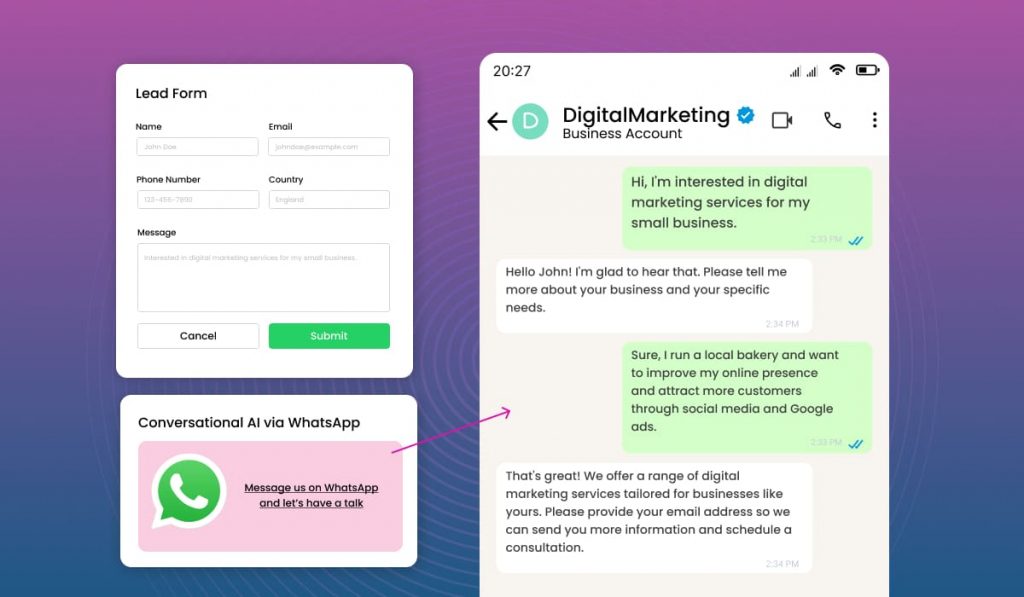
Here’s how the two approaches compare.
Scenario 1: A Traditional Lead Form
A company offers digital marketing services and has a lead form on its website. John, a visitor, fills it out:
- Name: John Doe
- Email: johndoe@example.com
- Phone: 123-456-7890
- Message: “Interested in digital marketing services for my small business.”
After submitting the form, John waits. The company might take hours or even days to follow up, so he may lose interest or choose a competitor.
Scenario 2: Conversational Lead Capture on WhatsApp
Now, the same company adds a WhatsApp chat button to its website and ads. When John taps it, a chatbot greets him instantly:
John: Hi, I’m interested in digital marketing services for my small business.
Chatbot: Hello John! Great to hear. Could you tell me more about your business and your goals?
John: Sure. I run a local bakery and want more customers through social media and Google ads.
Chatbot: That’s great! We offer services tailored to local businesses like yours. Please share your email, and I’ll send details and book a free consultation.
In this case, the AI responds immediately, personalizes the conversation, collects the right information, and schedules the next step in real time.
2. Navigating the Non-Linear Customer Journey
The customer journey is no longer a straight line. Instead, customers move across platforms and channels in no particular order before they buy.
That’s why brands use AI chatbots built with tools like Gupshup’s no-code Conversation Builder. These bots use natural language processing and machine learning to understand customer intent, automate tasks, and keep the experience smooth across channels. As a result, brands stay relevant and increase conversions.
Example: John researches smartphones online, sees an ad, visits a store’s website, and then decides to buy in-store. Along the way, a chatbot can:
- Answer his product questions in real time.
- Then, help him compare features so he can decide which phone to buy.
- Next, share store directions, book an appointment, and confirm stock.
- Finally, after the purchase, send order updates and warranty details.
In short, the chatbot simplifies John’s journey, improves his experience, and boosts conversions for the business.
3. First-Party Data Still Matters, Even as Cookies Stay
Google originally planned to phase out third-party cookies in Chrome. However, in April 2025, Google confirmed it would keep third-party cookies and wouldn’t launch a new standalone cookie prompt. Later, it also began retiring its Privacy Sandbox technologies.
So, cookie-based targeting remains viable for now. Even so, privacy rules, browser settings, and ad blockers keep limiting tracking. Therefore, smart brands are building their own first-party data through conversations. Every chat started from an ad gives you a consenting customer, their preferences, and a channel to reach them again.
4. QR Codes That Start Conversations

QR codes connect physical products, print ads, and packaging to digital experiences. When a QR code opens a WhatsApp chat instead of a static page, it becomes a conversational ad. In addition, it gives you measurable data on engagement and preferences.
For example, a QR code on packaging could let customers:
- Watch instructional videos to use the product like a pro.
- Unlock exclusive offers and discounts tailored to them.
- Get behind-the-scenes access to see how their favorite products are made.
5. Instagram Ads That Open Direct Messages
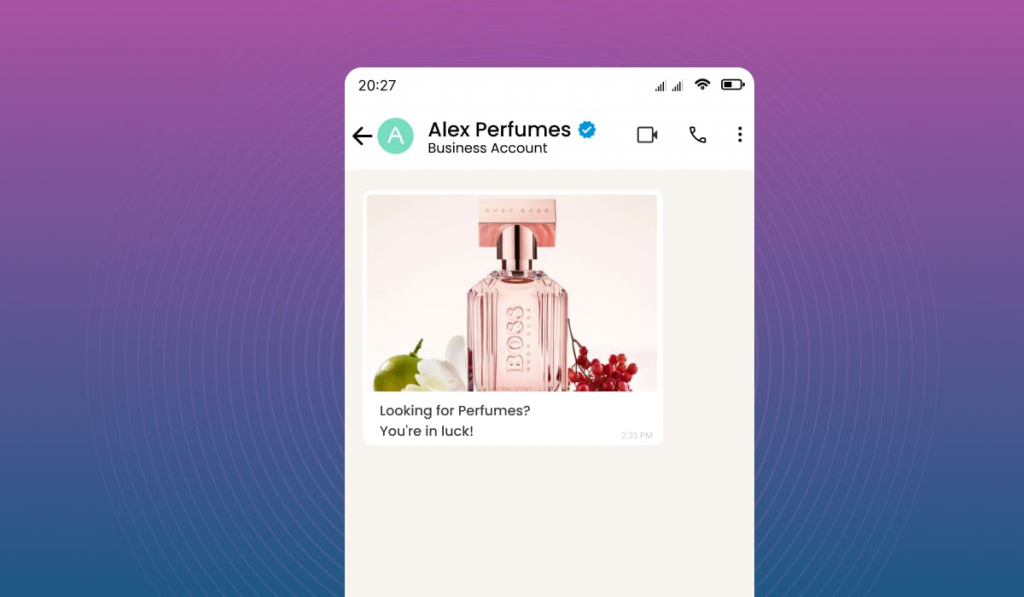
Instagram is a huge stage for advertising. According to Storyboard18, Meta CEO Mark Zuckerberg announced in September 2025 that Instagram has 3 billion monthly active users.
Effective Instagram ads combine strong visuals with a clear call to action. Even better, Instagram Direct ads open a private chat when users tap “Send Message.” As a result, brands can:
- Reach their ideal audience with precise targeting.
- Grab attention with compelling visuals and storytelling.
- Start conversations instead of sending users to a landing page.
- Share exclusive offers and close sales right inside the DM.
6. Click to WhatsApp Ads Go Mainstream
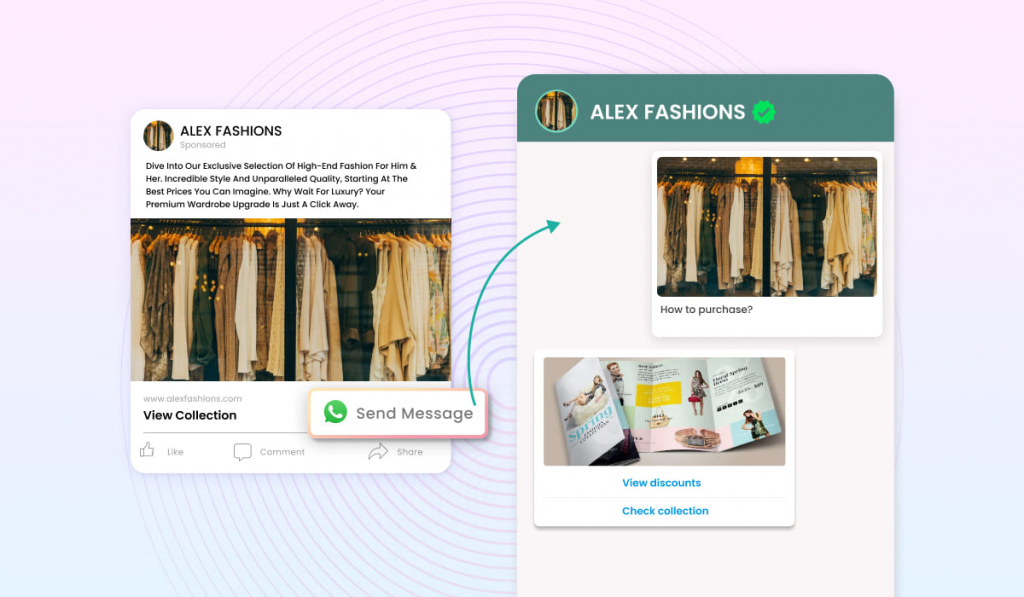
Click to WhatsApp ads (CTWA) are one of the fastest-growing conversational advertising formats. They let users start a WhatsApp chat with a business directly from a Facebook or Instagram ad in one tap. Their growth is clear. According to exchange4media, Meta reported that revenue from click-to-WhatsApp ads grew 60% year-on-year in Q3 2025.
For instance, a WhatsApp chatbot can handle the first questions and share product options or booking forms, so every interaction is fast and personal. In addition, click to WhatsApp ads help you build a first-party database, because every user who messages you becomes a contact you can re-engage.
CTWA also helps recover lost sales. For example, you can follow up with shoppers who abandoned their carts through personal WhatsApp messages. Consequently, you lower re-marketing costs and lift conversions, all within the same chat where the conversation started. Gupshup’s click to WhatsApp ad solution helps you set this up end to end.
7. AI Agents and CPaaS Power Conversations at Scale
Communications Platform as a Service (CPaaS) lets businesses add messaging, voice, and video to their apps without building the infrastructure themselves. Now, CPaaS platforms are adding AI, so brands can run millions of ad-driven conversations at once.
Meta itself is moving in this direction. According to PPC Land, WhatsApp handled more than 10 million weekly conversations through Business AIs in early 2026, up from 1 million at the start of the year.
Gupshup, recognized in Gartner’s CPaaS competitive landscape, combines CPaaS with AI agents and multilingual support. As a result, businesses can personalize conversations at scale, cross language barriers, and reach customers worldwide.
The Future of Conversational Advertising
AI has already transformed advertising. Generative AI, conversational AI, and augmented reality now let brands create more personal and immersive experiences. Brands that adopt these technologies early gain a clear competitive edge, because they capture attention and keep customers engaged.
At the same time, responsible AI use will matter more than ever. Brands that are transparent about data and respect customer consent will earn more trust. In short, conversational advertising is reshaping how brands market in a digital-first world.
Ready to turn your ads into conversations that convert? Gupshup’s AI-powered solutions can help you transform your advertising strategy. Book a demo with Gupshup today.
FAQ
What are examples of conversational advertising?
Common examples include click to WhatsApp ads, Instagram ads that open DMs, Messenger ads, QR codes on packaging or posters that start a chat, and website chat buttons on landing pages. In each case, the ad leads to a real-time conversation instead of a static page.
What are the latest trends in conversational advertising?
Key trends include conversational lead capture replacing static forms, click to WhatsApp ads, Instagram Direct ads, QR codes that open chats, AI agents that handle ad conversations at scale, and a stronger focus on first-party data.
Why is conversational advertising more effective than traditional ads?
Conversational ads answer questions instantly, personalize the experience, and remove friction like long forms. As a result, users stay engaged, and brands capture high-intent leads and first-party data they can use to re-engage customers later.
How do AI agents improve conversational advertising?
AI agents respond to every ad-driven chat instantly, 24/7. They understand intent, recommend products, qualify leads, and hand complex questions to human agents, so brands can handle thousands of conversations without growing their teams.
Does Google keeping third-party cookies change conversational advertising?
Not much. Cookies remain in Chrome for now, but privacy settings and regulations still limit tracking. Conversational ads help because they build consent-based, first-party relationships that don’t depend on cookies.

A passionate writer with a penchant for being a wordsmith, I turn complex cloud technology into compelling stories. Drawing from 15+ years of experience crafting content for SaaS and CPaaS brands, I help tech companies connect with their audiences by bridging the gap between technical features and business impact. Off the clock, I seek inspiration between mountain trails and ocean waves, where my best ideas often find me.