+91-9355000192
 Login
Login
Abandoned Cart Solution for Shopify: Why the Channel Is the Real Problem
- What Is the Average Cart Abandonment Rate for Shopify Stores in 2026?
- Why Email Fails as an Abandoned Cart Solution for Shopify
- How Gupshup's WhatsApp Abandoned Cart Solution Works for Shopify
- How Does WhatsApp Compare to Email for Cart Recovery?
- Why Gupshup Uses Trigger-Based Messaging Instead of Broadcast for Cart Recovery
- Can WhatsApp Help Prevent Shopify Cart Abandonment Before It Happens?
- How to Set Up an Abandoned Cart Solution on Shopify with Gupshup
- FAQs
See the power of intelligent conversations for your brand.

Seven out of ten Shopify shoppers add something to their cart and leave without paying. Most brands respond by tweaking checkout buttons or sending one more email, and wonder why nothing changes. The real fix isn’t a better reminder. It’s reaching customers on a channel they actually read, at the moment they’re still deciding. That’s what a working abandoned cart solution looks like in 2026, and it’s exactly what Gupshup builds on WhatsApp for Shopify stores.
What Is the Average Cart Abandonment Rate for Shopify Stores in 2026?
That 70% figure isn’t a rough guess. It comes from the Baymard Institute‘s meta-analysis of 50 separate studies, and it’s barely moved in two decades. Billions have gone into checkout optimization, retargeting ads, and email recovery flows. Still, 70% of carts walk out the door.
Why? Because the dominant recovery channel, email, was never built for this job.
Why Email Fails as an Abandoned Cart Solution for Shopify
Here’s what a typical email cart recovery sequence looks like in 2026:
- Email 1, sent 1 hour after abandonment, lands in Promotions and gets opened by roughly 15% of recipients
- Email 2, sent 24 hours later, is already cold and opened by fewer recipients
- Email 3, sent 72 hours later, arrives after the customer has bought elsewhere or forgotten entirely
A 3-email sequence recovers roughly 10 to 17% of abandoned carts. For every 100 customers who left, 83 to 90 are still gone.
Email Is One-Way; WhatsApp Isn’t
The problem isn’t the message; it’s the channel. Email can’t ask a question and wait for a reply, or walk a hesitant customer back to checkout. WhatsApp does both. The Gupshup Shopify WhatsApp plugin connects directly to your Shopify store, so the moment a cart is abandoned, a real conversation can begin.
How Gupshup's WhatsApp Abandoned Cart Solution Works for Shopify
When a customer abandons their cart, Gupshup fires a trigger-based WhatsApp message, personalized with the exact product they left behind, a direct checkout link, and optionally a time-limited offer.
What makes it genuinely different from email is that the customer can reply. When they do, the Gupshup AI agent is ready.
Here’s what that conversation can look like:
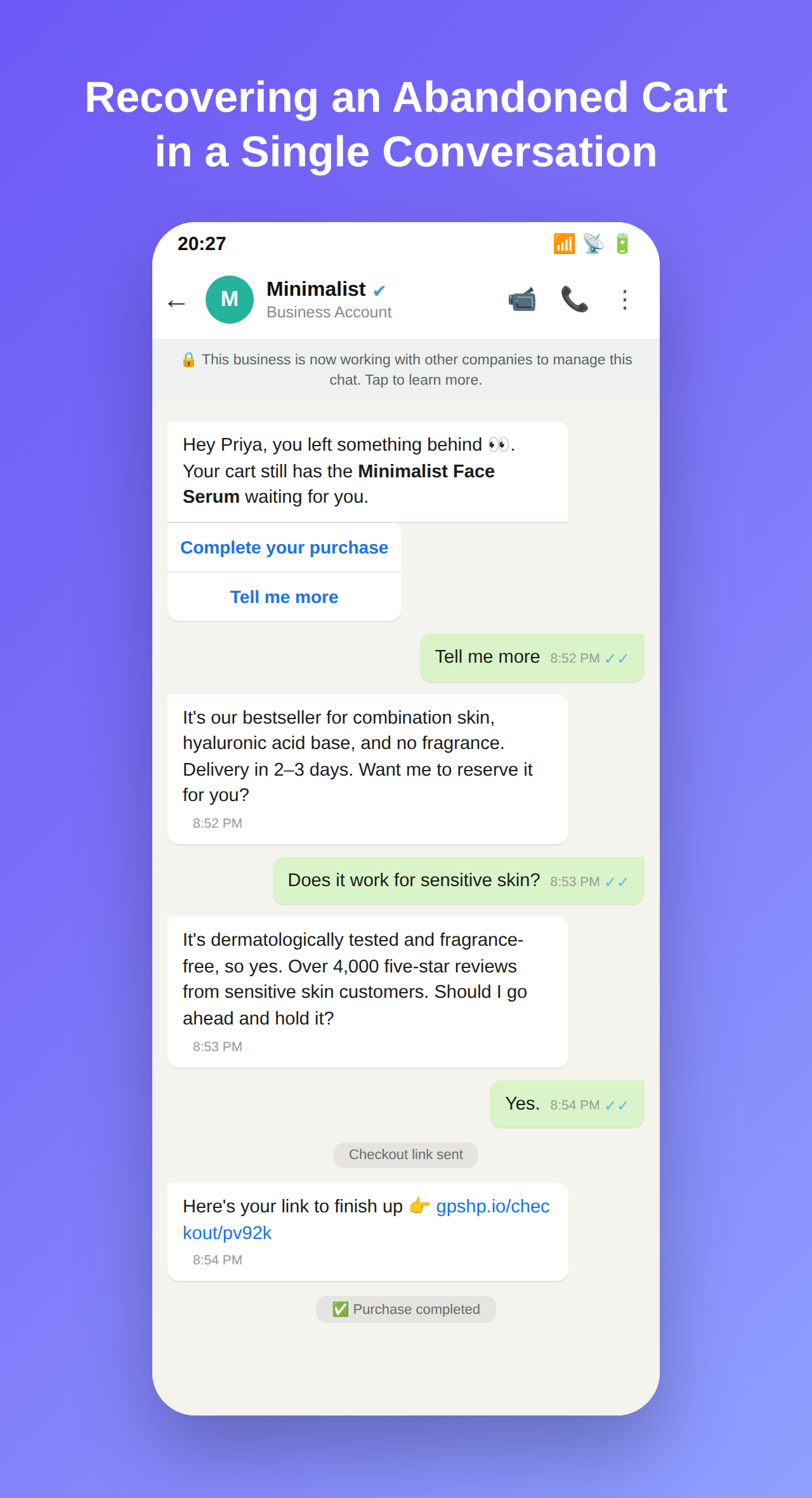
That’s not a notification. It’s a Gupshup-powered conversation that converted.
How Does WhatsApp Compare to Email for Cart Recovery?
The data is unambiguous:
- WhatsApp messages achieve a 98% open rate vs. roughly 15% for e-commerce email
- Gupshup’s WhatsApp cart recovery delivers 3 to 5x higher recovery rates than email sequences
- WhatsApp click-through rates reach up to 60% vs. 2 to 3% for email
- Messages are typically read within 5 minutes, while purchase intent is still alive
Mobile cart abandonment tends to run even higher than desktop, commonly cited in the 75 to 85% range across industry reports. The moment a cart is abandoned, the clock starts. Every minute the customer waits increases the chance they buy elsewhere or simply forget. Gupshup’s trigger-based WhatsApp messages get there first, on a channel they’re already in, at the moment it matters most.
Why Gupshup Uses Trigger-Based Messaging Instead of Broadcast for Cart Recovery
Not all WhatsApp cart recovery is equal.
A generic broadcast like “You left something in your cart!” performs significantly worse than a trigger-based, personalized message tied to the exact product, the exact customer, and the exact moment of abandonment.
Gupshup fires messages based on actual Shopify store events: cart abandoned, checkout started but not completed, product viewed multiple times but not purchased. Each trigger produces a different, contextually relevant message. Not a blast. A signal that says, “We noticed.”
Gupshup’s Conversational Intelligence layer enriches this further, factoring in the customer’s previous orders, browsing behavior, and engagement history to determine the right message, the right offer, and the right time to send it.
Can WhatsApp Help Prevent Shopify Cart Abandonment Before It Happens?
The best cart recovery is the one you don’t need.
Gupshup’s WhatsApp integration doesn’t just recover abandoned carts; it helps prevent abandonment in the first place. Common triggers like unexpected shipping costs, uncertainty about returns, and questions about product fit can be addressed proactively.
Gupshup can fire a WhatsApp message when a customer lingers too long on the checkout page, with an AI agent asking: “Can I help you complete your order?” A one-tap reply answers “What’s your return policy?” before the customer leaves.
Address the friction before it becomes abandonment, and you’ve solved the problem at the source.
How to Set Up an Abandoned Cart Solution on Shopify with Gupshup
Getting started is simpler than most brands expect:
- Connect your Shopify store to Gupshup: native integration, no custom engineering required
- Configure your cart abandonment trigger: set the timing and conditions, for example, a cart abandoned for 30 minutes with no checkout initiated
- Set up your message templates: personalized with product name, image, and checkout link, pre-approved for WhatsApp Business API
- Deploy your Gupshup AI agent: trained on your product catalog to handle replies, answer questions, and guide customers to checkout
- Go live: Gupshup campaigns fire automatically from your Shopify store events, no manual effort required
FAQs
What is the cart abandonment rate for Shopify stores in 2026?
Around 70%, consistent with Baymard Institute’s meta-analysis of 50 studies. Mobile cart abandonment tends to run even higher.
Why is WhatsApp more effective than email for Shopify cart recovery?
WhatsApp delivers a 98% open rate vs roughly 15% for e-commerce email, and it enables two-way conversations that can answer objections, offer support, and guide customers to checkout in real time. Gupshup’s native Shopify integration triggers these messages automatically at the right moment.
How does Gupshup personalize cart recovery messages for Shopify customers?
Gupshup pulls the exact products left in the cart and combines them with behavioral data from the customer’s Shopify profile, browsing history, past orders, and preferred engagement time to create messages that feel personal, not automated.
Can Gupshup run multi-step WhatsApp cart recovery sequences for Shopify?
Yes. Gupshup’s Campaign Manager supports multi-step cart recovery journeys: an initial recovery message, an AI agent conversation if the customer replies, and a time-limited offer if there’s still no purchase.
Does Gupshup’s WhatsApp cart recovery work for COD orders on Shopify?
Yes. Gupshup’s Shopify integration includes out-of-the-box support for COD verification and confirmation flows, reducing both RTO rates and COD-related cart drop-off.
Why Gupshup Is the Right Abandoned Cart Solution for Shopify
Abandoned carts are not an unsolvable problem. They’re a channel mismatch: high-intent customers chased through a low-engagement medium.
Gupshup puts your cart recovery message in the right place, at the right time, with the ability to hold the conversation that converts. The cart isn’t abandoned. It’s waiting for the right message, and Gupshup makes sure it arrives.
👉 Book a free demo to recover more carts on WhatsApp with Gupshup

A digital marketing enthusiast who enjoys solving complex marketing and SEO challenges with simple, effective strategies. He loves working on challenging projects, improving online visibility, driving organic growth, and finding new ways to strengthen digital performance.