+91-9355000192
 Login
Login
What Is Conversational AI in Healthcare?
- Conversational AI in Healthcare with Chatbots and Virtual Assistants
- Key Growth Drivers of AI in Healthcare
- The Benefits of AI in Healthcare
- Conversational AI Platforms for Healthcare
- Conversational AI in Healthcare: 7 Important Use Cases
- Conversational AI in Healthcare with Gupshup
See the power of intelligent conversations for your brand.

Recent research found that 50 to 70% of call center activity is related to health benefits. That alone isn’t a problem. But each interaction typically costs $5 to $15 or more and drives long wait times and unhappy customers, which makes it a real problem for healthcare organizations.
Healthcare in the U.S. and elsewhere is becoming more consumer-driven. Customers now expect better plans, personalized care, low-cost solutions, and accurate information from their providers, and organizations need to deliver all of that while lowering costs.
The key to meeting these goals is conversational AI in healthcare, covered by Gupshup’s healthcare solutions.
According to Accenture, AI in healthcare could save the U.S. healthcare economy $150 billion annually by 2026. Conversational AI augments human activity to improve healthcare quality, accessibility, and cost. Accenture expects the AI-in-healthcare market to grow from $600 million in 2014 to over $6.6 billion by 2021, a CAGR of 40%.
This guide covers:
- Key trends driving AI growth in healthcare
- The benefits of conversational AI in healthcare
- The most popular use cases
Conversational AI in Healthcare with Chatbots and Virtual Assistants
Conversational AI in the medical field is driving digital transformation for everyone in the healthcare value chain: consumers, providers, administrators, and marketers. By letting users talk to providers through voice or text chatbots, it helps streamline and automate many processes.
In simple terms, conversational AI covers chatbots and virtual assistants that use Natural Language Processing (NLP), voice technology, and Machine Learning (ML) to automate interactions. These tools go beyond rule-based answers. They analyze speech or text, understand intent, and generate responses that feel natural and human.
AI in healthcare covers tools that sense and understand human input, act on it in context, and improve over time. Unlike older AI tools that only support human activity, conversational AI can work independently, handling call center interactions on its own.
Qualities of a Good Healthcare Chatbot
To be genuinely useful, a healthcare chatbot needs to be:
- Knowledgeable: it fetches the right information and presents it in an easy-to-digest format.
- Empathetic: it understands the query and its intent, and resolves it with minimal hassle or wait time.
- Engaging: it converses in a warm, human tone, never robotic, so patients feel cared for.
Key Growth Drivers of AI in Healthcare
Today’s consumers take a more active role in their healthcare decisions. In the U.S., federal mandates like the CMS rules proposed in December 2020 improve patient access to health information, so patients can make better decisions.
Healthcare consumers now expect relevant information, delivered fast and in a format they can use. Staff shortages, especially post-COVID, make that harder to deliver consistently. Conversational AI helps close that gap by sharing information at low cost and at scale.
Consumers are also shifting toward digital channels like SMS, live chat, and chatbots over voice calls. These channels offer more privacy and a searchable record of past interactions, both of which users value.
The COVID-19 pandemic added another push. Due to pandemic-related concerns, 41% of U.S. adults delayed medical care, turning instead to digital solutions like telehealth and chatbots.
The Benefits of AI in Healthcare
From easing call center loads to catching fraud before it happens, AI is already paying for itself across healthcare. Here’s where it delivers the most value.
Chatbots and Virtual Assistants
Chatbots and virtual assistants answer common questions, which takes the load off call centers and human agents. Agents can then focus on higher-value work that automation can’t handle.
These bots use NLP, ML, contextual awareness, and multi-intent understanding to handle complex healthcare queries. They can understand intent, ask clarifying questions, and respond quickly, all through a low-friction, self-service channel.
Conversations can even be asynchronous, so patients can leave and return later, something a phone call can’t offer. Over time, these tools learn and adapt, and some connect Net Promoter Scores (NPS) to interactions to keep improving the experience.
Call volumes are higher than ever in the post-COVID era. Chatbots handle that volume while keeping the experience consistent every time.
Other AI Applications
Beyond chatbots, AI supports other administrative and clinical functions. According to Accenture, the top applications of AI in medicine include:
- Robot-assisted surgery
- Virtual nursing assistants
- Administrative workflow assistance
- Fraud detection
- Dosage error reduction
- Connected machines
- Clinical trial participant identification
- Preliminary diagnosis
- Automated image diagnosis
- Cybersecurity
These applications already save costs and generate revenue worth billions. As they keep improving, expect even better precision, efficiency, and healthcare outcomes.
Conversational AI Platforms for Healthcare
A conversational AI platform like Gupshup lets healthcare organizations build and maintain their own chatbots and virtual assistants. Its graphical interface deploys machine learning models to keep improving the bot over time.
When a patient asks a question, it runs through the NLP engine for processing and response. If no answer is found, the bot falls back to FAQs. If it still can’t help, the query transfers to a live agent without breaking the patient’s experience.
The platform lets you update dialogues, flows, and responses anytime. Its analytics turn bot data into insights you can act on, while the underlying ML keeps training the bot to get smarter over time.
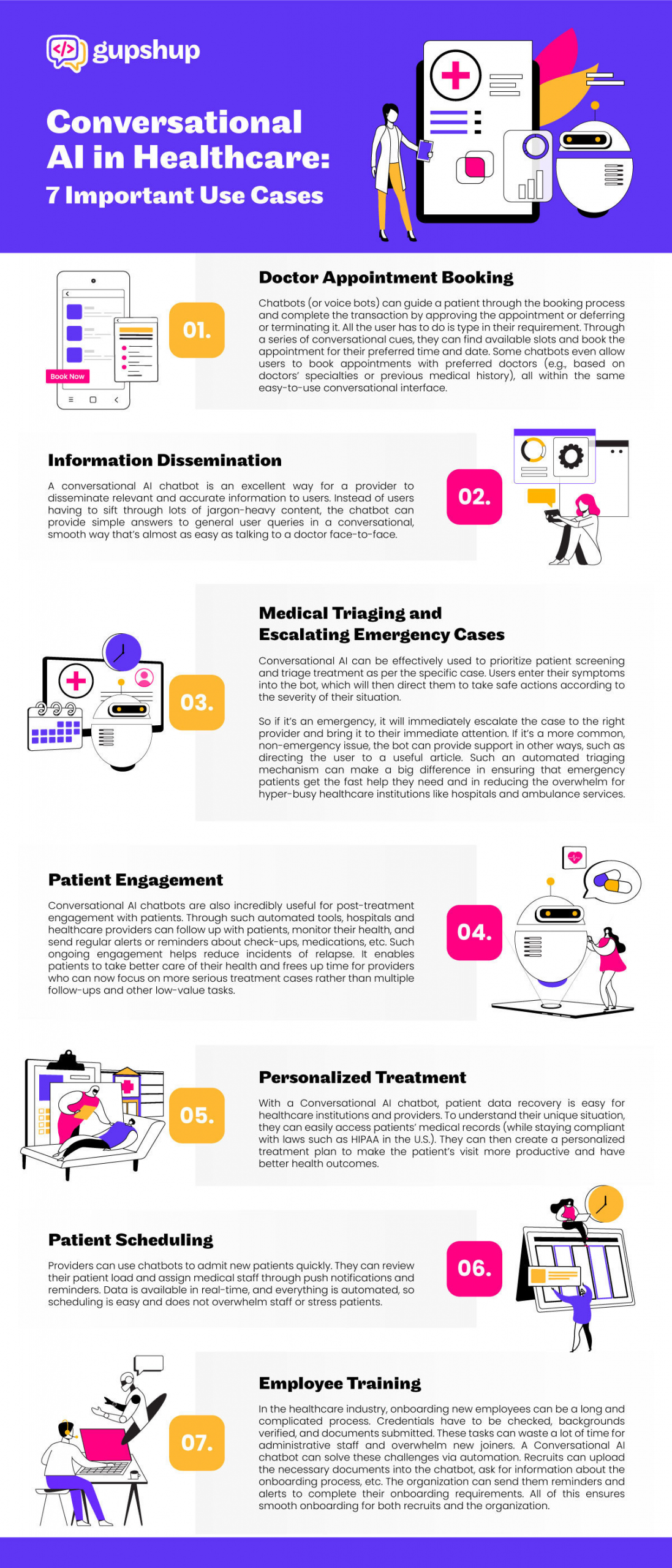
Conversational AI in Healthcare: 7 Important Use Cases
Artificial Intelligence in the medical field already has numerous applications, changing healthcare worldwide. Here are 7 Use Cases
Conversational AI in Healthcare with Gupshup
AI-driven chatbots and other applications are transforming patient care and easing the load on healthcare providers, from scheduling and information to diagnosis and engagement.
Building a conversational AI application like a chatbot or voice bot is easy with the right platform. Gupshup’s bot-builder platform is built for healthcare institutions that want to deliver better, more timely care using AI and Machine Learning.
Ready to bring conversational AI in healthcare to your organization? Talk to us to get started.