Singapore is experiencing a demographic shift towards an aging population, placing significant pressure on its healthcare system. The latest CNBC research report reveals that individuals aged 65 years and older now account for approximately one-fifth of Singapore’s total population. This shift intensifies the demand for quality healthcare services, straining traditional systems.
Traditional healthcare systems face limitations such as manpower shortages, escalating costs, and inefficiencies in handling complex health needs. These challenges hinder timely and personalized care, which is crucial for an aging population with diverse healthcare requirements.
In this context, conversational AI emerges as a key solution that enhances healthcare accessibility and efficiency. Tools like conversational chatbots and the WhatsApp Business API make this possible. Integrated through omnichannel messaging solutions such as Conversational Cloud, they let healthcare providers and patients stay connected around the clock on channels like WhatsApp.
Conversational AI streamlines patient interactions through automated responses and personalized guidance. It also reduces administrative burdens on healthcare professionals and gives patients prompt responses.
Let’s explore how AI in healthcare Singapore is transforming care for its aging population.
AI in Healthcare Singapore: Conversational AI Solutions
While Singapore’s seniors are digitally literate, complex interfaces can steal their confidence. So, supporting their healthcare with a chatbot won’t be very effective unless it is straightforward.
This is where conversational AI chatbots come in. They work especially well when integrated with a familiar platform like the WhatsApp API for the healthcare industry, creating a space where patients can ask health-related questions, share test results, and book appointments for routine checkups.
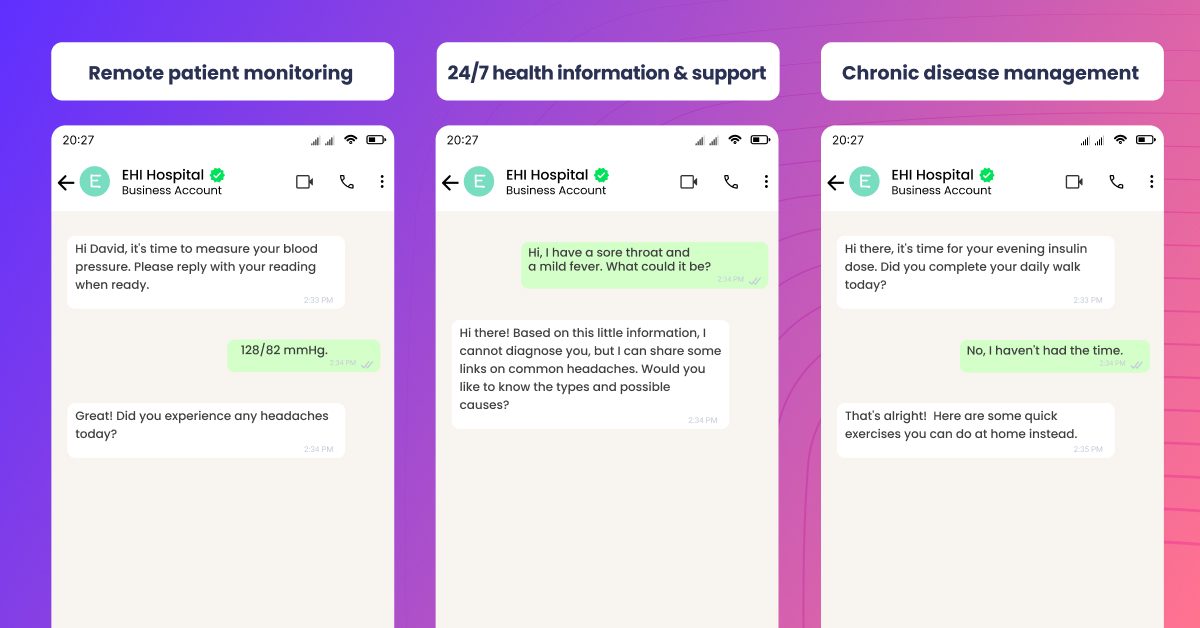
Here’s how opting for the WhatsApp API in Singapore can help healthcare across various areas:
1. Remote patient monitoring
Conversational AI integrated with the WhatsApp Business API makes it easier for healthcare providers to connect with their patients remotely. Through AI-driven chatbots, patients can easily report their health status, symptoms, and medication adherence in real time via WhatsApp.
These chatbots can understand patient responses, alert healthcare providers to any concerning changes, and suggest necessary actions. They can also remind patients to record their symptoms and take their next dose of medication. If the chatbots notice any unusual trends, they can prompt patients to contact their doctors right away.
2. 24/7 health information and support
Using the WhatsApp API for healthcare, paired with conversational AI, gives you on-demand access to reliable health information. These AI-driven chatbots can respond immediately to inquiries about symptoms, medications, and general health advice, regardless of time zone.
Whether it’s midnight in Singapore or your patients are in a different time zone, they can always get the support they need through your WhatsApp-based healthcare assistant whenever they need it.
3. Chronic disease management
Living with a chronic condition like diabetes requires constant support and care. Conversational AI integrated with the WhatsApp API plays a pivotal role in chronic disease management. It provides continuous support and monitoring for patients in Singapore.
These chatbots can engage patients in ongoing conversations to track symptoms and progress, allowing healthcare providers to intervene proactively when necessary.
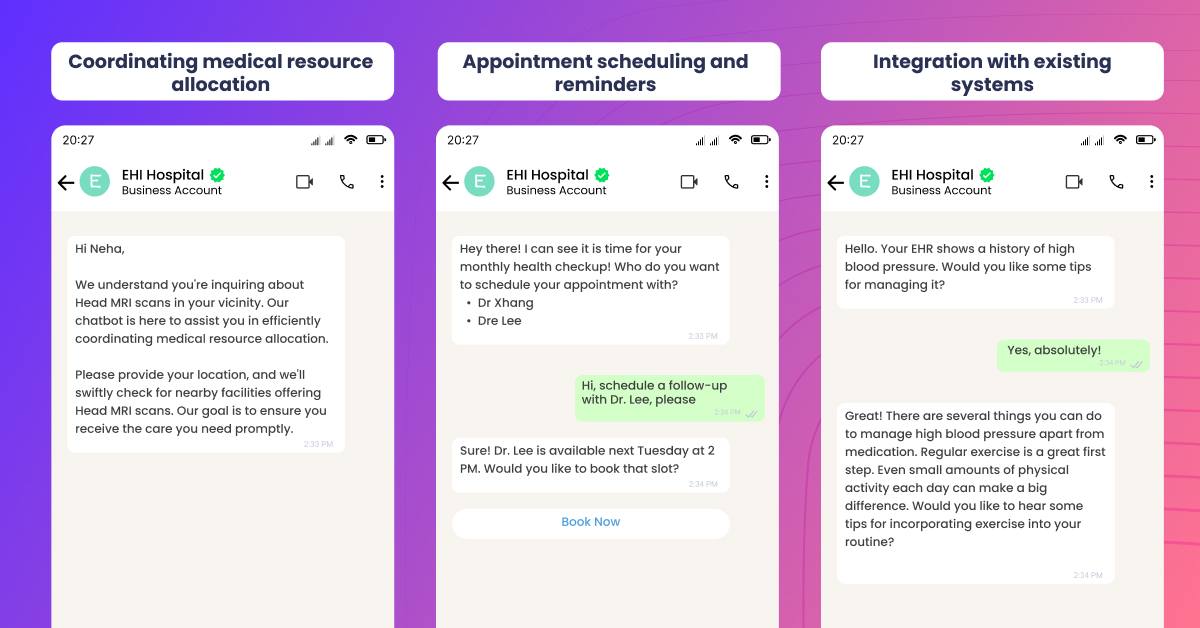
4. Coordinating medical resource allocation
Conversational AI-powered virtual assistants help efficiently manage and distribute medical resources in Singapore’s healthcare facilities. These AI tools identify resources like the availability of hospital beds, doctors, or testing facilities based on patient needs, and can loop in a human specialist through Agent Assist when a case needs extra attention.
By automating these tasks, AI reduces administrative burdens, optimizes workflows, and ensures critical resources meet patient demand.
5. Appointment scheduling and reminders
Gone are the days when your patients had to jot down appointment times in a journal. Chatbots in the WhatsApp Business API can streamline appointment scheduling by letting your patients book consultations directly through your chat window.
They can answer basic questions about appointment availability. Then they provide a clear call to action (CTA), like “Click here to book your appointment now!” This CTA links directly to your scheduling platform. Patients can then select a convenient time slot and confirm their appointment in seconds, saving them time and frustration while keeping your practice running efficiently.
Automated reminders can also prevent missed appointments, ensuring patients get the timely care they deserve.
Making AI in Healthcare Singapore Work: Key Considerations
WhatsApp Business API is already a great platform, making it easy to move your physical helplines online. But how do you leverage it fully? A few other key considerations are essential for optimal impact.
1. Integration with existing systems
Securely integrating with your healthcare system’s existing systems is the first step of chatbot integration, ensuring patient data stays confidential.
Conversational AI tools can integrate with Electronic Health Records (EHR) to access your patient’s medical history, allergies, and medications. This protects patient privacy and fosters a smooth user experience.
This way, HCPs can provide personalized recommendations and avoid medication conflicts. For example, your healthcare chatbot can look into a patient’s blood pressure data and suggest healthy practices to maintain it.
2. Multilingual support
Singapore’s vibrant culture is a multilingual environment. To ensure inclusivity, your chatbot solutions should cater to the nation’s diverse languages, such as English, Mandarin, Malay, and Tamil. This ensures everyone has equal access to healthcare information and support.
With WhatsApp API in the healthcare industry, you can offer multilingual support for a vast pool of customers. It lets your patients interact in their preferred language within the familiar app interface.
3. Data privacy & security
WhatsApp Business API keeps chatbot conversations encrypted, so patient data stays confidential. Chatbot solutions must still follow robust security measures like:
- Encryption: All data exchanged between patients and chatbots stays encrypted against unauthorized access.
- PDPA compliance: Chatbot development must follow Singapore’s Personal Data Protection Act.
Conclusion: The Road Ahead for AI in Healthcare Singapore
AI in healthcare Singapore is already reshaping how the system supports its elderly population and the country as a whole. These AI systems streamline workflows, reduce administrative burdens, and efficiently allocate critical resources like hospital beds and medical equipment.
Real-time updates through the WhatsApp API give healthcare providers the information they need to make swift decisions, helping them respond effectively to dynamic healthcare needs. This transformation not only optimizes operational efficiency but also improves patient outcomes.
Gupshup, one of the leading WhatsApp service providers in Singapore, offers innovative conversational solutions. Together, they create a more inclusive, efficient, and patient-centered healthcare environment.
By equipping healthcare providers with cutting-edge tools like chatbots and virtual assistants, we help create seamless interactions between patients and medical professionals. Our holistic approach can enhance patient outcomes while streamlining staff workflows, fundamentally reshaping the Singaporean healthcare landscape for the better.
Get in touch with us today!
FAQs
Is Conversational AI safe for my health information?
Data security always comes first. Conversational AI solutions for healthcare must adhere to strict regulations like Singapore’s Personal Data Protection Act (PDPA). Platforms like WhatsApp Business API offer encrypted communication to safeguard patient information.
How will Conversational AI impact healthcare professionals’ jobs?
Conversational AI cannot replace doctors and nurses. Instead, it is a helpful assistant, freeing up professionals’ time for complex cases. It mostly interacts with patients, handling appointment scheduling and basic health information requests, so doctors can focus on in-depth patient care.
What are the benefits of using AI for hospitals and clinics?
AI chatbots offer a win-win situation for healthcare providers. They can:
- Improve patient engagement and education
- Reduce administrative burden by automating tasks
- Offer 24/7 support, improving patient satisfaction
- Streamline appointment scheduling and reduce no-shows
What is the main use of AI in healthcare?
The main use of AI in healthcare is improving patient care while reducing the workload on medical staff. For AI in healthcare Singapore, this mostly means AI-driven chatbots on WhatsApp that handle appointment booking, health information requests, remote monitoring, and chronic disease follow-ups, freeing up doctors and nurses for hands-on care.
Are AI chatbots used in healthcare?
Yes. Healthcare providers across Singapore increasingly use AI chatbots for tasks like symptom triage, appointment scheduling, medication reminders, and 24/7 patient support. When these chatbots run on WhatsApp Business API, they let providers reach patients on a platform they already use daily.
Do hospitals in Singapore use WhatsApp for patient communication?
Yes, a growing number of hospitals and clinics in Singapore use the WhatsApp Business API to communicate with patients. It’s used for appointment reminders, lab result updates, post-visit follow-ups, and general health information, since most patients already have WhatsApp installed.
Is WhatsApp Business API PDPA-compliant for healthcare use in Singapore?
Yes, when set up correctly. WhatsApp Business API offers end-to-end encrypted messaging, and providers can build PDPA-compliant workflows around it by controlling how patient data is collected, stored, and used, in line with Singapore’s Personal Data Protection Act.
This also gives you a second natural, bolded mention of the focus keyword in the FAQ section, which helps both regular ranking and AI Overview eligibility since the answer directly names the keyword phrase.
Jaitashri is a content and social media marketer. Through insightful and data-driven content, she enables her audiences to leverage the potential of B2B SaaS products. Beyond writing, she's a culinary explorer, avid reader, and passionate painter, infusing creativity into every endeavor.
 +91-9355000192
 Login
Login