+91-9355000192
 Login
Login
Customer Support Chatbot: A Smarter Way to Serve Customers
- What Is a Customer Support Chatbot?
- Automating Customer Support with Chatbots: 8 Reasons to Make the Switch
- Conclusion
See the power of intelligent conversations for your brand.

Today, trying to speak to a customer service executive to answer your query is largely an exercise in increasing stress levels and one of the significant customer service issues. Usually, one ends up pressing a series of buttons only to be put on hold indefinitely while being subjected to piped music.
This experience of lack of customer service is less than ideal, of course, and often leaves customers frustrated. Companies are aware of this but have stuck with this system for years, due to a lack of a better alternative.
Until now, at least.
What Is a Customer Support Chatbot?
Are you wondering what problem a chatbot solves?
Chatbots are the latest paradigm in the tech world. Smartphones with data are ubiquitous, and messaging apps are among the most used apps in the world. It’s no surprise the ecosystem has moved to a messaging paradigm — chatbots are the new apps, and the services available on the web and in other apps are transitioning to them.
Now, imagine the current customer support model replaced voice with chat. Instead of dialing a number, you message the company on Facebook, Twitter, or any other messaging app. A series of clicks takes you to the relevant customer support executive, who answers your query over chat. It’s an improvement over the existing IVR-based system, since it’s less obtrusive than holding a phone to your ear and happens in a medium most people already prefer. But you’re still left with the same underlying problem: repeated back-and-forths explaining your issue, then waiting an eternity for an answer.

…. is typing
This is where a customer support chatbot solution can disrupt the ecosystem.
A customer support chatbot can significantly enhance a user’s experience. A customer service AI chatbot can become the new standard on which support operates by programming answers to commonly asked questions and automating service responses.
These bots parse a query and give relevant answers using Natural Language Processing (NLP). Most companies face nearly the same set of questions from different users, so automating the answers to these queries saves a lot of money and resources.
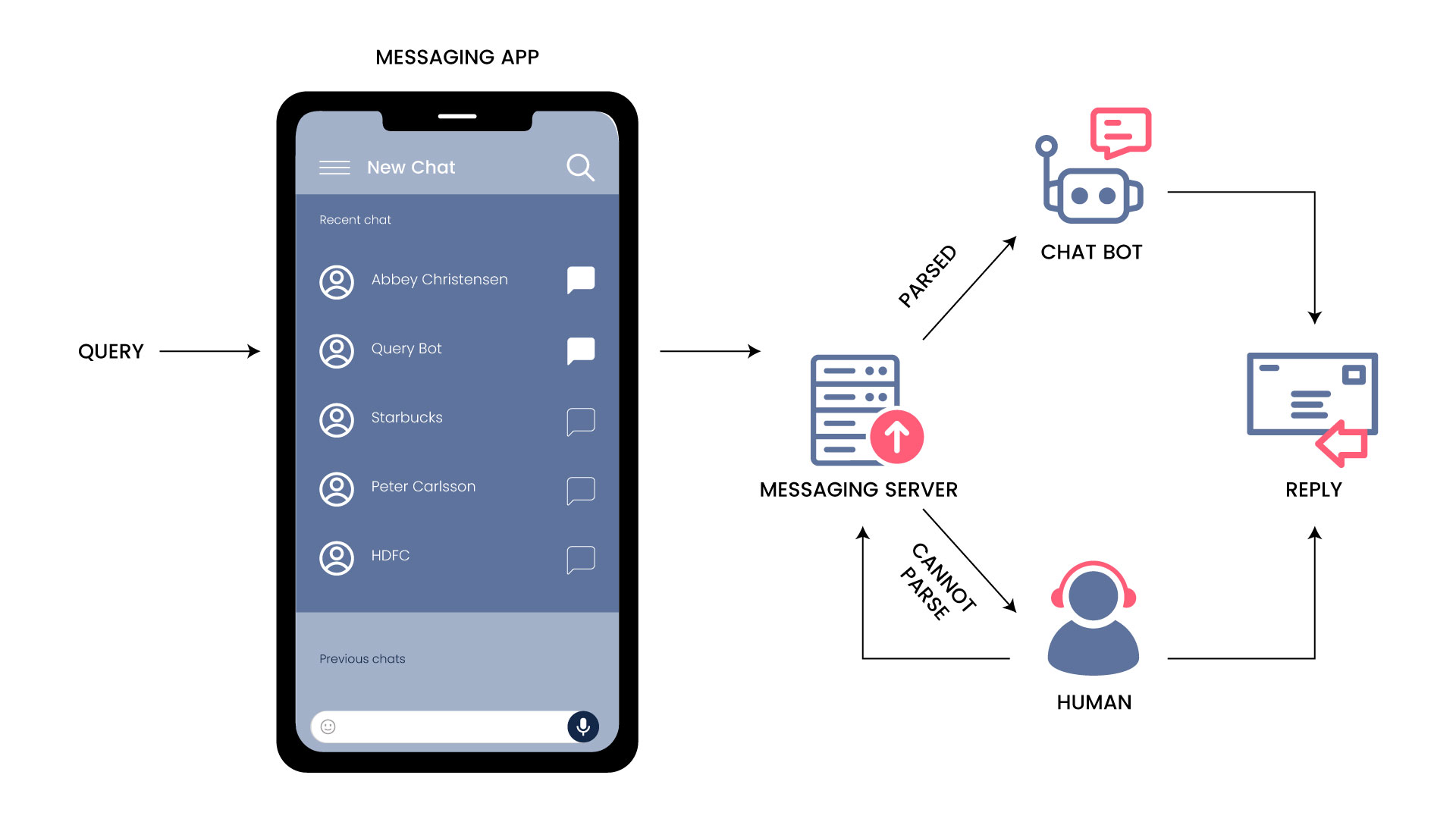
Completely automating customer service is nearly impossible, though. Queries a bot can’t parse should seamlessly switch to a human. Every query routed to a human then feeds back into the bot’s intelligence, making it smarter for similar questions in the future. This feedback loop is what makes automating customer support with chatbots get more accurate over time, not less.
Automating Customer Support with Chatbots: 8 Reasons to Make the Switch
There are several advantages to adopting a customer service chatbot, a primary one being that it solves the day-to-day challenges customer service reps face. If you’re a business owner who hasn’t yet implemented chatbots to manage customer service and assistance, here are several compelling reasons to adopt a customer support chatbot for your website.
1. Instant response
A chatbot for customer care responds to inquiries in real time. Customers don’t have to stand in a queue or wait several minutes for an agent. Until a human agent is available, a customer support chatbot can gather basic information, ask about the topic of the inquiry, and respond with pre-programmed answers. If a customer needs a human, the chatbot can route them to the right department.
A chatbot doesn’t merely make a guess when a customer asks a question — it draws on source content like knowledge bases and FAQs to answer automatically, which is exactly why it’s such a strong fix for poor customer service.
2. Self-service ability
Customers don’t need to contact a live representative for every task or question. An intelligent customer service chatbot gives customers self-service capability, letting them get quick answers and complete everyday tasks without waiting for a human agent to become available.
3. 24/7 availability
Staffing support around the clock is expensive, so many companies limit their support hours. But customer issues don’t respect business hours — they can come up at any time, including at night or on holidays.
Unlike people, a chatbot doesn’t need sleep. When your team is unavailable, an AI customer service chatbot can field inquiries and share information in their place, or at minimum tell the customer your available hours and when a human will follow up.
If your chatbot gets a lot of complex questions that almost always need a human, you can build a dedicated “out of office” bot to take over when no one’s around. The customer isn’t left waiting, and someone on your team can respond as soon as they’re back.
Conversational AI–powered chatbots make it possible to offer support 24 hours a day, seven days a week, without a matching increase in headcount.
4. Continuous learning
A customer service chatbot doesn’t only use AI to answer questions — it uses AI to improve its answers over time. That’s what conversational support actually means in practice.
Once a chatbot learns how to answer a question, it recognizes differently worded questions with the same meaning and adds that phrasing to its knowledge bank, so future questions get answered accurately regardless of how they’re phrased.
If a customer flags a bot’s response as unhelpful, the bot is less likely to reuse that response in future conversations — a simple rating helps it learn the difference. You don’t need full-blown AI for all of this learning, either: you can train your bot directly using the actual questions your customers ask, or the ones you expect they will.
5. Custom responses for different customer segments
Customers with the same question don’t always want the same answer. If a customer on your Enterprise plan asks whether a plan includes certain features and your bot answers by referencing the Startup plan instead, it’s as good as not answering at all.
You can configure who a chatbot talks to, and how it responds, based on parameters like customer spend, business type, location, and more. Answers hyper-targeted to what your customers actually need help them resolve issues far more effectively.
6. Better understanding of each customer
Customers who notice a chatbot are more likely to actually ask their question rather than quietly leaving as an “invisible lead.”
Once a customer reaches out, you have their information in your system — a strong starting point, since agents can refer back to that conversation history the next time the customer gets in touch, instead of starting from zero.
Logging every conversation, including the automated ones, gives your team a full picture of each customer’s journey and where they might need extra help. A prospect asking several pricing questions, for example, warrants a different follow-up than one with a single question about user roles — and patterns like these also show you where your chatbot needs more training.
7. A consistent experience
A customer support chatbot helps you deliver a consistent, on-brand experience. You control the voice, tone, and vocabulary in every response, so there’s no “we don’t say that” moment.
Accuracy adds to that consistency too — no missed conversations, no replies landing in spam, and no copy-paste or typing errors leading to the wrong information reaching a customer.
8. Cost-effectiveness
An AI customer support bot directly lowers the cost of running a support team. Automating routine processes and covering nights, weekends, and holidays reduces the need for extra headcount, and it also frees up your existing team by cutting their repetitive workload — a point borne out by IBM’s research on AI customer service, which found automation freeing agents to focus on the complex issues that genuinely need a human touch.
Conclusion
Companies are slowly recognizing what automating customer support with chatbots does for the customer experience. Chat allows for personalization and lets both the customer and the company carry context from past interactions. Soon you’ll be messaging your bank on Facebook, asking about concert tickets on Telegram, or reaching your internet provider on Slack — and, surprisingly, not pulling your hair out in frustration. Companies with the biggest customer service headaches today stand to gain the most from chatbot-driven customer engagement.
With Gupshup AI Agents, you can build intelligent bots using NLP tools, AI models, and ready-made templates in a plug-and-play setup, then deploy them on any messaging channel. Pick from a library of pre-built bot templates, customize the content, and publish instantly — a fully functional bot can be live in minutes, with a graphical editor to design your conversation flow and point-and-click tools for more advanced builds.