+91-9355000192
 Login

WhatsApp Compliance: How Compliant Chats Keep Conversations Secure

- What is WhatsApp Compliance?
- Why Regulated Brands Need WhatsApp Compliance
- How WhatsApp Compliance Works: Possible Scenarios
- Sector-Specific Use Cases For WhatsApp Compliance
- Benefits of WhatsApp compliance with Compliant Chats
- Making WhatsApp Compliance Part of your CX
- FAQs
See the power of intelligent conversations for your brand.

In September 2022, a wave of fines rocked Wall Street. The US Securities and Exchange Commission (SEC) charged 16 firms for failing to keep records of employee business chats that took place outside official channels, with penalties of over $1.1 billion. Parallel settlements with the Commodity Futures Trading Commission (CFTC) pushed the total to about $1.8 billion. The problem has not gone away. In 2024, the SEC fined 12 more firms a combined $88.2 million for the same kind of failure.
The messaging app’s convenient user experience means that both bankers and customers prefer it. But the lack of monitoring brings it under regulatory glare.
For years, investment banks and financial firms have faced a dilemma. They want to use popular messaging apps like WhatsApp for seamless customer communication. But regulators require them to record and retain business communications, and a firm cannot capture chats on an employee’s personal WhatsApp.
Compliant Chats on WhatsApp, also known as Moderated Chats, solve this problem. They capture and log messages, which gives you a secure and regulated channel for communication. To put it simply, a brand supervises these chats and keeps a record of every message. In sectors where compliant communication and customer engagement are a necessity, WhatsApp compliance through Compliant Chats scores well above one-way mediums such as email.
What is WhatsApp Compliance?
WhatsApp compliance means using WhatsApp for business in a way that meets two sets of rules. The first is regulatory. Many sectors, especially financial services, must record, store, and be able to produce customer conversations. The second is WhatsApp’s own rules. The WhatsApp Business Messaging Policy sets out what businesses may send and how, including getting customer opt-ins before you message them.
This blog focuses on the first part: how to keep a full, supervised record of customer conversations without giving up the speed and ease of WhatsApp.
Why Regulated Brands Need WhatsApp Compliance
Securing communication is imperative for brands. Today’s customers prefer one-on-one conversational channels such as WhatsApp, where they can ask questions and get instant responses. In the financial sector, speed of information matters most. In the era of digital trading, share prices rise and fall in seconds, making kings and paupers out of common people.
Compliant chats on WhatsApp combine this speed with the comfort of person-to-person messaging. Brands can use their usual WABA (WhatsApp Business API) handle to talk to customers, and bring in relationship managers (RMs) wherever needed, with the ability to log the complete conversation. It works both ways. When a customer messages a brand or chats with a relationship manager (RM) in the brand’s chat window, the brand can record the conversation. Banks already use this approach for WhatsApp banking and in fintech.
How WhatsApp Compliance Works: Possible Scenarios
There are several situations where Compliant Chats come into play.
A Customer Starts the Chat. A customer messages the bank’s official, published WhatsApp handle and asks for their relationship manager. A customer messages the bank’s official WhatsApp handle and asks for their relationship manager. The bank connects the customer to the RM in the same WhatsApp window and acts on the service request. The bank logs the entire chat for security and compliance. Even when a customer contacts an RM directly, the brand can keep communication compliant by issuing official WhatsApp numbers to key RMs and field representatives.

A Promotion Leads to a Conversation. A brand sends promotional messages that spark a customer’s interest in speaking with an agent. A brand sends promotional messages that spark a customer’s interest in speaking with an agent. The live agent takes the conversation forward in the same chat window, and the brand records the chat for compliance.
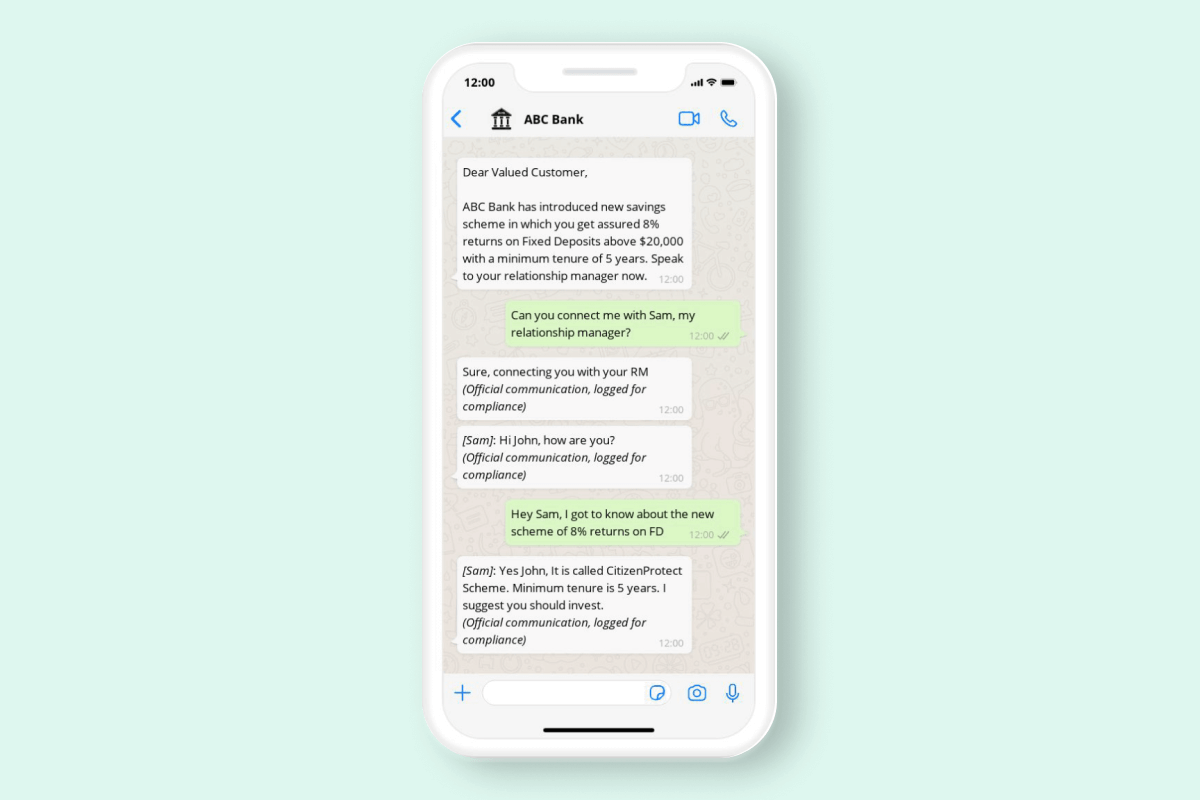
An RM Reaches out to the Customer. A relationship manager or field representative wants to connect with a customer directly. The RM messages the bank’s official WhatsApp number, which then shares a virtual number for the RM to use. Chats through the virtual number stay under the bank’s supervision, and the bank records every one.

Sector-Specific Use Cases For WhatsApp Compliance
The biggest use case for Compliant Chats is financial services, where keeping message logs is mandatory. But secure communication is a necessity across sectors. Customers worry about data leaks and about contact from executives outside business purposes. With virtual numbers, brands can remove both risks. Here are the sectors where compliant chats are most valuable.
E-commerce and Food Delivery
There have been many cases of delivery staff misusing customers’ contact details. Food delivery and e-commerce brands can avoid this and earn customer trust by moving the conversation onto a compliant chat. Delivery partners can then connect with the customer without the brand losing sight of the interaction.
Retail
Retail brands that use personal shoppers need to make sure conversations stay relevant and useful. With the brand acting as a bridge, compliant chats serve that purpose well.
Real Estate
For real estate developers, trust with potential clients is the cornerstone of success. But worries about data leaks and unsolicited contact from agents make many prospects cautious about sharing their details. Compliant Chats bridge this trust gap with a secure, regulated platform. Prospects can feel confident that the brand protects their personal information, while still having meaningful conversations with agents.
Home Services and Consumer Durables
Brands that send field staff for installation and service can move all communication between staff and customers onto Compliant Chats on WhatsApp. That keeps it safe, secure, and within context.
Closing the Feedback Loop with Irate Customers
When an irate customer reaches out with feedback or a complaint, it’s crucial to acknowledge it promptly. When an irate customer reaches out with feedback or a complaint, it’s crucial to acknowledge it promptly. With compliant chats, your team hears every concern, addresses it, and documents it. This leads to better customer satisfaction and loyalty. This leads to better customer satisfaction and loyalty.
Benefits of WhatsApp compliance with Compliant Chats
For financial firms in particular, Compliant Chats break down the barriers that once kept them from using WhatsApp’s full potential. Banks can build stronger relationships with clients, help employees work together, and handle the regulatory landscape with confidence. Here are the key advantages.
Better Customer Retention
Compliant chats keep communication channels open, even if a relationship manager or representative leaves the bank. When clients have ongoing conversations in the secure chat, the handover to a new point of contact is smoother.
Secure Communication
With virtual numbers, brands can be sure that communication between the business and customers is secure. Compliant Chats protect sensitive information and personal data. Customers don’t have to worry about data leaks or contact from executives outside business purposes. Learn more about Gupshup’s approach to enterprise security.
Regulatory Compliance
Compliant chats automatically record and archive all conversations between customers and representatives. The records include message content, timestamps, and user details, so the brand stores a complete history of every interaction. This helps brands meet regulators’ requirements, which often mandate keeping customer communication data for a set period.
No New Software to Learn
Many existing solutions need new software downloads and training. With Gupshup’s Compliant Chat solution, brands don’t need new software because it works inside the familiar experience of WhatsApp.
Stronger Brand Trust
Customers are often hesitant to share their phone numbers with ride-sharing apps and delivery businesses. Compliant Chats with virtual numbers earn customers’ trust, which improves customer engagement.
Making WhatsApp Compliance Part of your CX
As we have seen, this secure platform can reshape customer experiences across many sectors. In financial services, where keeping message logs is mandatory, and in sectors like e-commerce and real estate, where data privacy matters, Compliant Chats support smooth, efficient, trust-building interactions.
As the world embraces digital communication, secure and compliant conversations are the way forward. We are at the start of a new era in customer communication, where trust, transparency, and personalized interactions are the foundation of lasting partnerships.
You don’t have to worry about new software. Gupshup can help you secure communication between customers and your representatives and improve your CX. With Gupshup’s expertise in conversational engagement through WhatsApp, we can help you achieve much higher CSAT. So take the leap, embrace Compliant Chats, and unlock the true potential of the WhatsApp Business API for your business. Request a Demo today.
FAQs
What is WhatsApp Compliance?
WhatsApp compliance means using WhatsApp for business in line with regulations and WhatsApp’s own policies. For regulated sectors like banking, it mainly means recording, storing, and supervising customer conversations so you can produce them for audits, while also following WhatsApp’s rules on opt-ins and message templates.
Is WhatsApp Compliant For Banks and Financial Services?
A personal WhatsApp account is not compliant by default, because the firm cannot record or supervise it. Banks can use WhatsApp compliantly through the WhatsApp Business API with a compliant chat solution that logs and archives every conversation. Always confirm requirements with your own compliance team.
Why Did Regulators Fine Banks for Using WhatsApp?
Regulators fined firms because employees discussed business on personal devices and messaging apps, and firms didn’t keep records. In September 2022, the SEC charged 16 firms over this recordkeeping failure, and it has continued to bring similar cases since.
How Do You Record WhatsApp Messages for Compliance?
Use the WhatsApp Business API with a compliant chat solution. Conversations run through the brand’s official number, or a virtual number for relationship managers, and the platform automatically records message content, timestamps, and user details. This avoids relying on employees’ personal phones.
Do You Need Customer Opt-in to Message on WhatsApp Business?
Yes. WhatsApp’s business policy requires customers to opt in before a business sends them messages. Collect clear consent, such as at checkout, on a form, or through a click-to-chat link, and make it easy to opt out. Following this keeps your account in good standing.

Vandana leads content and communications at Gupshup. Before turning to communications, she was a journalist for more than 13 years, writing stories across varied subjects- from equity markets, policy to consumer tech. In her current role, she crafts engaging content and PR strategies that helps drive the company's marketing efforts.