+91-9355000192
 Login

AI Agent ROI: How to Measure the Real Business Impact of AI Agents
- What are AI Agents, and How are They Different From Chatbots?
- Why Measuring AI Agent ROI Matters
- How to Calculate AI Agent ROI
- How AI Agents Improve ROI in E-commerce
- 10 Ways to Maximize AI Agent ROI
- How to Track AI Agent Performance
- Why AI Agent ROI is Worth Measuring
- FAQs
See the power of intelligent conversations for your brand.

Your customer queries get resolved in seconds. Every message feels personal, and revenue keeps growing. AI agents make this possible. They work as a digital workforce that engages customers, streamlines operations and supports profit.
But how do you prove it? AI agent ROI is the number that justifies the investment to your stakeholders. It also shows which use cases deserve more budget.
This blog explains how to calculate AI agent ROI across seven factors. It also covers e-commerce examples, ten ways to improve returns, and how to track performance over time.
What are AI Agents, and How are They Different From Chatbots?
AI agents are software systems that act on their own to complete tasks. They use machine learning, natural language processing (NLP), and analytics to learn and improve over time. They can answer customer queries, forecast demand, or manage inventory.
Traditional chatbots follow fixed scripts. AI agents go further:
✅ Understand and predict customer intent
✅ Automate end-to-end workflows, including payments and bookings
✅ Give context-aware, hyper-personalized recommendations
✅ Handle thousands of conversations at once
✅ Work 24/7 with no response delays
In e-commerce, these agents recommend products based on browsing history, process orders, and answer questions in real time. Their value, however, only counts when you can measure it. That is where AI agent ROI comes in.
Why Measuring AI Agent ROI Matters
Investing in AI agents is a strategic decision. Tracking AI agent ROI helps you:
- Justify the Investment: Clear financial results win stakeholder buy-in and funding for future projects.
- Allocate Resources Better: You can see which use cases perform best and fund those first.
- Measure Performance: ROI shows whether your agents deliver what you expected.
- Keep Improving: Results show where to refine your strategy over time.
How to Calculate AI Agent ROI
Start with a simple formula:
AI agent ROI (%) = (total benefits − total cost) ÷ total cost × 100
Total cost includes licences, setup, integrations, training and ongoing maintenance. Total benefits go beyond cost savings. Use the seven factors below.
1. Cost Reduction and Efficiency Gains
AI agents handle routine customer interactions without human help, which lowers operational costs. Gartner predicts that agentic AI will resolve 80% of common customer service issues on its own by 2029, leading to a 30% reduction in operational costs.
Businesses typically see:
✔ Lower customer support costs
✔ Faster resolution of queries
✔ Fewer abandoned carts in e-commerce
2. Revenue Growth and Upselling
These agents do more than answer questions. They also drive conversions, upsells, and repeat purchases.
✔ Product recommendations can raise average order value (AOV)
✔ Automated retargeting messages help recover abandoned carts
✔ Personalized promotions encourage repeat purchases
3. Better Customer Experience and Retention
Customer expectations are high, and AI agents help you meet them with:
✔ Instant replies that cut response time from minutes to seconds
✔ Conversational commerce that gives real-time shopping help
✔ Multilingual support for global customers
4. Increased Productivity
AI agents take over routine tasks. Your human team can then focus on complex issues.
5. Fewer Errors
AI-assisted decisions reduce mistakes in data analysis, order processing, and customer interactions.
6. Scalability
AI agents handle growing workloads without a drop in service quality as demand rises.
7. Strategic Insights
Conversation analytics show what customers ask, where they drop off and what drives sales. These insights support better planning.
Add up the gains from all seven factors. The total gives you a realistic view of your AI agent ROI.
How AI Agents Improve ROI in E-commerce
AI agents for retail and e-commerce give real-time assistance, support inventory decisions, and improve customer service. Here are four places where the returns show up.
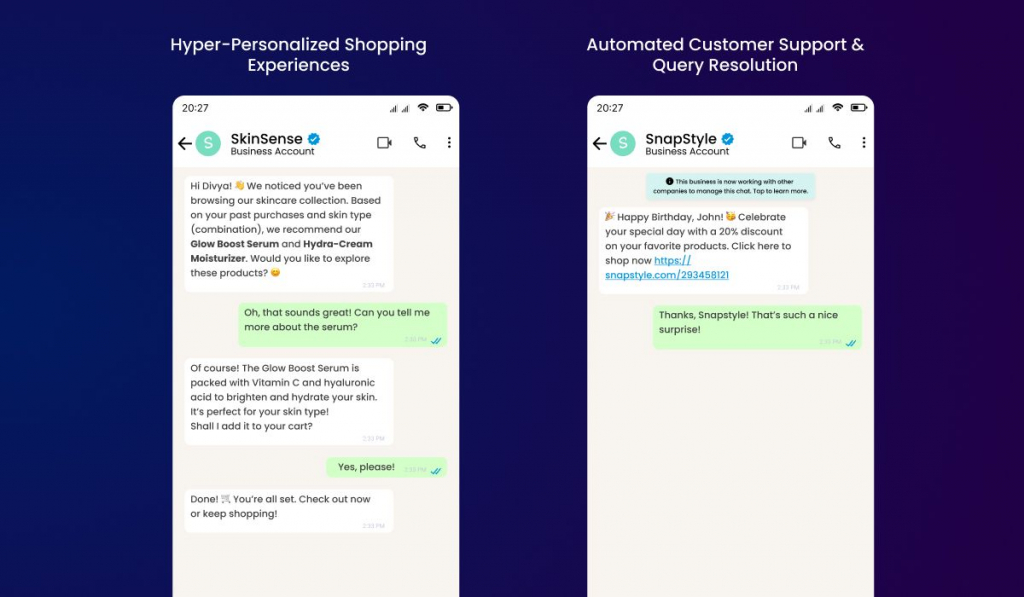
1. Hyper-Personalized Shopping
Agents use browsing history, past purchases, and live behavior to suggest the right products.
Example: A beauty brand’s AI agent recommends a skincare routine based on skin type and past purchases, which lifts conversion rates.
2. Automated Support and Query Resolution
Agents can answer questions on order tracking, refunds, and products instantly, 24/7.
Example: An electronics retailer cuts human agent workload by letting AI agents resolve most routine queries instantly.
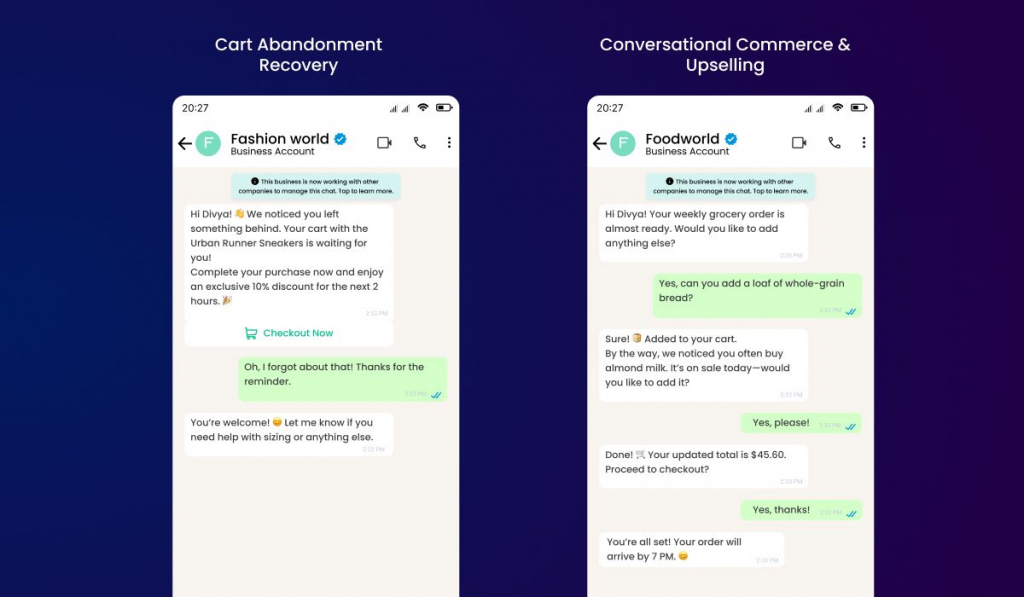
3. Cart Abandonment Recovery
Agents re-engage shoppers who leave items behind with personalized follow-ups and limited-time offers.
Example: A footwear brand sends WhatsApp reminders for abandoned carts and recovers lost sales.
4. Conversational Commerce and Upselling
Agents help shoppers discover products and check out through natural conversation. This raises order values and repeat purchases. Learn more in our guide to conversational commerce.
Example: A grocery delivery service lets customers place and change orders through an AI agent, which improves retention.
10 Ways to Maximize AI Agent ROI
A clear plan makes the difference between a pilot and real returns. Follow these steps:
- Set Clear Objectives: Define goals such as better customer experience, lower costs, or faster decisions.
- Train your Team: Show employees how to work with AI agents.
- Customize for your Industry: Tailor the agent to your sector’s needs.
- Integrate Smoothly: Connect agents to your CRM, databases, and other business tools.
- Monitor and Optimize: Review performance often and adjust using real-time feedback.
- Scale Plan: Choose systems that grow with your business.
- Protect Data: Follow strict privacy and compliance standards.
- Act on Feedback: Use customer and employee input to improve the agent.
- Work Across Teams: Bring IT, marketing, and support together around shared goals.
- Review KPIs Regularly: Check the agent’s impact on key metrics and refine your approach.
A focused plan helps you get more value from every AI agent you deploy.
How to Track AI Agent Performance
Ongoing evaluation keeps your AI agent ROI high. Use this checklist:
- Set KPIs: Track response time, customer satisfaction (CSAT), and resolution rate.
- Monitor in Real Time: Catch and fix problems quickly.
- Analyze Customer Feedback: Use it to improve user experiences.
- Check Accuracy: Test how well agents understand and resolve queries.
- Test Scalability: Make sure performance holds under heavier loads.
- Run Security Audits: Review data protection regularly to maintain customer trust.
- Keep Models Updated: Retrain agents on fresh data and trends.
Consistent tracking improves efficiency and satisfaction. It also protects long-term profitability.
AI Agents vs Traditional Automation
Many businesses still rely on IVR (Interactive Voice Response) and email ticketing. AI agents beat them on scalability, personalization, and efficiency. The table makes the difference clear.
| Area | Traditional automation | AI agents |
|---|---|---|
| Conversations | Fixed menus or scripts | Natural, context-aware chats |
| Personalization | Same flow for every customer | Tailored to each customer’s data and behavior |
| Learning | Needs manual updates | Improves from past conversations |
| Channels | Often limited to one channel | Works across channels such as WhatsApp |
| Scalability | Needs more staff or setup as volume grows | Handles thousands of chats at once |
| Typical ROI impact | Mainly cost savings | Savings plus revenue growth |
AI agents do more than automate tasks. They add intelligence and adaptability that support growth.
Why AI Agent ROI is Worth Measuring
AI agents now sit at the center of growth plans. They cut costs, lift revenue, and improve customer satisfaction. Measure all three, and you will see the full return.
Start with one use case. Set a baseline, track your KPIs, and expand what works. Businesses that deploy and refine AI agents with care gain a clear edge.
Ready to see what AI agents can do for your business? Book a demo to explore how Gupshup can help.
FAQs
1. What is AI Agent ROI?
AI agent ROI is the return a business earns on its AI agent investment, compared with what it spends. It counts savings, such as lower support costs, and gains, such as higher sales, faster resolutions, and better retention. Express it as a percentage so you can compare it with other projects.
2. How Do You Calculate AI Agent ROI?
Use this formula: AI agent ROI (%) = (total benefits − total cost) ÷ total cost × 100. For example, if an agent costs $50,000 a year and delivers $80,000 in savings and extra revenue, ROI is 60%. Include setup, integration, and maintenance in the cost.
3. Which Metrics Should You Track to Measure AI Agent ROI?
Track cost per conversation, resolution rate, containment rate (chats solved without a human), response time, CSAT, conversion rate, and average order value. Compare each against a pre-launch baseline. Then convert the changes into money to calculate ROI.
4. How Long Does it Take to See ROI From AI Agents?
It depends on the use case, setup effort, and conversation volume. Simple, high-volume tasks such as order tracking usually pay back sooner than complex workflows. Set a baseline before launch, review results monthly, and expand only the use cases that perform.
5. What Costs do Businesses Miss When Calculating AI Agent ROI?
Many teams count only licence fees. Also include integration work, knowledge-base upkeep, staff training, monitoring, and model updates. Add the cost of human review for edge cases. Leaving these out makes ROI look better than it is.

Divya is a multifaceted writer and a journalism graduate. A wordsmith by profession and passion, she crafts compelling narratives as a seasoned content writer while also weaving poetic tapestries in her leisure moments. Whether delving into informational prose or evocative verse, her love for the written word brings finesse to every piece she pens down.