+91-9355000192
 Login

AI Chatbot for Business: Choosing the Right Type for Your Business Needs
- Why Should Your Business Consider an AI Chatbot?
- What Is an AI Chatbot for Business?
- 4 Types of Chatbots for Business
- The Technology Behind AI Chatbots
- AI Chatbot for Business: Use Cases by Industry
- Self-Service Chatbots: Put Customers in Control
- Getting Started With an AI Chatbot for Business
- FAQs
See the power of intelligent conversations for your brand.

Customers want answers in seconds, at any hour, on whatever app they’re using. Meanwhile, most support teams still work office hours, and every unanswered message is a lost sale or a frustrated customer. An AI chatbot for business fixes that gap. It answers questions instantly, handles orders and bookings, and passes complex issues to your team. However, not every chatbot fits every business, so this guide explains the main types, the technology behind them, and how to pick the right one.
Why Should Your Business Consider an AI Chatbot?
AI already handles a large share of customer service, and that share is growing fast. In Salesforce’s 2025 State of Service report, a survey of 6,500 service professionals found that teams estimated that AI handles about 30% of cases today. They expect that to reach 50% by 2027.
Looking further ahead, Gartner predicts that by 2029, agentic AI will resolve 80% of common customer service issues without human help. As a result, Gartner expects operational costs to fall by 30%.
The market reflects this shift too. According to Grand View Research, the global chatbot market was worth about $9.6 billion in 2025 and could reach $41.2 billion by 2033.
What Is an AI Chatbot for Business?
An AI chatbot for business is software that uses natural language processing and machine learning to talk with customers on websites, apps, and messaging channels like WhatsApp. It understands what customers mean, answers questions, completes tasks such as bookings or order tracking, and hands complex conversations to human agents.
Today’s chatbots have come a long way from clunky, scripted responders. Instead, the best ones hold intelligent, proactive, and personalized conversations that improve customer engagement at every step.
4 Types of Chatbots for Business
Chatbots range from simple scripted bots to advanced voice assistants. Here’s how each type works.
1. Rule-Based Chatbots
Rule-based chatbots follow predefined rules on an “if this, then that” basis. For example, when a customer asks about store hours, the bot pulls the answer from a fixed database. They work well for basic FAQs and fixed workflows like appointment booking. However, they can’t handle questions outside their rules.
2. AI-Powered Chatbots
AI-powered chatbots use machine learning and natural language processing (NLP) to understand complex questions. They also get smarter with every interaction.
For instance, if a customer types “I want a red shirt,” an AI chatbot understands the request, finds matching products, and makes recommendations. That’s why these bots suit businesses that need a personal touch, such as e-commerce brands and customer support teams.
3. Hybrid Chatbots
Hybrid chatbots combine rule-based flows with AI. They answer common questions quickly through set flows, then switch to AI when a customer asks something more complex.
Say a customer starts with a simple FAQ. The hybrid bot answers it instantly. If the customer then asks a tricky follow-up, the bot uses AI to understand the nuance, or it escalates the chat to a human agent. In short, hybrid bots balance efficiency with flexibility.
4. Voice-Activated Chatbots
Voice bots respond to spoken commands, much like virtual assistants. They’re useful in hands-free settings, such as driving, warehouse work, or busy clinics, which makes them popular in the automotive, healthcare, and logistics industries. For example, when a customer says “Call customer service,” the voice bot connects the call.
Types of Chatbots at a Glance
| Type | How it works | Best for | Limitation |
|---|---|---|---|
| Rule-based | Follows fixed “if-then” rules | Simple FAQs and fixed workflows | Can’t handle unexpected questions |
| AI-powered | Uses NLP and machine learning | Personalized support and sales | Needs good training data |
| Hybrid | Combines rules with AI | Businesses that want speed and flexibility | Takes more planning to set up |
| Voice-activated | Responds to spoken commands | Hands-free environments | Accuracy drops in noisy settings |
Which Type Fits Your Business?
- Need simple automation? Choose a rule-based bot.
- Want a personal touch? An AI-powered bot is your best option.
- Looking for an all-rounder? Pick a hybrid bot.
- Working hands-free? Go with a voice bot.
Request a Demo as per your Business Need
The Technology Behind AI Chatbots
Several technologies work together to make chatbots sound more human.
Natural Language Processing
NLP helps chatbots understand what customers actually mean. For example, a bot can tell whether “I need help” refers to technical support or general information.
Machine Learning
Chatbots also learn from past conversations, so they perform better over time. If many users ask about delivery delays, the bot learns to prioritize those answers.
Conversational AI and Generative AI
Conversational AI and large language models (LLMs) let chatbots create fresh responses on the spot. For instance, a bot connected to your CRM can suggest personalized birthday gifts based on a customer’s past purchases. Our guide to generative AI chatbots explains this in more detail.
Voice Recognition and Synthesis
This technology lets bots understand voice commands and reply in a natural voice. With it, your voice bot can even greet callers by name.
Integration Across Channels
AI chatbots aren’t just for websites anymore. They also run on the WhatsApp Business API, social media, and even inside your ERP systems. Picture one chatbot that replies to Instagram queries, manages website orders, and syncs with your inventory software.
AI Chatbot for Business: Use Cases by Industry
Chatbots work around the clock and bring value to almost every industry. Here’s how businesses in different sectors use them.
Retail: Customer Support Automation
Chatbots don’t take breaks or miss questions, and they handle high traffic without delays. Consequently, retailers use them to solve queries instantly, answer FAQs, and keep customers engaged during sales peaks.
E-Commerce: Virtual Shopping Assistant
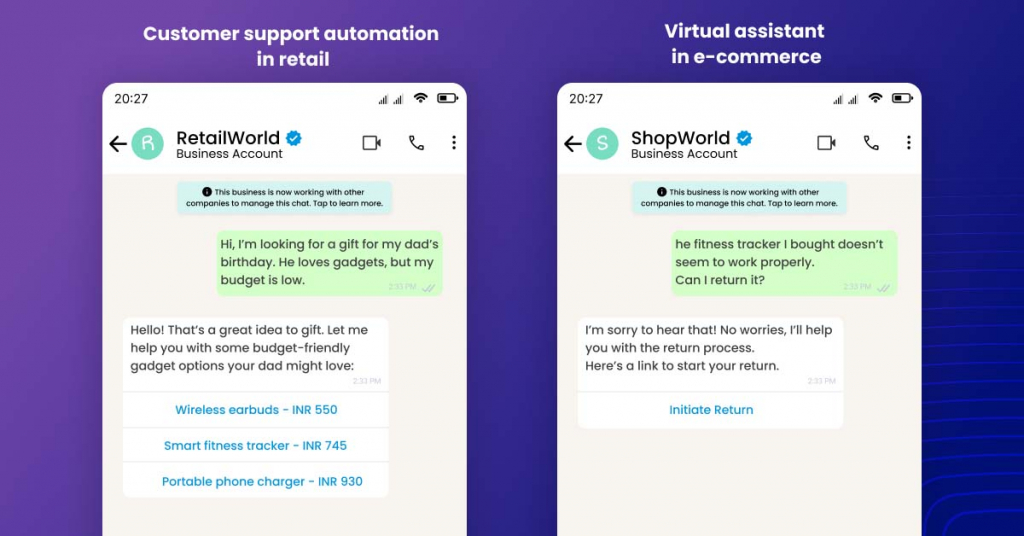
In e-commerce, a well-designed chatbot boosts sales as well as service. It acts as an expert sales assistant that helps customers decide and buy.
- Product recommendations: AI chatbots understand customer intent and suggest the right products.
- Order tracking: they send timely post-purchase updates without customers having to ask.
- After-sales support: they handle returns and collect feedback.
- Cart recovery: they remind shoppers about items left behind, as shown in our guide to AI agents for e-commerce.
Healthcare: Patient-Care Assistant
In healthcare, chatbots simplify work for both patients and providers. Patients can book appointments without calling or waiting. In addition, the bot sends reminders and helps track symptoms or medication schedules. Think of it as a healthcare assistant that makes sure patients never miss an appointment.
Education: Student Navigation
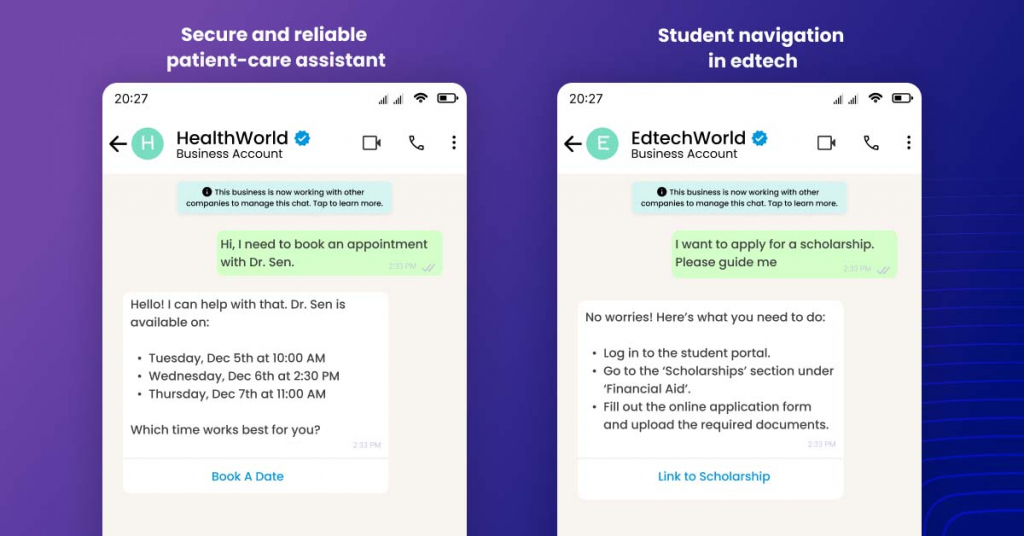
In education, AI chatbots act as virtual tutors. They guide students through courses, explain concepts step by step, and answer admin questions about fees, deadlines, and admissions.
Banking and Financial Services: Personalized Support
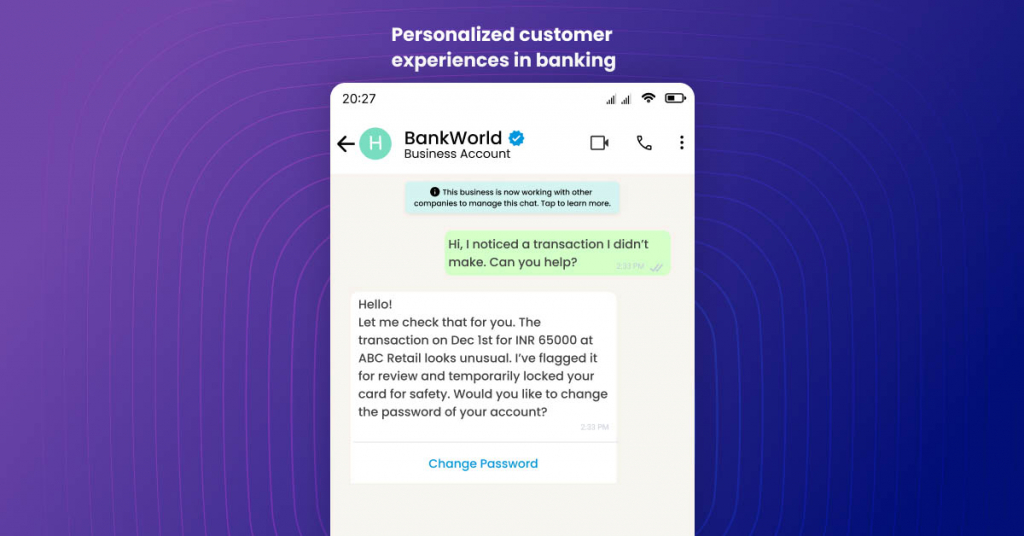
Finance runs on trust and security. Chatbots help customers check balances, manage accounts, and flag suspicious activity, all within secure conversations. Gupshup’s solutions for financial services show how banks deliver these services in seconds.
Travel and Hospitality: Personal Travel Buddy
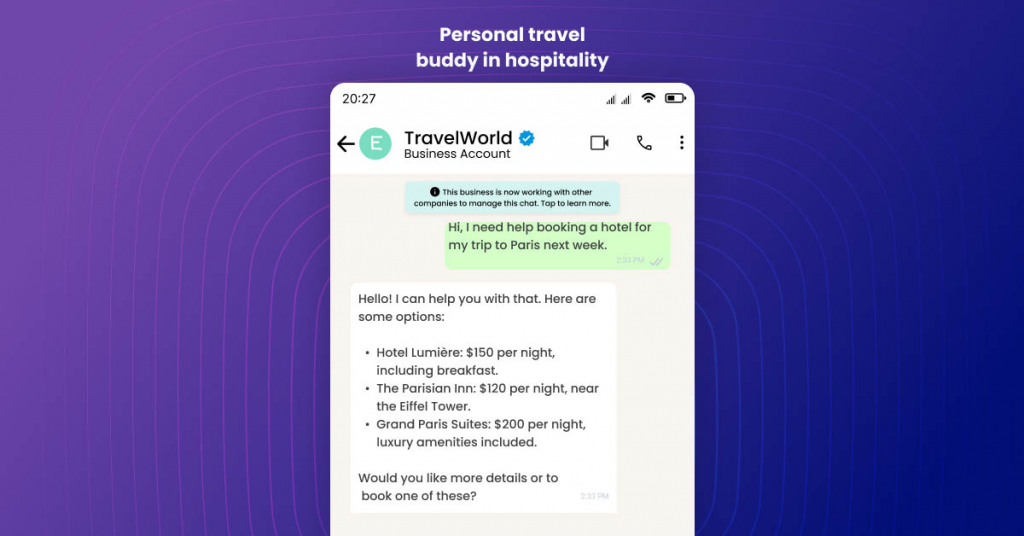
Travelers want to feel informed and looked after. A chatbot helps with bookings, itinerary changes, and queries 24/7, from planning to check-out. As a result, travel businesses get happier customers and faster processes.
You can explore more ready-made scenarios on our AI agent use cases page.
Self-Service Chatbots: Put Customers in Control
Customers often prefer to solve problems themselves rather than call or email. In fact, Salesforce’s earlier research found that 65% of customers had already used self-service portals. Self-service chatbots take this further.
- Knowledge base integration: you train the chatbot on your FAQs, policies, and product details. When that information changes, you update the knowledge base, and the bot uses the new details right away.
- Shorter wait times: customers hate being on hold. A self-service chatbot answers instantly, so no one waits in a queue.
- Easy interfaces: even customers who aren’t tech-savvy can type “How do I reset my password?” and get step-by-step help. Many bots also offer clickable menus for common requests.
Getting Started With an AI Chatbot for Business
Chatbots get smarter every year as AI and NLP improve. So if you’re planning to add one, choose a platform that can grow with you.
Gupshup makes building and launching chatbots easy, even for teams without technical skills. With Gupshup’s AI agents, you can create chatbots that answer questions, complete tasks, and work across WhatsApp, web, apps, and more.
Whether you want to simplify support, increase engagement, or speed up operations, Gupshup has you covered. Connect with us today to start smarter conversations with your customers.
FAQs
Can AI chatbots send proactive messages?
Yes. AI chatbots can send proactive messages such as order updates, appointment reminders, payment alerts, and promotional offers. On WhatsApp, businesses must use pre-approved message templates and get customer opt-in before sending these messages.
How do AI chatbots improve customer retention?
AI chatbots give instant support, personalized offers, and quick resolutions at any hour. Because customers get help without waiting, satisfaction rises, and they’re more likely to buy again.
How do chatbots handle sensitive customer data?
A secure chatbot encrypts data, limits who can access customer records, and complies with laws such as the EU’s GDPR and India’s DPDP Act. Before you choose a platform, ask how it stores data and how long it keeps it.
What is the difference between a chatbot and an AI agent?
A chatbot mainly answers questions in a conversation. An AI agent goes further. It understands goals, makes decisions, and completes multi-step tasks, such as rescheduling an order or processing a refund, by connecting to your business systems.
Which type of chatbot is best for a small business?
Most small businesses start with a hybrid chatbot. It handles common FAQs through simple flows and uses AI for harder questions, so you get good results without a big setup effort.
Can an AI chatbot integrate with my CRM?
Yes. Most business chatbot platforms connect with CRMs, e-commerce stores, and helpdesk tools through APIs. As a result, the chatbot can pull customer details, update records, and personalize every reply.

Divya is a multifaceted writer and a journalism graduate. A wordsmith by profession and passion, she crafts compelling narratives as a seasoned content writer while also weaving poetic tapestries in her leisure moments. Whether delving into informational prose or evocative verse, her love for the written word brings finesse to every piece she pens down.