+91-9355000192
 Login

Chatbot vs Conversational AI: What Works for Your Brand?
- What Is the Difference Between a Chatbot and Conversational AI?
- Why Chatbot vs Conversational AI Matters
- Chatbots: Built for Speed and Efficiency
- Conversational AI: Built for Natural, Personal Interactions
- Chatbot vs Conversational AI: How to Choose
- The Hybrid Approach: Get the Best of Both
- Conclusion
- Frequently Asked Questions
See the power of intelligent conversations for your brand.

A customer types “Where’s my order?” and gets an instant reply. Then they ask, “Can I change the delivery address and use my store credit?” Suddenly, the bot replies with “Sorry, I didn’t understand that.” That moment shows the real difference between a chatbot and conversational AI. A traditional chatbot follows scripts and handles simple, predictable questions. Conversational AI, by contrast, understands natural language, remembers context, and handles complex, multi-step requests. Most businesses get the best results by combining the two.
What Is the Difference Between a Chatbot and Conversational AI?
A chatbot is a program that answers questions using predefined rules, menus, or keywords. Conversational AI is the broader technology, built on natural language processing and machine learning, that lets software understand intent, keep context, learn from interactions, and respond naturally. In other words, a conversational AI assistant is a smarter kind of chatbot, but not every chatbot uses conversational AI.
Chatbot vs Conversational AI at a Glance
| Feature | Traditional chatbot | Conversational AI |
|---|---|---|
| How it works | Fixed rules, buttons, and keywords | NLP, machine learning, and large language models |
| Understands free text | Only expected phrases | Yes, including typos and slang |
| Remembers context | No | Yes, across the conversation |
| Handles complex requests | Rarely | Yes, including multi-step tasks |
| Learns over time | No, needs manual updates | Yes, improves from interactions |
| Personalization | Basic | Based on history, intent, and preferences |
| Channels | Usually one | Website, apps, WhatsApp, voice, and more |
| Setup effort and cost | Low | Higher, but scales better |
| Best for | FAQs, order status, simple bookings | Sales, support, and personalized journeys |
Why Chatbot vs Conversational AI Matters
Customers are quick to judge a bad bot. In a September 2026 Gartner survey of 3,566 customers, only 27% said they would try a chatbot again after a negative experience. On top of that, 87% said access to a human agent is essential when companies use GenAI for service.
Scripted bots also hit a ceiling. An earlier Gartner study found that chatbots resolved up to 58% of returns and cancellations, which are simple, predictable tasks. However, they resolved only 17% of billing disputes, which need more understanding.
Meanwhile, investment keeps growing. According to Grand View Research, the conversational AI market could reach $41.39 billion by 2030. In short, businesses see value in moving beyond basic scripts.
Chatbots: Built for Speed and Efficiency
Picture a busy sale day. Customers want to track their orders, your phone lines are full, and your website doesn’t help. In that moment, a simple chatbot is a lifesaver. A customer types their order number and gets the status instantly.
What Chatbots Do Best
Above all, chatbots work well for predictable, high-volume tasks, especially on messaging channels like the WhatsApp Business API:
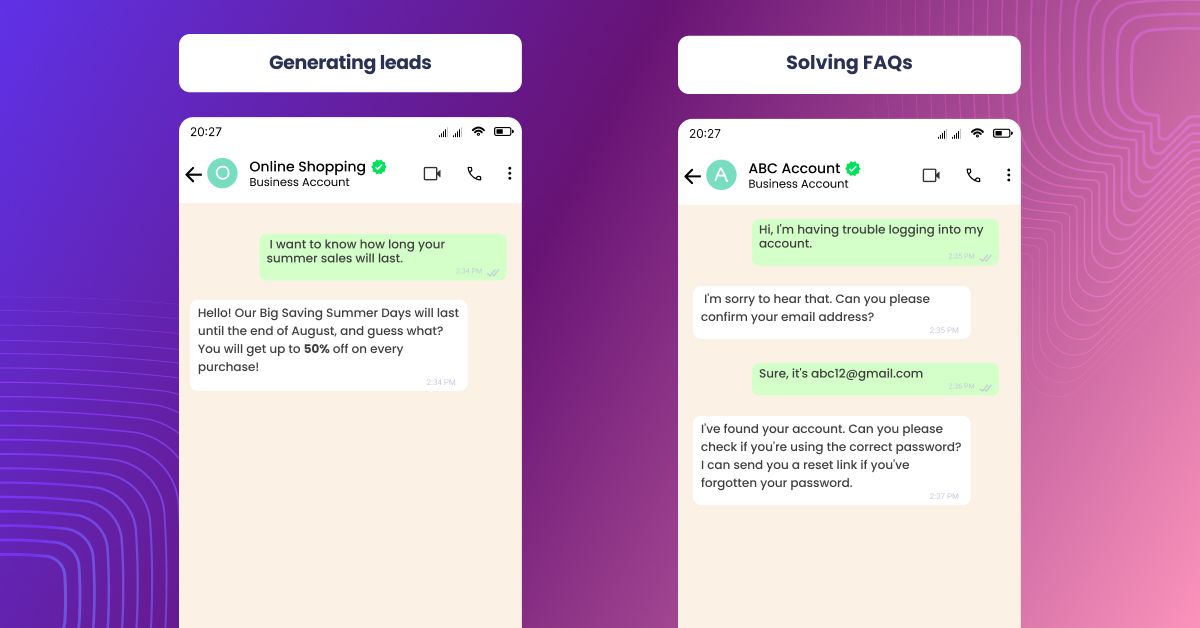
Generating leads: first, they ask a few set questions, collect contact details, and pass leads to sales.
Answering FAQs: in addition, they handle common questions about pricing, hours, and policies, so agents can focus on harder issues.
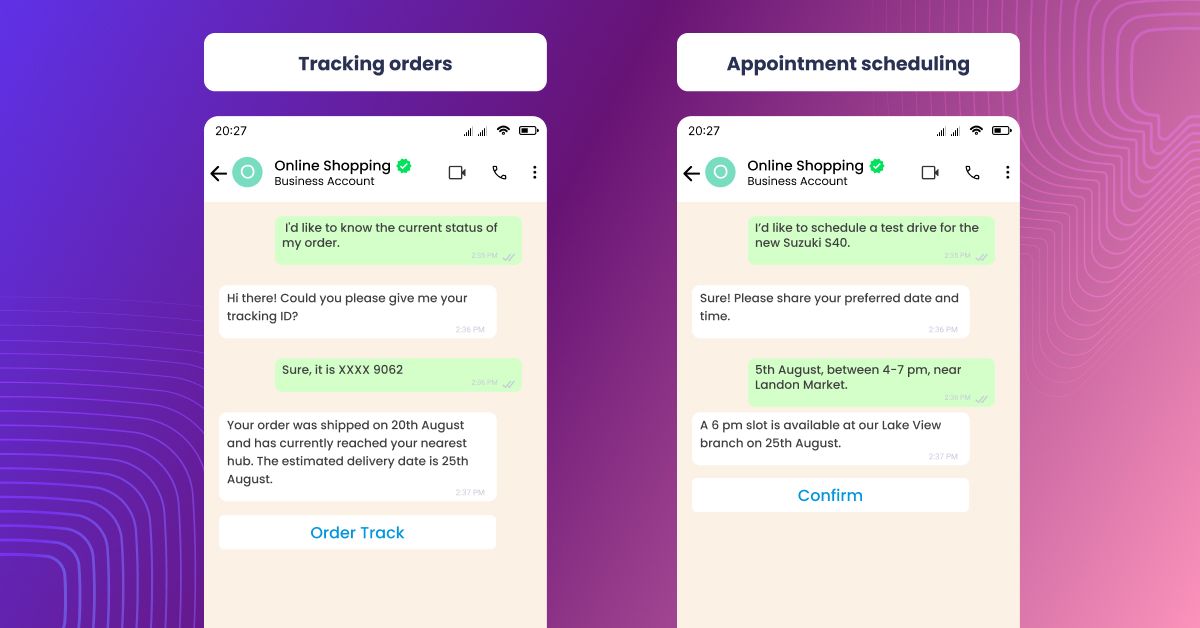
Tracking orders: they also share real-time order status faster than any agent.
Scheduling appointments: they book, confirm, and reschedule slots without phone calls.
Benefits of Chatbots
- Low cost: because they’re simple, they’re quick and affordable to set up.
- Always available: they answer instantly, even at night or on weekends.
- Easy to manage: since you control every answer, responses stay consistent.
Limitations of Chatbots
On the other hand, scripted chatbots break when customers go off-script. In addition, they can’t remember earlier messages, and you have to update every flow by hand when your products or policies change.
Conversational AI: Built for Natural, Personal Interactions
Now imagine a shopper who can’t find the right product on your website. They type, “I need a waterproof jacket for a trek next week, under ₹5,000.” A simple chatbot can’t handle that. Conversational AI, however, understands the request, checks your catalog, and recommends options in seconds.
What Conversational AI Does
Conversational AI combines natural language processing, machine learning, and large language models. As a result, it can:
- Make personalized recommendations: for instance, it uses purchase history and chat context to suggest the right products or content.
- Read customer sentiment: when it detects frustration or urgency, it adjusts its tone or escalates to a human.
- Engage proactively: it reaches out with timely updates, reminders, or offers on channels like WhatsApp.
- Complete tasks: it connects to your systems to process returns, update orders, or book services.
Benefits of Conversational AI
- More sales: it cross-sells and upsells 24/7. For example, it can pick up leads from click-to-chat ads and guide them to a purchase. Our guide to click-to-WhatsApp ads explains how this works.
- Better customer experience: since conversations feel natural, customers don’t have to repeat themselves.
- Data-driven insights: in addition, every conversation reveals what customers want, which helps you improve products and service.
Limitations of Conversational AI
That said, conversational AI needs more setup, good training data, and regular monitoring. It can also misread ambiguous questions, which is why a clear handoff to human agents still matters.
Chatbot vs Conversational AI: How to Choose
Before you decide, weigh these four factors:
- Business size: generally, large brands with complex queries need conversational AI. Smaller brands may start with a simple chatbot.
- Industry: high-volume, complex industries like banking, telecom, and e-commerce benefit most from conversational AI. Simpler service businesses can often rely on chatbots.
- Target audience: similarly, if your customers expect personal, natural conversations, choose conversational AI.
- Budget: chatbots cost less upfront. Conversational AI costs more, but it often delivers a stronger long-term return because it resolves more issues and drives more sales.
The Hybrid Approach: Get the Best of Both
For most businesses, the smartest answer isn’t either-or. Instead, a hybrid approach uses simple chatbot flows for routine tasks and conversational AI for everything else. As a result, you keep costs low while still giving customers smart, personal help.
Gupshup’s conversation cloud handles exactly this. With Gupshup’s AI agents, you can:
- Handle every type of query: answer simple FAQs instantly and manage complex support requests with AI.
- Personalize every interaction: offer tailored recommendations and proactive updates across your website, apps, and WhatsApp.
- Reduce agent workload: automate routine tasks so that your team focuses on high-value conversations.
- Hand off smoothly: pass complex cases to human agents with the full conversation history attached.
- Maximize ROI: pay for advanced AI only where it adds value, while simple flows handle the rest.
In addition, Gupshup’s no-code Conversation Builder lets your team design both simple flows and AI-powered journeys without waiting on developers.
Conclusion
The chatbot vs. conversational AI debate comes down to what your customers need. Chatbots are fast, affordable, and perfect for simple, repetitive tasks. Conversational AI, on the other hand, delivers natural, personalized, and task-completing conversations that grow sales and loyalty.
As NLP and machine learning keep improving, the gap between the two will keep shrinking. Until then, the best approach is to combine both and expand as your needs grow. Gupshup can help you build that hybrid solution across every channel your customers use.
Ready to upgrade your customer conversations? Contact us today for a personalized consultation.
Frequently Asked Questions
Is ChatGPT a chatbot or conversational AI?
ChatGPT is both. It works as a chatbot because people interact with it through chat, but it’s built on conversational and generative AI. That’s why it understands natural language, remembers context, and creates new responses instead of following a script.
Is conversational AI the same as generative AI?
No, but they overlap. Conversational AI is any technology that lets machines hold natural conversations. Generative AI creates new content, such as text or images. Today, many conversational AI systems use generative AI models to write more natural, flexible replies.
Which is cheaper, a chatbot or conversational AI?
A rule-based chatbot is usually cheaper to build and run at first. Conversational AI costs more upfront, but it often delivers better long-term value because it resolves more queries without human help and drives more sales.
Can I upgrade my existing chatbot to conversational AI?
Yes. Most businesses keep their working chatbot flows for simple tasks and add an AI layer for free-text questions, recommendations, and complex requests. This hybrid upgrade avoids rebuilding from scratch.
Are there ethical concerns with chatbots and conversational AI?
Yes. Tell customers when they’re talking to a bot, protect their data, avoid misleading answers, and always offer an easy way to reach a human. Following data laws such as the EU’s GDPR and India’s DPDP Act is also essential.
What are the main challenges of conversational AI?
Conversational AI can still struggle with ambiguous questions, sarcasm, or rare topics. It also needs quality training data, regular testing, and clear guardrails. Starting with a few well-tested use cases and expanding gradually helps avoid these problems.

Divya is a multifaceted writer and a journalism graduate. A wordsmith by profession and passion, she crafts compelling narratives as a seasoned content writer while also weaving poetic tapestries in her leisure moments. Whether delving into informational prose or evocative verse, her love for the written word brings finesse to every piece she pens down.