+91-9355000192
 Login

Chatbots in Banking: Enhancing Customer Service During the Festive Season
- What Are Chatbots in Banking?
- Why Chatbots in Banking Matter During the Festive Season
- Banking Customer Service Challenges During the Festive Season
- Why WhatsApp Is a Popular Channel for Chatbots in Banking
- 7 Ways Chatbots in Banking Manage Festive Season Demand
- Benefits of Chatbots in Banking During Peak Seasons
- How Gupshup Helps Banks Launch WhatsApp Chatbots
- FAQs
See the power of intelligent conversations for your brand.

The festive season is almost here, and your bank is about to face one of its busiest periods of the year. Customers are shopping, booking travel, and finishing year-end financial tasks, so queries flood in at all hours. Meanwhile, your support lines fill up and wait times grow. Chatbots in banking solve this problem. A WhatsApp banking chatbot answers routine questions instantly, guides customers through payments, alerts them to suspicious activity, and hands complex cases to your team. As a result, your bank keeps service fast and responsive without overwhelming staff.
What Are Chatbots in Banking?
Chatbots in banking are AI-powered assistants that help customers with banking tasks through chat on a bank’s website, mobile app, or messaging apps like WhatsApp. They answer account and card questions, share balances and transaction alerts, guide payments and loan applications, flag suspicious activity, and route complex issues to human agents.
Why Chatbots in Banking Matter During the Festive Season
Customers already expect banks to offer chat support. According to the Consumer Financial Protection Bureau, about 37% of the U.S. population interacted with a bank’s chatbot in 2022, and all of the top 10 U.S. commercial banks use chatbots.
Demand also spikes during the holidays. For example, Salesforce’s 2025 holiday shopping data found that shoppers used retailers’ AI agents for customer service 126% more during the holiday rush than in the two months before. Banks see the same pattern, because every festive purchase can trigger a payment question, a card issue, or a fraud alert.
Picture this: instead of your phone lines overflowing, your bank’s AI chatbot on WhatsApp handles most routine conversations. It resolves issues instantly, answers common questions, and guides customers through transactions. In short, it becomes a support team that works 24/7 and never gets tired.
Banking Customer Service Challenges During the Festive Season
The festive season is a time of celebration. For banks, however, it also brings a sharp rise in customer activity. Without chatbots, human agents struggle to keep service fast and accurate. Here are the biggest challenges.
Rising Customer Expectations
Customers want faster, more personal service, especially during busy periods. If banks can’t keep up, satisfaction drops and customers may switch to a competitor.
Need for 24/7 Support
People shop at all hours, and online stores span time zones. Consequently, payment and card issues can appear at any time of day or night, and customers expect help right away.
High Transaction Volume
Last-minute shopping drives a huge surge in transactions. As a result, support channels slow down, and banks risk service disruptions just when customers need them most.
Cybersecurity Risks
Busy periods also attract fraudsters. Higher transaction volumes make banks more exposed to scams, phishing, and data breaches, so real-time fraud alerts and strong security become critical.
Compliance
Banks handle large amounts of sensitive data and must follow strict regulations. During peak periods, operational risk and regulatory scrutiny both increase, so every customer conversation must stay compliant.
Consistency and Accuracy
When agents rush through a flood of repetitive questions, mistakes happen. Therefore, keeping answers consistent and accurate becomes harder as volume grows.
Operational Strain
Together, these pressures stretch teams thin. Without automation, banks often need extra temporary staff, which raises costs and still may not solve the problem.
Why WhatsApp Is a Popular Channel for Chatbots in Banking
To handle festive demand, many banks now run their chatbots on WhatsApp. The reason is simple: customers are already there. According to TechCrunch, Meta CEO Mark Zuckerberg said in 2025 that WhatsApp has more than 3 billion monthly users.
For banking, WhatsApp offers a familiar, easy interface. Customers can check balances, receive transaction alerts, and get help without downloading another app. With the WhatsApp Business API, banks can also send verified, secure messages from an official business account, which builds trust.
7 Ways Chatbots in Banking Manage Festive Season Demand
Here’s how a WhatsApp banking chatbot helps your bank stay ahead of the festive rush.
1. Payment Assistance
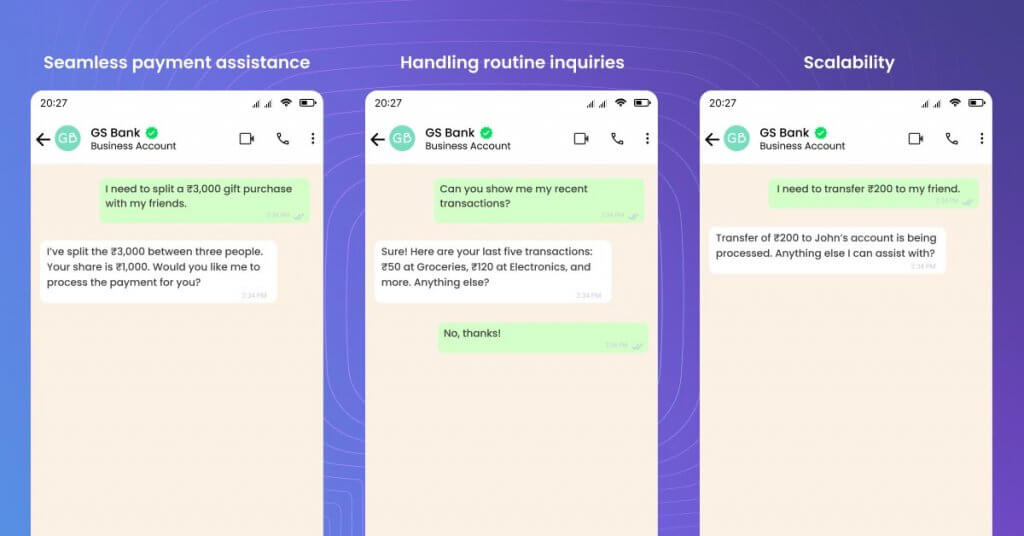
During the holidays, customers need help with bill splits, gift transfers, and travel payments. A chatbot guides them step by step and can share secure one-click payment links. As a result, payments go through faster with fewer errors.
2. Routine Inquiries
Most frequent queries repeat: balance checks, card limits, transaction status, and branch hours. A chatbot answers these instantly, so your agents can focus on complex issues that need a personal touch.
3. Scalability
A chatbot can handle thousands of conversations at the same time. Therefore, service quality stays consistent even when transaction volumes spike.
4. Personalized Services
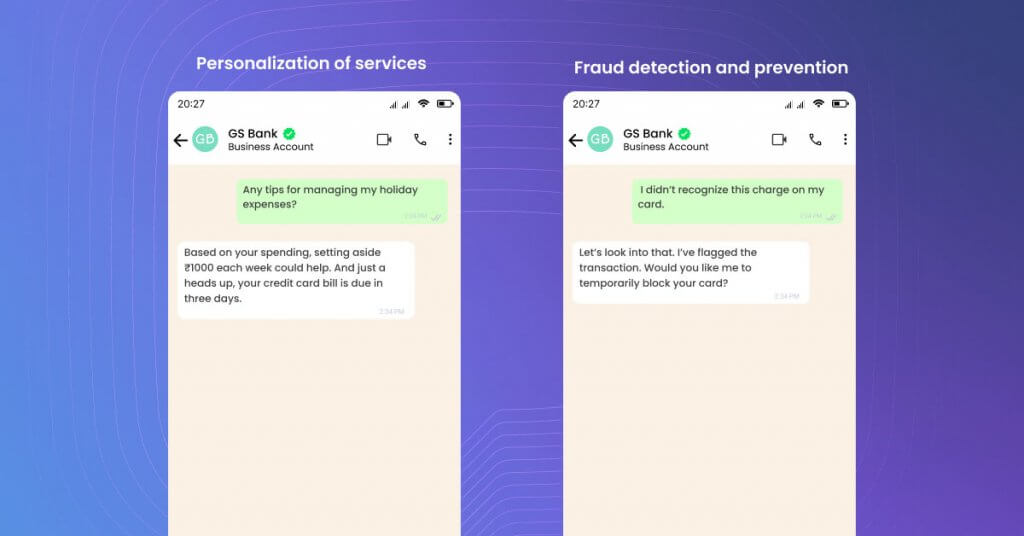
By using customer data and past interactions, a banking chatbot can:
- Share relevant product information, such as festive card offers
- Remind customers about payment due dates
- Suggest useful services, such as travel insurance or forex cards
Gupshup’s solutions for financial services show how banks personalize these conversations at scale.
5. Fraud Alerts and Prevention
Fraud attempts rise when spending rises. A chatbot can alert customers to unusual transactions in real time and let them confirm or block a payment in the chat. In addition, it can share timely warnings about common festive scams. Learn more in our guide to conversational AI in banking.
6. Lead Generation and Conversion
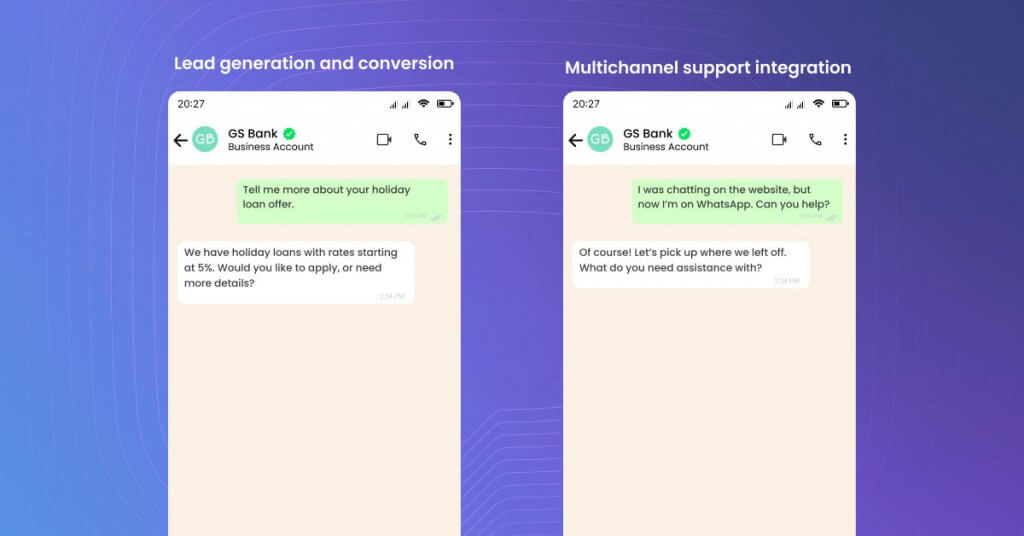
The festive season is prime time for loan offers, card upgrades, and special deposit rates. A chatbot answers questions about these offers, checks eligibility, and guides customers through applications. Consequently, more interested customers complete their applications.
7. Omnichannel Support
Customers reach banks through apps, websites, and social media. Modern chatbots work across all these channels, so customers get the same quality of help wherever they start. Our ebook on omnichannel communication explains why this matters.
Benefits of Chatbots in Banking During Peak Seasons
Beyond handling demand, chatbots bring clear business benefits.
- Cost efficiency: industry reports cited by the CFPB estimate that chatbots save around $0.70 per customer interaction compared with human agents. So, you need fewer extra staff during peak periods.
- Higher customer satisfaction: instant, 24/7 answers mean customers get help when they need it.
- Operational continuity: chatbots keep service consistent without overwhelming customers, even during peak periods.
- Scalability: they manage thousands of conversations at once, which makes festive spikes easy to absorb.
- Multilingual support: they reply in each customer’s preferred language, which is essential in diverse markets like India.
However, banks need to build chatbots well. Accenture’s Global Banking Consumer Study 2025, which surveyed 49,300 banking customers, found that chatbots score lowest on satisfaction of any banking channel, because many simply respond rather than understand. That’s why AI-powered chatbots with smooth human handoff matter so much.
How Gupshup Helps Banks Launch WhatsApp Chatbots
Gupshup helps banks launch secure, AI-powered chatbots on WhatsApp and other channels before the festive rush begins. With Gupshup’s AI agents, your chatbot understands natural language, completes tasks, and hands complex cases to human agents. On top of that, our no-code guide to creating a WhatsApp chatbot shows how quickly you can get started.
As a result, your bank delivers consistent, personal, and secure service during peak periods and stands out for customer satisfaction.
The Future of Chatbots in Banking
Chatbots in banking will keep getting smarter. Here’s what lies ahead:
- More personal conversations: advances in natural language processing and machine learning will help chatbots understand each customer’s needs and preferences better.
- Proactive support: instead of waiting for questions, chatbots will predict needs, send timely reminders, and stop fraud before it happens.
- Voice banking: voice assistants will let customers check balances or make payments with simple spoken commands.
In short, the future of banking chatbots isn’t just about automation. It’s about smarter, more helpful customer experiences.
Ready to prepare your bank for the festive season? Connect with Gupshup to launch your WhatsApp banking chatbot.
FAQs
What is the role of chatbots in banking?
Chatbots in banking automate customer service tasks such as balance checks, card blocking, payment help, and loan applications. They provide 24/7 support, personalize interactions, alert customers to suspicious transactions, and pass complex issues to human agents.
Are banking chatbots safe to use?
Yes, when banks build them properly. A secure banking chatbot verifies the customer’s identity, encrypts data, and runs only on official channels, such as a verified WhatsApp Business account. Customers should never share passwords, PINs, or OTPs in any chat.
Can I do banking on WhatsApp?
Yes. Many banks now offer WhatsApp banking, where customers can check balances, get mini statements, block cards, and receive transaction alerts. To use it, save your bank’s official WhatsApp number from its website and start a chat.
Which banks use chatbots?
Most large banks now use chatbots. In the U.S., for example, the CFPB found that all of the top 10 commercial banks use chatbots in some form. Many banks in India, the Middle East, and Africa also run chatbots on WhatsApp.
Can a banking chatbot transfer money?
Some can. Advanced banking chatbots let verified customers pay bills or transfer money after strong authentication, such as an OTP or app approval. Others share secure payment links that open the bank’s app or website to complete the transaction.
Will chatbots replace bank customer service agents?
No. Chatbots handle high-volume, routine questions, while human agents manage complex issues, disputes, and sensitive situations. The best banks use both, with chatbots passing conversations to agents smoothly when needed.

Divya is a multifaceted writer and a journalism graduate. A wordsmith by profession and passion, she crafts compelling narratives as a seasoned content writer while also weaving poetic tapestries in her leisure moments. Whether delving into informational prose or evocative verse, her love for the written word brings finesse to every piece she pens down.