Amazon’s arrival in South Africa has given local brands a huge new marketplace, but also a lot more competition. Shoppers can now compare thousands of products in seconds, so brands that answer questions slowly or offer a generic experience quickly lose the sale. Fortunately, conversational AI in South Africa helps brands close this gap. With WhatsApp chatbots and AI agents, they can answer shoppers instantly, personalize offers, and guide buyers straight to their Amazon listings.
Why Amazon’s Launch Matters for South African Brands
Since launching in South Africa in May 2024, Amazon has grown fast. In June 2026, it rolled out Prime locally, and in October 2026, it said it had cut selling fees by up to 80% for local sellers. Meanwhile, World Wide Worx expects South African online retail to reach R159 billion in 2026, or 10% of total retail.
This is a big opportunity for small sellers in particular, since more than 60% of products sold on Amazon globally come from independent sellers. As a result, local brands that pair Amazon’s reach with personalized shopping experiences on WhatsApp can engage customers in real time and grow sales faster.
In this article, you’ll learn how South African brands can use conversational AI to do exactly that.
Why Should Brands Use Conversational AI in South Africa?
Conversational AI uses virtual assistants and tools like a WhatsApp chatbot for business to hold real-time, personal conversations with customers. Therefore, for South African brands competing for sales on Amazon, this is a critical advantage.
The audience is ready, too. DataReportal counted 51.7 million internet users in South Africa at the end of 2025, or 79.6% of the population. As a result, brands can reach most shoppers on the messaging apps they already use every day.
Here’s how conversational AI helps businesses in South Africa.
Creates a Smooth Customer Experience
First, conversational AI tools like the WhatsApp Business API help brands build a connected customer journey across channels. When customers get the same quick, helpful service everywhere, they’re more satisfied and more likely to stay loyal.
Makes Integration Simple
Setting up a WhatsApp chatbot through the WhatsApp Business API is quick and efficient. For instance, it lets brands deploy fast, automate replies, and connect with their CRM systems. Consequently, businesses can adapt quickly to market changes and keep up with customer expectations.
Drives Cost Efficiency
Finally, conversational AI automates routine tasks, which saves time and money. For example, a WhatsApp chatbot can handle many inquiries at once, so brands need fewer agents for repetitive questions. At the same time, customers get faster answers, which raises satisfaction.
How Can Brands Use Conversational AI to Close Deals on Amazon?
As the e-commerce market in South Africa grows, conversational AI becomes essential for driving more sales on Amazon. Here are four practical ways to use it.
1. Use Click to WhatsApp Ads for Instant Engagement
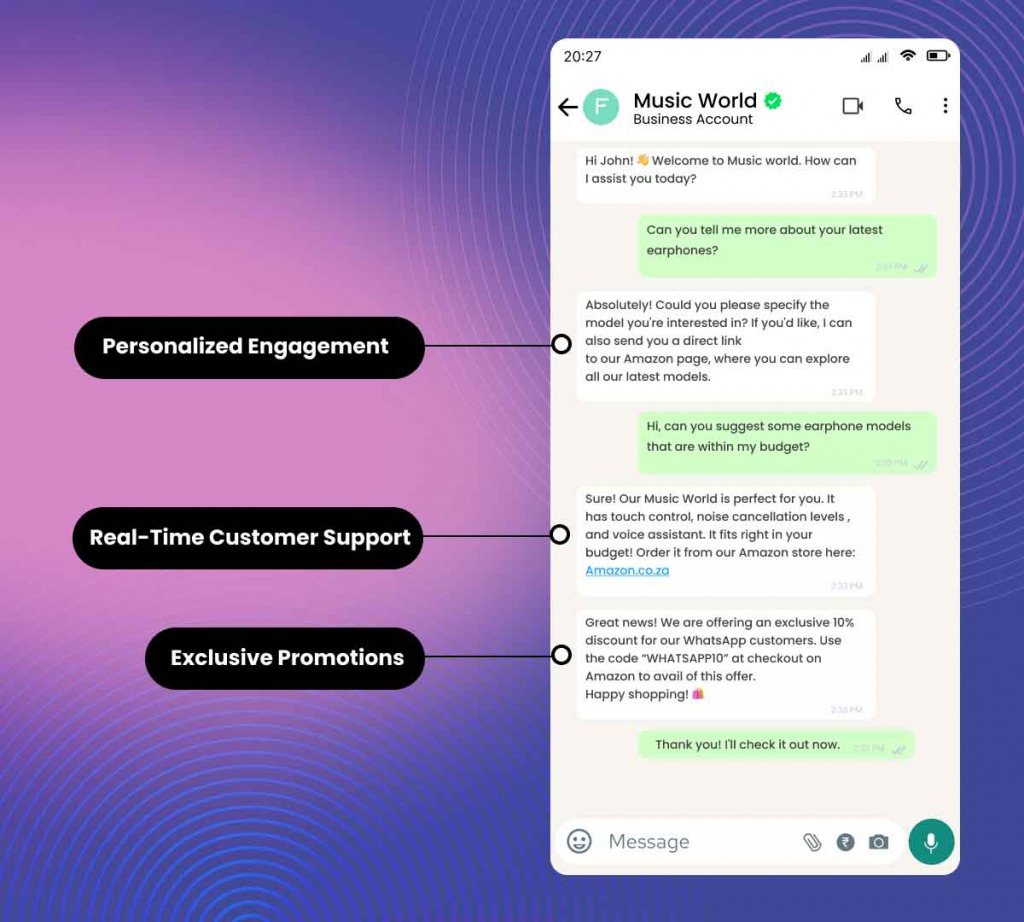
Challenge: Many brands struggle to capture and convert leads from social media.
Solution: Run click-to-WhatsApp ads on Facebook and Instagram that open a chat with your brand and guide customers to your Amazon listing.
How to implement it:
- Personalized engagement: greet users instantly with a personal message from your WhatsApp chatbot as soon as they tap the ad. Also, users don’t need to save your number, which makes it easier for them to engage.
- Real-time support: next, let your chatbot answer product questions immediately. This shortens the sales cycle because shoppers get answers while they’re still interested.
- Exclusive promotions: in addition, share special discounts or free delivery codes in the chat. Personalized offers like these create urgency and encourage shoppers to act quickly.
Gupshup’s click to WhatsApp ad solution helps you set up these journeys from ad to chat to sale.
2. Use QR Codes for Instant Access to Amazon Listings
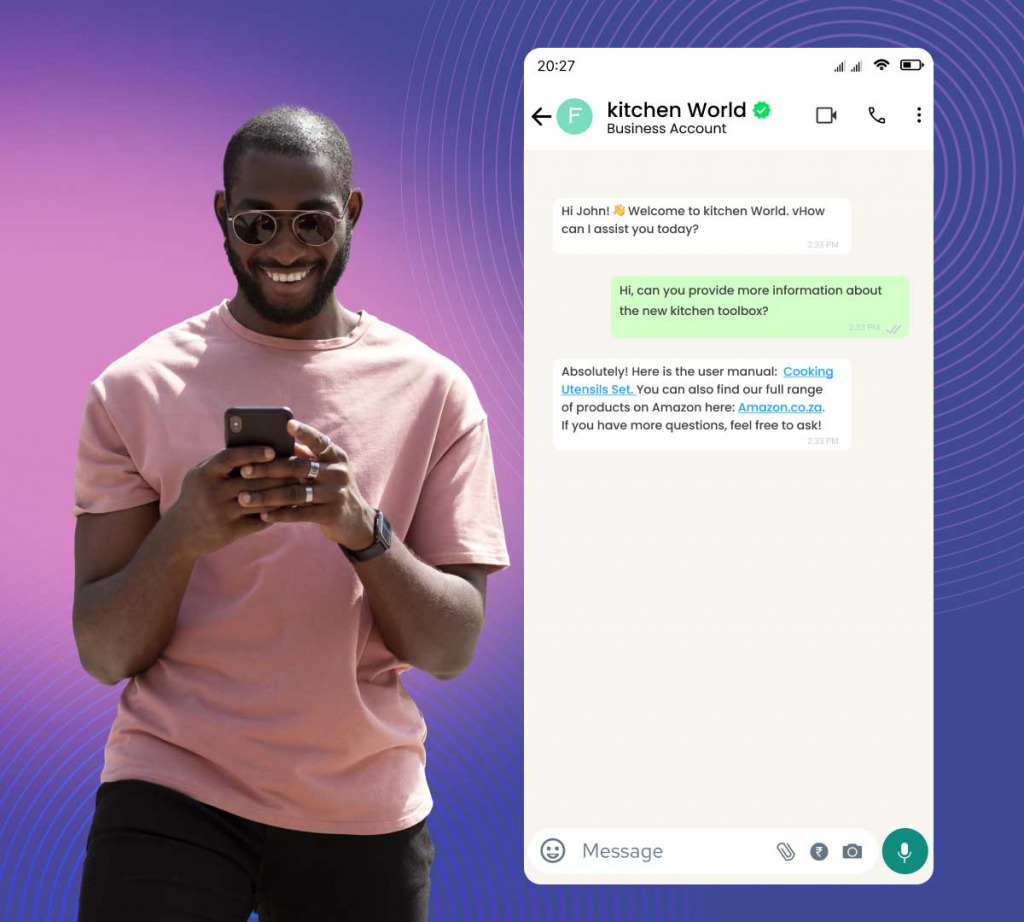
Challenge: Similarly, brands need to move offline customers to their online Amazon store smoothly.
Solution: Add QR codes to your marketing materials to connect offline and online shopping.
How to implement it:
- Confirm interest and share details: place QR codes on brochures, posters, product packaging, and in-store displays. When customers scan them, they go straight to the matching Amazon listing or a WhatsApp chat with your brand.
- Share helpful resources: link QR codes to content that helps customers decide, such as:
- FAQs that answer common questions quickly
- User manuals in digital form, so customers know how to use the product
- Product tutorials with videos or step-by-step guides that show key features
3. Offer Voice-Enabled Shopping Support
Challenge: However, text-only online experiences don’t suit every South African shopper.
Solution: offer voice-enabled support that highlights local products and brands available on Amazon.
How to implement it:
- Accept voice notes on WhatsApp: in fact, many shoppers prefer sending voice notes to typing. An AI chatbot can understand these messages and reply quickly, which makes support hands-free and more convenient.
- Give spoken order updates: let customers ask about their order by voice and get real-time updates without moving through multiple screens.
- Collect feedback by voice: in addition, voice feedback reveals customer preferences and pain points in detail. Local brands can then use these insights to improve their products and their Amazon presence.
- Offer voice-guided tutorials: short audio or video guides help customers use products correctly, which reduces returns and raises satisfaction.
4. Combine Augmented Reality With Conversational AI
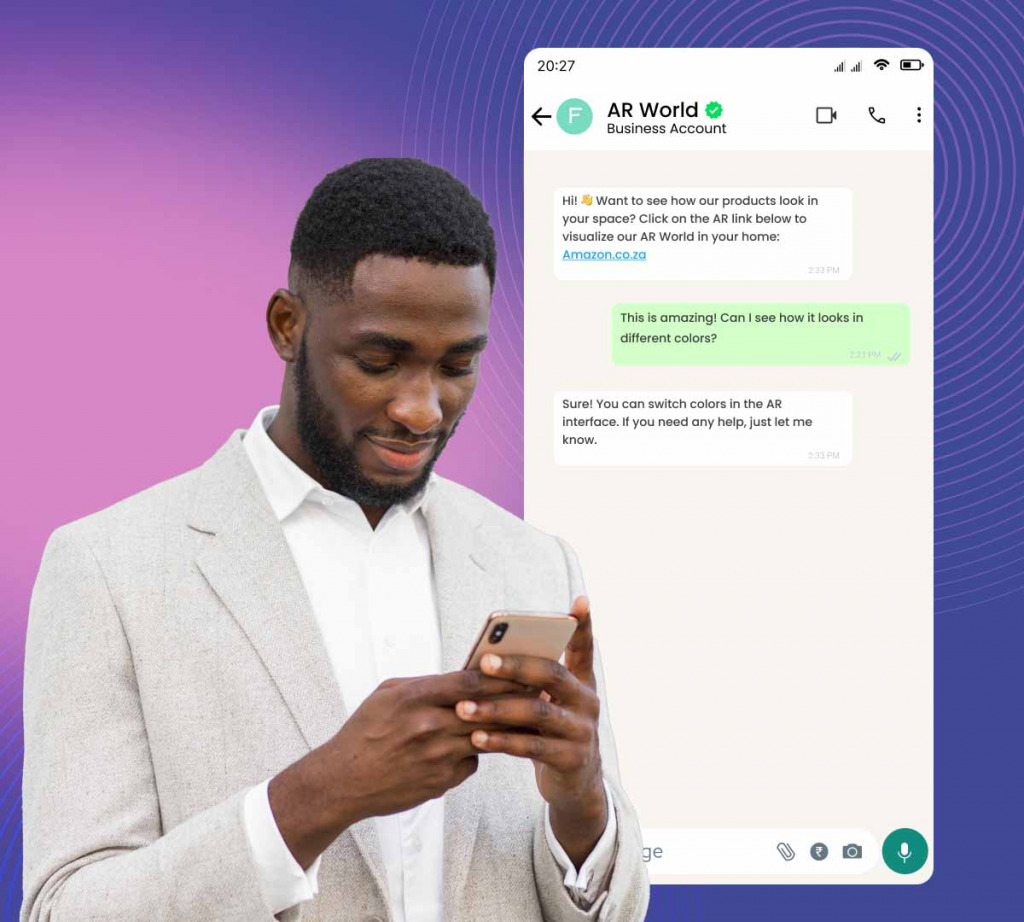
Challenge: Finally, customers often hesitate to buy products they can’t try first.
Solution: Combine augmented reality (AR) with conversational AI on WhatsApp, so customers can see products in their own space and get help instantly.
How to implement it:
- Better product visualization: share links to AR or 3D product views in the chat, and point shoppers to Amazon’s own “View in Your Room” feature where it’s available. Then, your chatbot answers questions about size, color, or fit, so customers buy with confidence.
For example, say John wants to see how a product he was browsing would look in his home. Here’s how his conversation with a WhatsApp chatbot for business might go:
Overall, conversational AI and the WhatsApp Business API give South African brands an omnichannel experience, simple integration, lower costs, and happier customers, which all lead to more sales on Amazon.
Conclusion
Amazon’s arrival in South Africa gives local brands a unique chance to grow with technologies like conversational AI and the WhatsApp Business API. Above all, these tools make operations more efficient and create personal conversations that improve the shopping experience.
As e-commerce keeps evolving, conversational AI is no longer optional for brands that want to win market share and build long-term loyalty. Gupshup’s AI agents help you automate support, personalize offers, and guide shoppers to purchase on WhatsApp and beyond.
Ready to grow your brand on Amazon with conversational AI? Book a demo with Gupshup today.
FAQ
What is conversational AI?
Conversational AI is technology that lets computers understand and respond to people in natural language, through text or voice. It powers chatbots, virtual assistants, and AI agents that answer questions, recommend products, and complete tasks on websites and messaging apps like WhatsApp. Learn more in our conversational AI FAQ.
How are businesses using conversational AI in South Africa?
South African businesses use conversational AI for customer support, sales, marketing, and order updates, mostly on WhatsApp. For example, retailers, banks, insurers, and telecom brands use chatbots to answer questions 24/7, share offers, take payments, and hand complex issues to human agents.
Can conversational AI support South African languages?
Yes, depending on the platform. Modern AI chatbots can understand and reply in English and Afrikaans, and many also support languages such as isiZulu and isiXhosa. Test the quality in each language before launch, and offer a handover to a human agent when needed.
Is the WhatsApp Business API available in South Africa?
Yes. South African businesses can use the WhatsApp Business API through a Meta Business Partner like Gupshup to automate conversations, send notifications, and run click to WhatsApp ads.
Do chatbots need to comply with POPIA in South Africa?
Yes. Any chatbot that collects personal information from South African customers must follow the Protection of Personal Information Act (POPIA). In practice, that means collecting only the data you need, getting consent, keeping data secure, and telling customers how you use it.
Can South Africans sell on Amazon?
Yes. Local businesses and individuals can sell on Amazon.co.za through its Individual or Professional selling plans. Many South Africans also earn through Amazon’s affiliate program or Kindle Direct Publishing.
Is Amazon available in South Africa?
Yes. Amazon launched its South African store, Amazon.co.za, in May 2024. Since then, customers have been able to buy from a wide range of categories, and local sellers can list their products on the marketplace.
Divya is a multifaceted writer and a journalism graduate. A wordsmith by profession and passion, she crafts compelling narratives as a seasoned content writer while also weaving poetic tapestries in her leisure moments. Whether delving into informational prose or evocative verse, her love for the written word brings finesse to every piece she pens down.
 +91-9355000192
 Login