+91-9355000192
 Login

Insurance Chatbot: Benefits, Use Cases, and How to Get Started

- How AI Is Changing the Insurance Industry
- What Is an Insurance Chatbot?
- What Does an Insurance Chatbot Conversation Look Like?
- Benefits of an Insurance Chatbot for Insurers
- 7 Use Cases for Insurance Chatbots
- How to Set Up a Custom Insurance Chatbot
- FAQ
See the power of intelligent conversations for your brand.
Insurance customers want quick quotes, simple claims, and answers at any hour. Yet many insurers still rely on call centers, long forms, and office hours, so customers wait, get frustrated, and drop off. An insurance chatbot solves this. It answers policy questions instantly, helps customers compare and buy plans, collects documents, files claims, and sends renewal reminders, all inside a chat on WhatsApp, your website, or your app, 24/7 and at a fraction of the cost of a large support team.
In this guide, we’ll answer the questions insurers ask most:
- What is an insurance chatbot?
- What role can chatbots play in the insurance industry?
- What does an insurance chatbot conversation look like?
- Is there a chatbot for health insurance? What about a life insurance chatbot?
We’ll also explore the most popular use cases and the benefits that make insurance chatbots a must-have for modern insurers.
How AI Is Changing the Insurance Industry
AI and its related technologies will have a seismic impact on all aspects of the insurance industry, from distribution to underwriting and pricing to claims. McKinsey, Insurance 2030: The impact of AI on the future of insurance
In short, AI is bringing the insurance industry into the future. Today, it affects everything from underwriting and pricing to claims processing, fraud detection, and, of course, customer conversations.
Customers are also moving to digital channels to research and buy insurance. According to Capgemini’s World Life Insurance Report, covered by Cafemutual in September 2026, 51% of consumers expect to use generative AI tools to research insurance products within three years. At the same time, one in four consumers drops out of the life insurance buying journey before finishing it.
Insurers are responding, too. In fact, a Capgemini survey from November 2025 found that customer service is the top area where insurers are deploying AI agents at scale, cited by 70% of insurers. Clearly, AI-powered insurance bots are becoming essential for modern insurance firms.
What Is an Insurance Chatbot?
An insurance chatbot is an AI-powered virtual assistant that helps insurance customers and teams through text or voice conversations. It answers policy questions, shares quotes, recommends plans, collects documents, files and tracks claims, sends renewal reminders, and hands complex cases to human agents, on channels like WhatsApp, websites, and mobile apps.
The best insurance chatbots work both for customers, for example, to provide quotes, and internally, for example, to support claims processing. This guide covers both.
For customers, an insurance chatbot extends office hours. As a result, they don’t need to call or book a meeting with an agent to get answers. Instead, the chatbot helps them find the right quote and product in minutes. For example, a health insurance chatbot can suggest suitable plans based on age, medical history, current health, and other factors.
An insurance chatbot can also connect with backend systems to create claim tickets and speed up claims management. Therefore, it costs far less than custom software or a large support team.
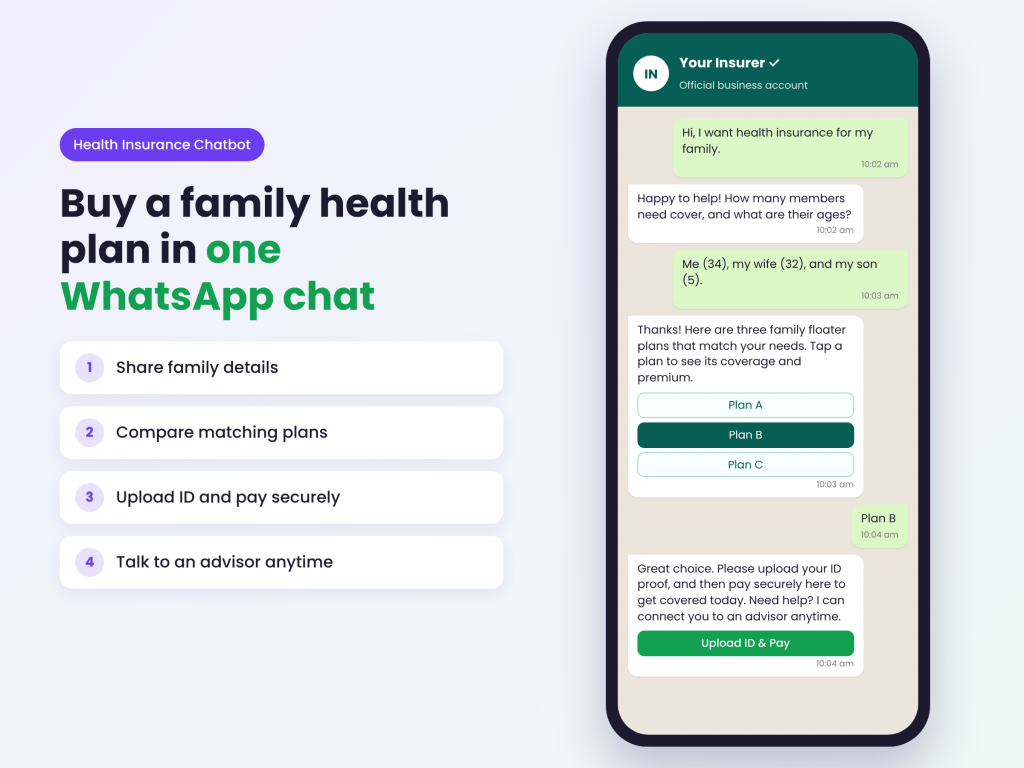
What Does an Insurance Chatbot Conversation Look Like?
Here’s a simple example of a health insurance chatbot on WhatsApp:
How Insurance Chatbots Improve Customer Experience
The only way to win and keep customers in insurance today is through great experiences. However, that has little to do with a pretty website or fancy brochures. Instead, customers care about fair premiums, self-service options, and fast, personal service. They also expect quick claims processing and smooth support without long queues, repeated transfers, or complicated paperwork. Unfortunately, websites, email, and phone calls alone can’t meet these needs.
So what can? The answer is insurance chatbots.
Unlike older digital tools, insurance bots are:
- Quick
- Available 24/7
- Intuitive
- Easy to personalize
- Easy to monetize for a high ROI
- Low-cost
- Scalable
With a WhatsApp insurance chatbot, insurers can offer services that once needed human agents and support staff. From policy information and selection to premium calculations and claims tracking, chatbots are changing how customers experience insurance. Because WhatsApp is an app people already use every day, a chatbot there helps insurers meet new customer needs and stay ahead of the competition.
Benefits of an Insurance Chatbot for Insurers
A better customer experience is a strong reason to add a life insurance chatbot or a chatbot for health insurance to your communication stack. However, insurance chatbots also deliver many other advantages that make them worth the small investment.
Scalable, 24/7 Support
Customers can use an insurance chatbot at any time to check policy details, pay premiums, make claims, update accounts, or start renewals. Since chatbots work 24/7, customers don’t have to wait or jump through hoops to get help.
Besides making life easier for policyholders, an insurance chatbot also gives insurers a scalable, low-cost support solution. For example, it handles thousands of conversations at once without adding staff.
Omnichannel Capabilities
Insurers can support customers anytime across the digital channels they already prefer, including:
- Facebook Messenger
- Company website and app
- SMS and RCS
Regardless of the channel, an insurance chatbot gives instant support that would be difficult and costly with an all-human team. Since chatbots are channel-agnostic, insurers can be wherever customers want them. Conversational AI makes all of this possible, and even easy.
Natural, Human-Like Conversations
On websites and apps, customers often have to navigate complicated menus, multiple screens, and long forms to get help. Naturally, this hurts their experience and doesn’t guarantee they’ll find the answer quickly.
Insurance chatbots fix this. Because they’re powered by natural language processing (NLP), natural language understanding (NLU), and machine learning, they can talk with customers in a natural, human-like way. They also understand context and give the best answer in a simple conversation. As a result, they resolve queries, share information, and engage customers through personal interactions.
Multilingual Support
Insurance chatbots can easily support multiple languages. In a country like India, where English isn’t the first language for most people, this is a real advantage.
A multilingual insurance chatbot speaks to users in their native language, which removes language barriers without hiring translators. This lowers operating costs and helps insurers connect with customers in the language they’re most comfortable with. In addition, the best insurance chatbots let you add a new language easily, so you don’t need to rebuild the bot to enter new regions.
End-to-End Support With Human Handover
Today, many insurers offer mobile apps. Although they’re better than voice and email, apps have limits. They work on only a few channels, customers can’t continue conversations across channels, and they rarely offer full end-to-end help.
An insurance chatbot solves these limits. It answers common queries quickly. Then, for complex cases, it hands the conversation to a human agent. This handover matters because Capgemini found that 69% of consumers still prefer a human agent when they need help solving a problem. In either case, customers enjoy the ease and convenience of a chatbot backed by real people.
7 Use Cases for Insurance Chatbots
Insurance chatbots deliver self-service, omnichannel experiences at a low cost. They’re also versatile and suit many use cases in the insurance sector.
1. Automate Lead Generation and Qualification
With a conversational AI chatbot, insurers can automate lead qualification. As a result, sales teams get all the details they need to focus on the most qualified leads and close more deals.
2. Provide Policy Information
Customers can chat with the insurance chatbot on their preferred channel to learn about:
- Policy types
- Premium amounts
- Coverage conditions
- Quotes
- Add-on options
Using dynamic logic, integrations, NLU, and NLP, the bot asks guiding questions and shares relevant information based on each answer.
3. Help With Policy Selection
Customers often struggle to choose the policy that best fits their needs, lifestyle, and goals. An insurance chatbot reduces this overwhelm and helps them decide faster.
It collects details about the customer, compares available policies, and narrows down options based on coverage needs and risk profile. Then, customers can pay their premium in the same chat for a smooth end-to-end purchase.
4. Simplify Document Submission
Document submission often slows down the buying process. An insurance chatbot makes it easy for customers to upload required documents and personal details in the chat. Consequently, applications move forward, and customers get covered without delays.
5. Automate Customer Support
Customers can have questions, doubts, or complaints at any point in their journey. However, traditional contact centers, websites, and apps rarely make support fast or simple.
An insurance chatbot gives fast, relevant answers through an easy chat interface, which reduces stress and improves the brand experience. Since the chatbot handles routine queries and FAQs, it also lowers support volume. Human agents can then focus on high-value work like closing sales, upselling, and cross-selling.
6. Send Automated Updates and Alerts
Customers often miss premium reminders sent by email or SMS. When they miss a payment, they may lose coverage and face a long process to reinstate it, which hurts their experience and loyalty.
A WhatsApp insurance chatbot can send automated alerts about renewal dates, policy status, declared bonuses, and more. Because customers check WhatsApp every day, these reminders are far harder to miss. Our guide to WhatsApp for insurance explains how insurers use it.
7. Simplify Claims Processing
Traditional, paper-based claims are slow, complicated, and frustrating. For insurers, this means unhappy customers and higher churn.
With conversational AI, insurers can make claims simple, with easy claim filing, quick document uploads, instant status checks, and regular updates.
Other Use Cases
Beyond these core use cases, an AI-powered insurance chatbot can also simplify:
- Policy cancellations
- Customer re-engagement
- Account updates
- CRM data updates
- First notice of loss (FNOL)
All in all, a versatile, low-cost insurance chatbot helps insurers reach customers on their preferred channel, personalize service, and build long-term loyalty.
How to Set Up a Custom Insurance Chatbot
The best insurance chatbots focus on the customer’s needs, behaviors, and preferences. Powered by AI, they talk with customers in a friendly, natural way. They listen, simplify tasks, give tailored advice, and save customers time and effort.
For insurers, chatbots lower costs, improve support, automate processes, and raise ROI. Gupshup offers solutions built for banking and financial services, including insurance. You can design flows quickly with our no-code Conversation Builder and launch on the WhatsApp Business API and other channels.
Want to build a customer-focused insurance chatbot? Book a demo with Gupshup today.
FAQ
How do insurance companies use chatbots?
Insurance companies use chatbots to answer policy questions, share quotes, qualify leads, sell policies, collect documents, process claims, send renewal reminders, and handle customer support. They also use them internally to help agents find information and update CRM records faster.
Can a chatbot process insurance claims?
Yes. An insurance chatbot can register a first notice of loss, collect photos and documents, create a claim ticket in backend systems, and share real-time status updates. Complex or high-value claims are then passed to a human claims adjuster.
Is there a chatbot for health and life insurance?
Yes. A health insurance chatbot helps customers compare plans, check network hospitals, file cashless or reimbursement claims, and renew policies. A life insurance chatbot shares quotes, explains coverage, collects nominee details, and reminds customers about premium payments.
Can I buy insurance through WhatsApp?
Yes. Many insurers now let customers get quotes, compare plans, upload documents, and pay premiums inside a WhatsApp chat. For example, SBI General Insurance offers a health insurance buying journey on WhatsApp powered by Gupshup.
Are insurance chatbots secure?
They can be, when built on a secure platform. A good insurance chatbot verifies the customer’s identity, encrypts data, runs on official channels like a verified WhatsApp Business account, and follows local data protection and insurance regulations.
Will chatbots replace insurance agents?
No. Chatbots handle routine questions and tasks, while human agents focus on advice, complex claims, and sensitive conversations. Since most customers still want a human for problem-solving, the best approach combines a chatbot with smooth handover to agents.