+91-9355000192
 Login

Conversational AI for Banks in South Africa: Use Cases and Benefits
- What Is Conversational AI for Banks?
- The State of Customer Experience in South African Banking
- How AI Agents Give Banking a Personal Touch
- Why Conversational AI for Banks Works Best on WhatsApp
- Benefits of Conversational AI for Banks in South Africa
- Use Cases of Conversational AI for Banks
- Conclusion
See the power of intelligent conversations for your brand.

Long branch queues, endless phone menus, and slow email replies still frustrate many bank customers. For example, imagine a professional in Johannesburg who urgently needs help with her account. Instead of waiting on hold, she sends a quick WhatsApp message, and an AI agent resolves her issue in minutes. Fortunately, that’s what conversational AI for banks makes possible. Today, banks use AI agents and chatbots on WhatsApp, apps, and websites to answer questions, share balances and transaction alerts, process loan requests, flag fraud, and support customers 24/7, while human agents handle complex cases.
South Africa is ready for this shift. According to DataReportal, the country has 51.7 million internet users, or 79.6% of the population, and 127 million mobile connections. In fact, local banks are already moving to chat. For instance, Absa launched ChatBanking on WhatsApp in 2018 and later added ChatWallet, which lets users send payments, buy airtime, and withdraw cash through WhatsApp.
In this blog, you’ll learn how conversational AI for banks in South Africa improves customer experience, the key use cases, and how Gupshup helps financial institutions get started.
What Is Conversational AI for Banks?
Conversational AI for banks is the use of AI agents and chatbots that understand natural language to serve customers through chat or voice. In practice, banks use it to answer account questions, send balance and transaction alerts, process loan and card requests, detect fraud, share payment reminders, and hand complex issues to human agents on WhatsApp, apps, and websites, 24/7.
The State of Customer Experience in South African Banking
In general, South Africans are embracing digital financial services. However, banks still face a few challenges:
- Data privacy concerns: customers are more careful about how banks use and share their personal data. Therefore, under the Protection of Personal Information Act (POPIA), banks must protect that data and use it responsibly.
- Service delays: meanwhile, outdated systems and overloaded call centers lead to long waits for support and transaction updates.
- Generic service: in addition, customers feel ignored when they receive one-size-fits-all offers that don’t match their needs.
To solve these problems, banks and financial services companies are turning to conversational AI and the WhatsApp Business API. Here’s how it helps:
- Stronger data security: WhatsApp encrypts messages in transit, and a trusted provider adds access controls and compliance safeguards. Learn more about tackling conversational AI security risks.
- Faster service: AI agents reply instantly and handle routine requests. As a result, human agents can focus on complex issues.
- Personalized service: similarly, AI agents use customer history to share relevant offers, alerts, and recommendations.
How AI Agents Give Banking a Personal Touch
AI agents make banking easier in several ways:
- 24/7 availability: first, customers get help at any hour, including weekends and public holidays.
- Instant answers: AI agents answer simple questions right away. If a query is complex, they connect the customer to a human agent with the full conversation history.
- Personalized interactions: AI agents use customer data, with consent, to tailor replies and offers. As a result, satisfaction and loyalty grow.
- Human-like conversations: conversational AI understands intent and context, so chats feel natural instead of scripted.
In addition, Gupshup offers ready integrations with CRMs and core systems, so AI agents can pull the right account details in real time.
Why Conversational AI for Banks Works Best on WhatsApp
After all, customers already trust and use WhatsApp every day. According to Meta’s State of Business Messaging report, based on a 2025 Kantar survey across 22 markets, 74.6% of consumers trust businesses more when they can message them. So, South African banks are adding AI-powered WhatsApp banking to their customer engagement strategies. As a result, customers can check balances, get transaction alerts, and reach support in an app they already know.
To support this, Gupshup’s WhatsApp Business API gives banks the tools to build and run these AI agents at scale. That means wait times drop, and customers get fast, reliable service.
Benefits of Conversational AI for Banks in South Africa
Here’s what banks gain:
- Better engagement: first, banks chat with customers directly on the app they use most.
- Personalized messages: banks send tailored alerts, offers, and reminders based on customer history.
- Efficient service: AI agents handle common questions and tasks 24/7, which reduces pressure on call centers.
- Lower costs: as a result, self-service and automation cut the cost of routine interactions.
- Secure, compliant messaging: encrypted messaging, verified business accounts, and strong data controls help banks meet POPIA requirements.
Use Cases of Conversational AI for Banks
Here are the most common ways banks and insurers use conversational AI on WhatsApp.
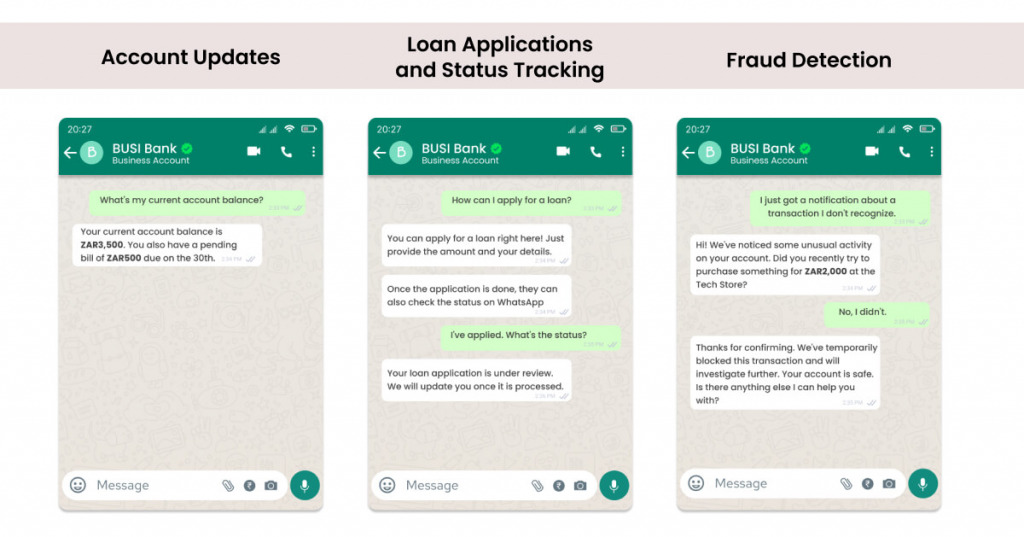
Account Updates
First, customers get real-time balance, transaction, and bill updates on WhatsApp instead of SMS or email.
Loan Applications and Status Tracking
Next, customers check loan eligibility, apply, upload documents, and track their application status in the chat.
Fraud Detection and Alerts
AI agents monitor for unusual activity and instantly alert customers in the chat. Then, customers can confirm or report the transaction in one tap. Learn how conversational AI chatbots help banks prevent fraud.
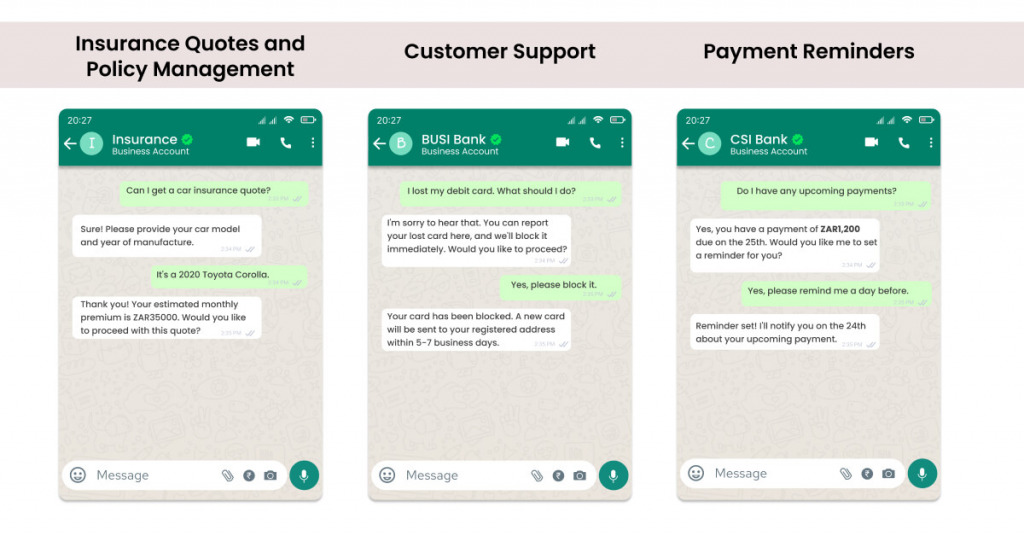
Insurance Quotes and Policy Management
Similarly, insurers share instant quotes, policy details, renewal reminders, and claim updates on WhatsApp, which makes the process faster.
Customer Support
In addition, AI agents answer FAQs, block lost cards, and resolve common issues 24/7, while passing complex cases to human agents.
Payment Reminders
Finally, automated reminders help customers pay on time and avoid late fees.
Conclusion
Conversational AI for banks is changing how South African financial institutions serve customers. In short, with AI agents on WhatsApp, banks can offer 24/7 support, instant updates, personalized service, and faster fraud response, all in an app customers already use.
Gupshup helps banks and insurers in South Africa launch secure, AI-powered WhatsApp experiences that improve customer satisfaction and efficiency. Ready to transform your banking customer experience? Book a demo today.
FAQs
What is conversational AI for banks?
Conversational AI for banks uses AI agents and chatbots that understand natural language to serve customers through chat or voice. It answers account questions, sends transaction alerts, processes loan and card requests, detects fraud, and offers 24/7 support on WhatsApp, apps, and websites.
How do banks in South Africa use conversational AI?
Banks in South Africa use conversational AI on WhatsApp and apps for balance checks, transaction alerts, payments, airtime purchases, loan applications, fraud alerts, card blocking, and customer support.
How does AI improve customer experience in banking?
AI provides 24/7 support, instant answers, personalized offers, real-time alerts, and faster issue resolution. In addition, it hands complex cases to human agents with full context, so customers don’t have to repeat themselves.
Is WhatsApp banking safe in South Africa?
Yes, when you use your bank’s verified official WhatsApp account. However, never share your PIN, password, or OTP in any chat, and ignore messages from unknown numbers asking you to click links.
How is AI used in BFSI?
AI in banking, financial services, and insurance (BFSI) is used for customer support, fraud detection, risk assessment, credit scoring, personalized offers, claims processing, and automating routine tasks.
What are the benefits of conversational AI for financial services?
Conversational AI lowers service costs, speeds up responses, improves customer engagement, personalizes advice, and helps banks serve more customers without growing their call centers.

A passionate writer with a penchant for being a wordsmith, I turn complex cloud technology into compelling stories. Drawing from 15+ years of experience crafting content for SaaS and CPaaS brands, I help tech companies connect with their audiences by bridging the gap between technical features and business impact. Off the clock, I seek inspiration between mountain trails and ocean waves, where my best ideas often find me.