+91-9355000192
 Login

Conversational AI for Customer Service: Benefits, Tips, and How to Implement It
- What Is Conversational AI for Customer Service?
- Why Move Away From Traditional Customer Service?
- How Conversational AI Is Transforming Customer Service
- Benefits of Conversational AI for Customer Service
- Tips to Improve Conversational AI for Customer Service
- How to Implement Conversational AI for Customer Service
- How Gupshup Helps You Deliver Conversational Customer Service
- Conclusion
- FAQ
See the power of intelligent conversations for your brand.

Imagine you’re browsing an online store for the perfect gift, and you have a question about shipping times. Instead of searching the site or waiting on hold, a friendly assistant pops up and answers in seconds, so you keep shopping without interruption. That’s the power of conversational AI for customer service. It uses AI chatbots and AI agents to answer customers instantly, in natural language, on the channels they already use, like WhatsApp, websites, and apps. As a result, businesses resolve issues faster, cut support costs, and keep customers happier.
Meanwhile, today’s customers expect fast, accurate, and personal service. Traditional support models often struggle to keep up, while AI-driven tools deliver speed and consistency at scale. In this article, you’ll learn what conversational AI for customer service is, its key benefits, practical tips, and how to implement it step by step.
What Is Conversational AI for Customer Service?
Conversational AI for customer service is the use of AI chatbots, virtual assistants, and AI agents to talk with customers in natural language over chat or voice. Powered by natural language processing, machine learning, and large language models, it understands what customers mean, answers questions, completes tasks like order tracking or refunds, and hands complex issues to human agents.
This approach is often called conversational customer service. Unlike traditional customer service, which relies only on human agents, it combines AI and people to deliver real-time support across web, mobile, and messaging apps. In addition, customers don’t have to repeat themselves because the conversation keeps its context. Learn more in our conversational AI guide.
Chatbots vs Conversational AI
| Feature | Rule-based chatbot | Conversational AI |
|---|---|---|
| Understanding | Keywords and fixed menus | Natural language and intent |
| Responses | Scripted | Context-aware and personalized |
| Learning | Doesn’t improve on its own | Improves with data and training |
| Tasks | Simple FAQs | FAQs, transactions, and multi-step workflows |
| Handover | Basic or none | Smooth handover to human agents with full context |
Why Move Away From Traditional Customer Service?
As customer expectations keep rising, traditional customer service often falls short. Long wait times, inconsistent quality, and limited personalization frustrate customers and push them to competitors. Conversational AI for customer service solves these problems by providing instant, consistent, personalized answers around the clock.
The Rise of Messaging Apps in Customer Service
Have you noticed how messaging apps have become part of daily life? WhatsApp alone has more than 3 billion monthly users, according to TechCrunch. Naturally, customers now want to reach businesses the same way they chat with friends.
The data confirms it. Meta’s State of Business Messaging report, based on a 2025 Kantar survey of more than 11,000 people in 22 markets, found that:
- 73.3% of consumers prefer messaging when contacting a business.
- 72.4% are more likely to buy from a brand that offers messaging.
- 67.7% find an AI chatbot response helpful.
Therefore, businesses that pair messaging apps with conversational AI can serve customers faster and more personally.
How Conversational AI Is Transforming Customer Service
Conversational AI tools give customers instant, personal answers at any hour. Plus, they keep getting smarter. In fact, Gartner predicts that by 2029, agentic AI will autonomously resolve 80% of common customer service issues without human intervention.
Real brands are also already seeing results. For example, South Africa’s Capitec Bank runs conversational banking on WhatsApp. According to Meta’s Capitec success story, 50% of all Capitec customer conversations happened on WhatsApp between April and October 2025, with a 77% first-contact resolution rate.
Benefits of Conversational AI for Customer Service
Here are the key benefits to help you make an informed decision.
1. Simplified Customer Journey
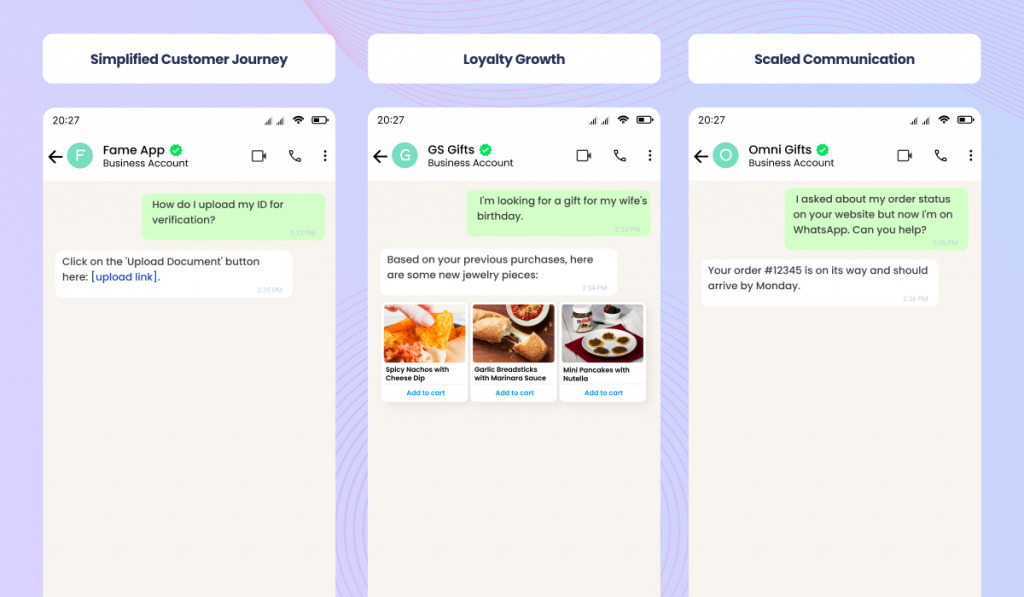
Conversational AI speeds up processes like onboarding, account setup, verification, and order resolution. Chat channels support photos, videos, documents, and buttons, so customers can, for example, upload a document without navigating complex menus. Because it runs on channels customers already use, such as the WhatsApp Business API, they don’t need to download new apps.
2. Stronger Loyalty
Personalized conversations based on behavior, purchase history, and preferences make customers feel understood. For instance, a recommendation based on past purchases boosts satisfaction and encourages repeat business.
3. Consistent Conversations Across Channels
Customers dislike repeating themselves. Fortunately, a conversational platform keeps the context as customers move between channels, so the conversation continues smoothly wherever they reach out.
4. Unified Internal Operations
Conversational AI brings all channels into one platform. As a result, marketers, agents, and chatbots work together, and the AI can access customer data in real time to give personal answers while reducing manual work.
5. Better Customer Service
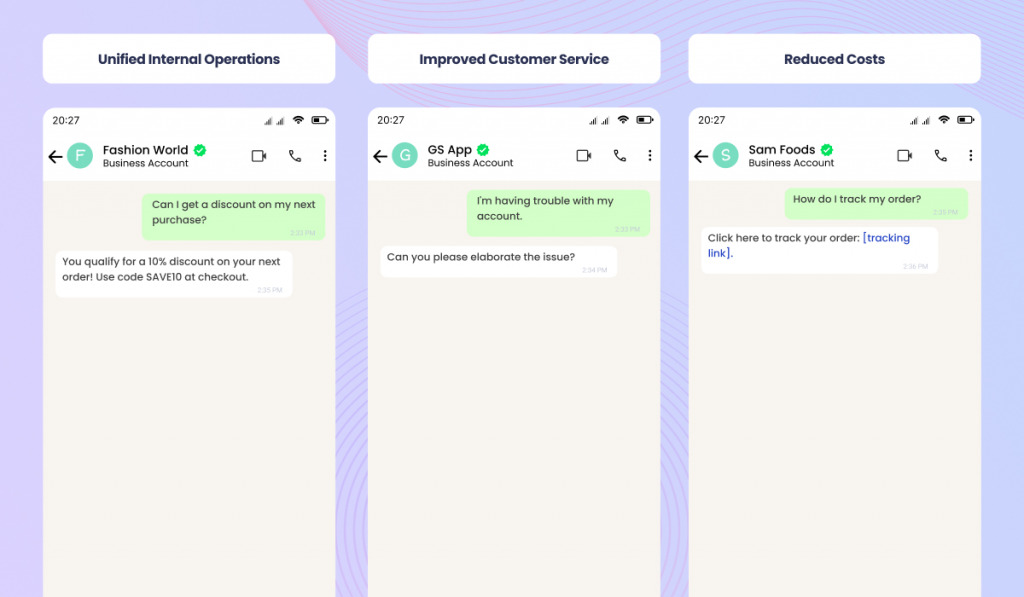
Customers get help on their preferred channels without hold times or complex phone menus. Also, AI remembers past interactions, so it resolves issues faster and in context.
6. Lower Costs
By automating routine tasks and offering self-service options, conversational AI reduces the number of repetitive queries agents handle. Consequently, businesses lower operating costs and work more efficiently.
7. Faster Response Times
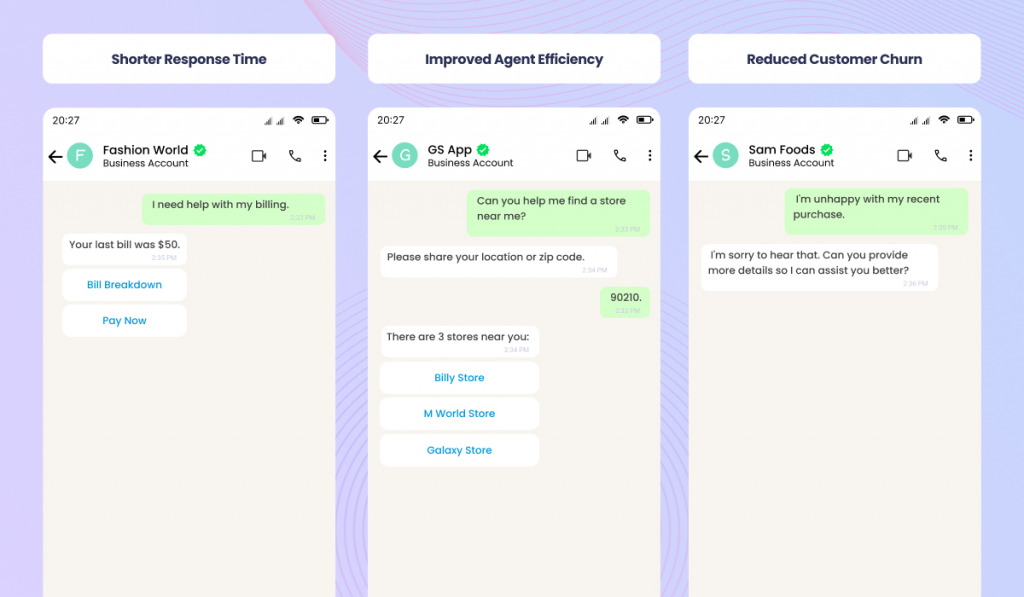
Customers expect instant answers. That’s why AI chatbots and virtual assistants respond immediately, 24/7, which meets expectations and builds trust.
8. Higher Agent Efficiency
When AI handles repetitive questions, human agents can focus on complex, high-value conversations. In addition, tools like Agent Assist suggest answers in real time, which helps agents resolve issues faster.
9. Lower Customer Churn
Ultimately, fast, personal, and effective support reduces frustration. As a result, fewer customers switch to competitors.
Tips to Improve Conversational AI for Customer Service
Here are five practical tips to get the most from your conversational AI:
- Use AI agents for routine queries: let AI agents handle common questions, give instant answers, and offer 24/7 support.
- Track key metrics: monitor response time, resolution time, containment rate, and customer satisfaction to keep improving.
- Analyze conversations: review customer interactions to spot common issues, predict needs, and fix problems before they grow.
- Support your agents: give agents AI tools that suggest replies and surface customer information during conversations.
- Keep a human touch: design AI conversations to feel natural, and let human agents handle complex or emotional issues. This matters because a 2026 Gartner survey found that 87% of customers say companies using generative AI for service must offer access to a human agent.
How to Implement Conversational AI for Customer Service
Implementing conversational AI can boost engagement and retention. However, success depends on careful planning. So, here’s how to do it step by step.
Step 1: Align Key Stakeholders
- First, bring together operations, product teams, subject matter experts, and support agents.
- Next, identify the most common customer queries and agree on how to handle them.
- Then, train both agents and AI on these scenarios, so everyone follows the same approach.
Step 2: Choose the Right Tech Stack
- To begin with, select an easy-to-use platform with strong natural language understanding.
- In addition, make sure it supports consistent cross-channel conversations and fast responses.
Step 3: Structure and Label Your Data
- First of all, organize your FAQs, help articles, and past conversations.
- After that, categorize and label this data to train your AI effectively.
- Finally, connect the AI to your workflows and business systems.
Step 4: Map Customer Journeys
- Start by identifying every touchpoint where customers interact with your brand.
- Then, use journey maps to give your AI and agents the context they need.
Step 5: Personalize Customer Conversations
- For example, use customer profiles, transaction history, and sentiment analysis.
- As a result, you can tailor responses so they’re relevant and personal.
Step 6: Train and Improve Continuously
- Above all, monitor and update your AI regularly.
- Also, check for bias, integration issues, and security risks.
- Finally, retrain with new data to keep answers accurate over time.
How Gupshup Helps You Deliver Conversational Customer Service
Gupshup’s Conversation Cloud helps businesses deliver conversational AI for customer service across channels like WhatsApp, Instagram, RCS, and SMS. With AI agents, no-code journey building, and analytics, you can automate routine tasks, personalize two-way conversations, and hand complex issues to live agents with full context.
As a result, your team resolves issues faster, customers get answers on the channels they prefer, and your business builds stronger relationships.
Conclusion
Conversational AI for customer service is now essential for businesses that want to meet rising expectations. It improves customer satisfaction, simplifies internal operations, and builds stronger relationships by delivering immediate, personal, and consistent support across digital channels.
By following the tips and steps above, you can stay ahead and build a support experience customers love. Ready to get started? Book a demo with Gupshup today.
FAQ
What is conversational AI in customer service?
Conversational AI in customer service uses AI chatbots, virtual assistants, and AI agents to understand customer questions in natural language and respond instantly over chat or voice. It answers FAQs, completes tasks like order tracking, and hands complex issues to human agents.
What is the difference between a chatbot and conversational AI?
A basic chatbot follows fixed rules and keywords, so it only handles simple, scripted questions. Conversational AI understands intent and context, learns over time, handles multi-step tasks, and personalizes replies, which makes conversations feel more natural.
Will conversational AI replace customer service agents?
No. Conversational AI handles routine, high-volume questions, while human agents focus on complex, sensitive, or emotional issues. Most customers still want access to a human, so the best results come from combining AI with smooth handover to agents.
What are examples of conversational AI in customer service?
Common examples include WhatsApp chatbots that track orders, banking assistants that share balances and fraud alerts, airline bots that rebook flights, and website assistants that answer product questions and process returns.
How do you measure the success of conversational AI for customer service?
Track first response time, resolution time, containment or self-service rate, first-contact resolution, customer satisfaction (CSAT), and cost per conversation. Together, these metrics show whether your AI is improving speed, quality, and efficiency.
Which channels support conversational AI for customer service?
Conversational AI works on websites, mobile apps, WhatsApp, Instagram, Facebook Messenger, RCS, SMS, and voice. The best approach is to deploy it on the channels your customers already prefer.

Manna, an IT graduate with 8 years of content writing experience, is passionate about words and their power to convey ideas. When she's not crafting content, she is immersed in books, enjoys cricket matches and the rhythm of music, relishes beach strolls, and cherishes quality time with her furry friend. Her love for languages extends beyond writing, as she is a knower of Hindi, English, Urdu, and Spanish.