+91-9355000192
 Login
Login
Making the Most of the 24-Hour Service Window in WhatsApp
See the power of intelligent conversations for your brand.

If you’re using WhatsApp to connect with your customers, chances are you’re doing it in one of three ways:
1. Promotional Messages
You’re running marketing campaigns to drive awareness, engagement, and sales — either as manual broadcasts to specific customer segments (a flash sale to past buyers, for instance) or as automated campaigns triggered by user behavior on your website, app, CRM, or WhatsApp itself (like cart abandonment nudges or re-engagement messages).
2. Utility Messages
You’re sending transactional updates — order confirmations, shipping alerts, appointment reminders, payment receipts. Not glamorous, but incredibly high-value because your customers actually read them.
3. Responding to Customers Who Reach Out
Sometimes your customers come to you — with questions, complaints, or just curiosity. These inbound conversations are some of your most valuable touchpoints.
Now here’s the question: are you making the most of all three?
The 24-Hour Window: The Rule You’re Probably Under-using
WhatsApp’s 24-hour service window works like this: every time a customer sends you a message, a window opens that lets you reply with free-form messages(AI or non-AI bot messages) and utility messages — completely free, for the next 24 hours. Allowing you to converse, engage, sell and support customers without bearing additional messaging costs.
Most businesses know about this window in the context of customer service — you can reply freely when someone reaches out. But here’s what most are missing: you can engineer your own campaigns to trigger this window.
And that changes everything.
The Shift in Thinking: From Notifications to Invitations
What if every message you sent — whether promotional or transactional — was designed to invite a reply?
By adding reply buttons, quick replies, or simple conversational CTAs to your outbound messages, you give customers an easy reason to respond. And the moment they do, that 24-hour window opens — giving you a free, unrestricted channel to take the conversation wherever it needs to go.
Here’s what that looks like in practice:
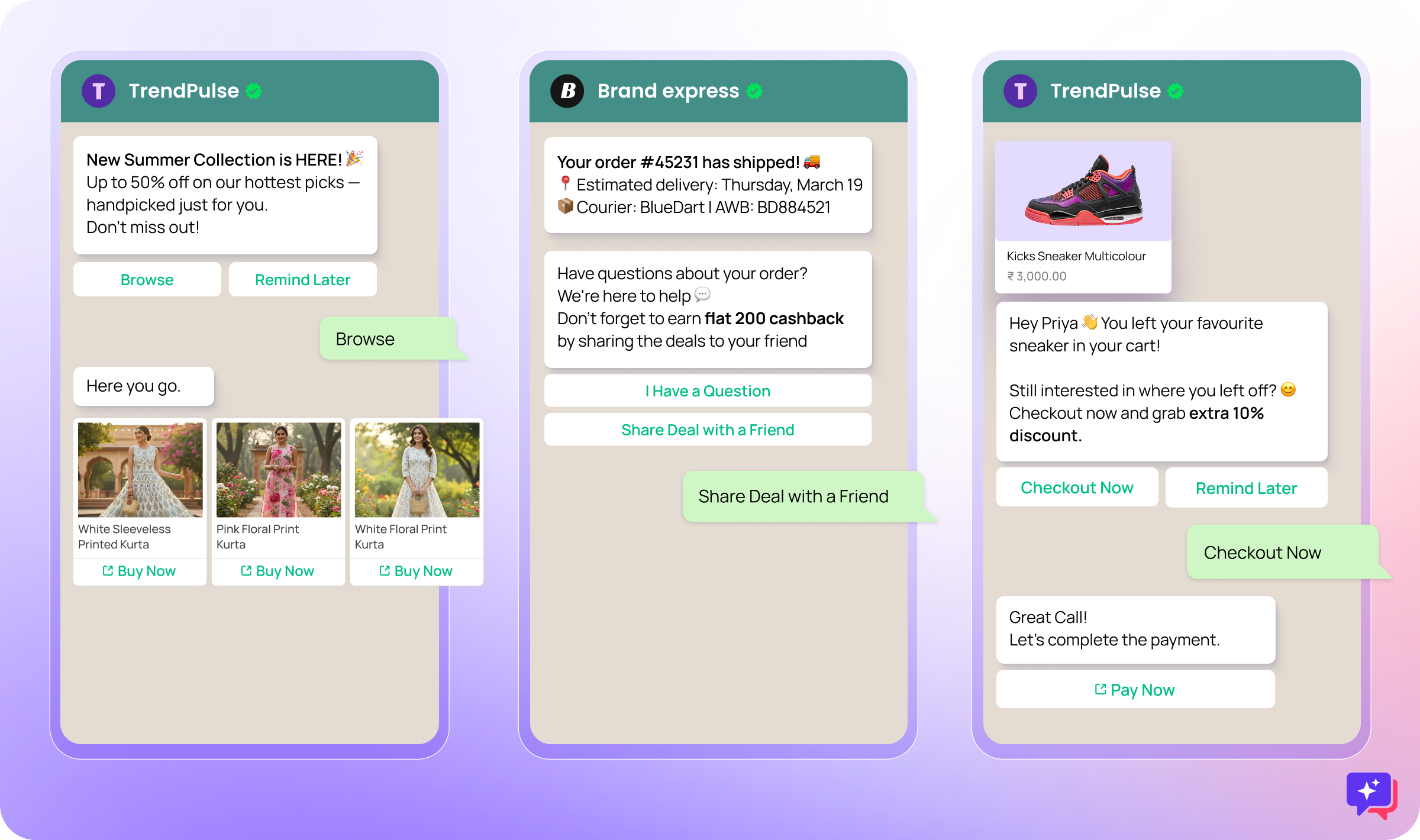
- Your promotional campaign about a new collection ends with “Tap to explore your style 👇” — customer taps, window opens, a bot walks them through a personalized lookbook and straight to checkout.
- Your shipping update says “Share deal to a friend” — customer replies, window opens, a lead is generated and customer is informed about the status of the referral program.
- Your reactivation message asks “Still interested in where you left off?” — customer responds, window opens, a guided journey brings them back and drives conversion.
Every message becomes a conversation starter. Every reply becomes an opportunity.
The Cost Advantage You Can’t Ignore
Here’s where this strategy gets really compelling.
When you send a marketing template to re-engage customers outside the service window, you’re charged for it. Those costs add up fast at scale.
But inside the 24-hour window:
- ✅ Free-form conversational messages are free
- ✅ Utility template messages are free
- ✅ Bot and AI agent interactions are free
- ❌ Only marketing templates sent during the the window cost you
So once you get a customer to reply — through a well-crafted interactive campaign — you can use chatbots and AI agents to carry the entire conversation forward: answering questions, making personalized recommendations, upselling, cross-selling, resolving issues — all at no additional messaging cost.
The strategy: spend smartly on the message that opens the window, and maximize everything that happens inside it.
What This Looks Like End-to-End: Real Journey Examples
Example 1: E-Commerce
Promo Campaign → Guided Shopping
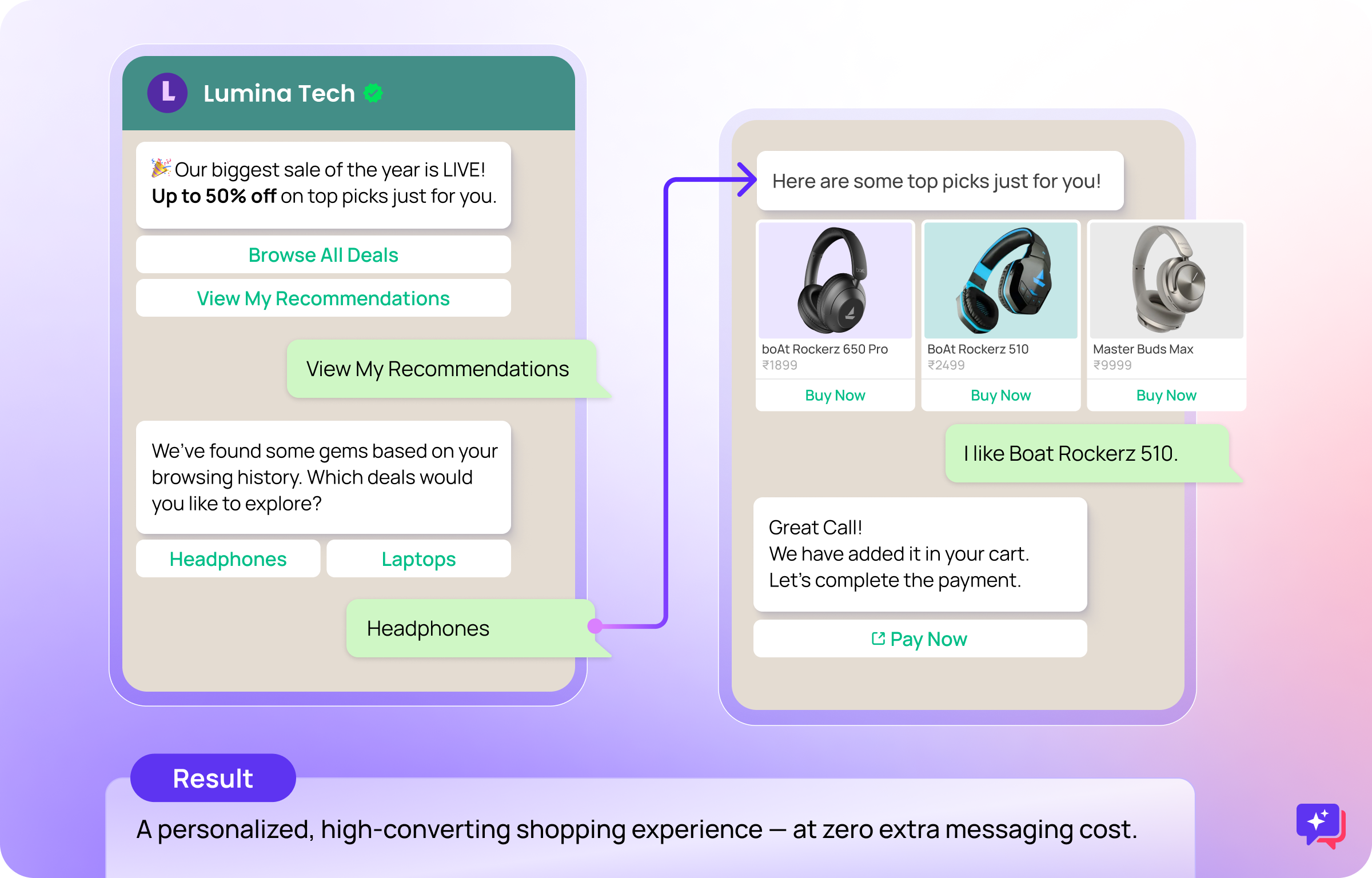
You send: A promotional broadcast about your sale.
“🎉 Our biggest sale of the year is LIVE! Up to 50% off on top picks just for you.” [Browse Deals] [View My Recommendations]
Customer taps “View My Recommendations” → Window opens.
The journey:
- Customer replies to check recommendation
- AI Agent / Bot enquires the category customer is looking to explore
- AI Agent / Bot shares top selling items
- AI Agent / Bot helps customer add product to cart
- Customer makes purchase within chat interface
Result: A personalized, high-converting shopping experience — at zero extra messaging cost.
Example 2: Retail
Order Update → Post-Purchase Engagement
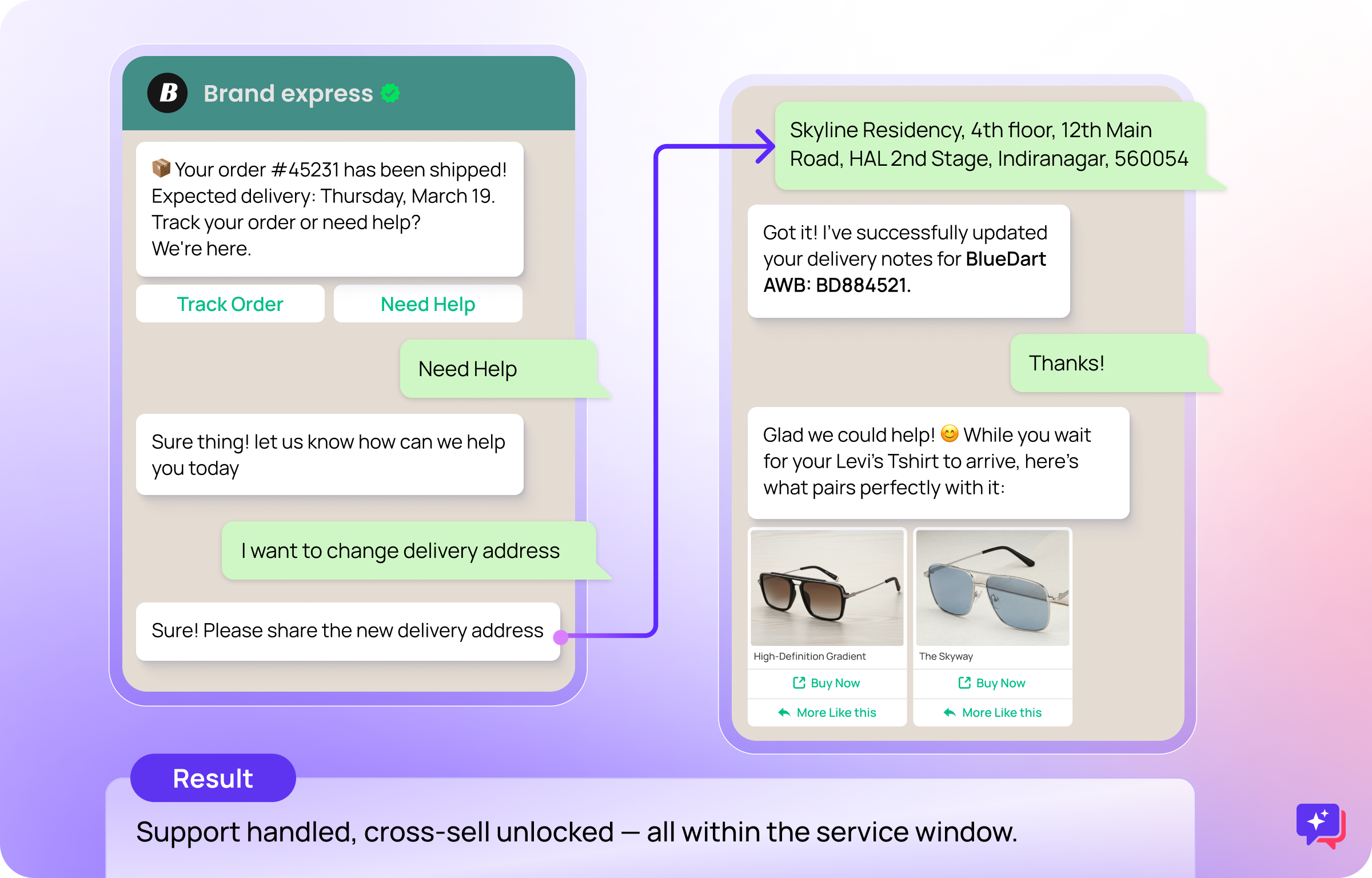
You send: An automated utility message when the order ships.
“📦 Your order #45231 has been shipped! Expected delivery: Thursday, March 19. Track your order or need help? We’re here.” [Track Order] [Need Help]
Customer taps “Need Help” → Window opens.
The journey:
- Customer replies that saying they need help
- AI Agent / Bot investigates the issue
- AI Agent / Bot resolves the issue or escalates it to a Human Agent
- Customer receives post-resolution confirmation message: “Glad we could help! 😊 While you wait for your order, here’s what pairs well with your purchase 👇”
- Customer shares feedback of the experience
- AI Agent shares an offer / products the customer might be interested in
Result: Support handled, cross-sell unlocked — all within the service window.
Example 3: BFSI
Triggered Re-engagement → Application Completion
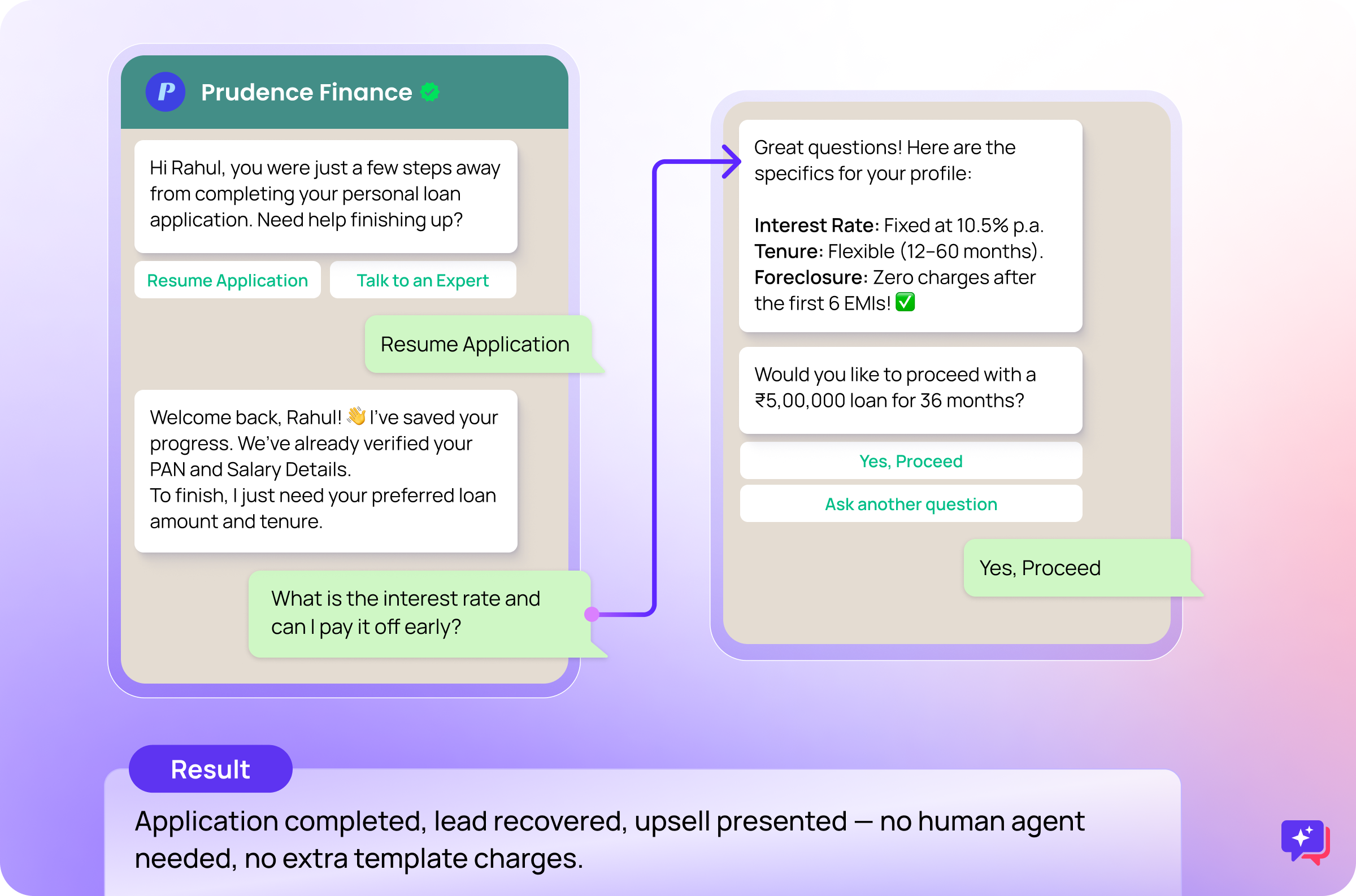
You send: A triggered message to a customer who dropped off mid-application.
“Hi Rahul, you were just a few steps away from completing your personal loan application. Need help finishing up?” [Resume Application] [Talk to an Expert]
Customer taps “Resume Application” → Window opens.
The journey:
- Bot picks up from where they left off — known data is pre-filled
- Customer is guided through remaining steps with clear prompts
- FAQs on interest rates, tenure, and EMIs are handled instantly
- On completion: confirmation sent + a complementary insurance product introduced
Result: Application completed, lead recovered, upsell presented — no human agent needed, no extra template charges.
🤫 The Secret Trick: Use Utility Messages as Your Trojan Horse
Here’s a cost-saving hack that most brands haven’t caught on to yet.
Did you know that utility messages cost significantly less than marketing templates on WhatsApp? That shipping update, that payment confirmation, that appointment reminder — each one is a fraction of what you’d pay to send a promotional broadcast.
So here’s the trick: use utility messages to start the conversation, and let the 24-hour window do the selling for you.
Think about it. Your customer just received an order confirmation. They’re in a great headspace — they just bought something they wanted. That utility message already has their attention. Now, add a simple reply button:
“✅ Your order #45231 is confirmed! We’ll notify you when it ships. In the meantime, do let us know how was your shopping experience” [Loved it] [Could have been Better]
Customer taps either button → Window opens.
Now, within that free conversation window, your bot can organically weave in:
- A “you might also like” recommendation based on what they just bought
- An exclusive loyalty offer or early access to an upcoming sale
- A nudge to complete a related purchase they browsed but didn’t buy
No marketing template. No marketing template charges. Just a natural, flowing conversation that started with a perfectly legitimate transactional message.
The math is simple: Pay utility message rates to open the door, then upsell and cross-sell for free inside the window. Compared to launching a full marketing campaign for the same outcome, the cost difference is substantial — and the experience feels far less intrusive to your customer.
A word of balance: This works best when the conversation feels natural. Lead with genuine value — resolve their query, confirm their order, answer their question — before introducing any offers. Customers appreciate relevance. If the upsell fits the context, it won’t feel like an ad. It’ll feel like good service.
How Gupshup Conversation Cloud Makes This Possible
Pulling this strategy off at scale isn’t just about having WhatsApp access — it’s about having the right platform to connect your campaigns, automation, AI, and analytics into one seamless flow.
That’s exactly what Gupshup Conversation Cloud is built for. With it, you can:
- 🎯 Make every campaign interactive — design promotional and utility messages with reply buttons and CTAs that are built to start conversations
- 🤖 Build AI-powered journeys — deploy bots and AI agents that guide customers toward real business outcomes once the window opens
- 🔗 Connect your entire stack — integrate with your CRM, e-commerce platform, or app to trigger campaigns on the right behavior and sync data back in real time
- 📊 Measure what matters — track window open rates, engagement depth, conversions, and cost savings in one place
- 💬 Stay human when it counts — hand off to a live agent seamlessly whenever the conversation needs a personal touch
The Bottom Line
WhatsApp is no longer just a messaging channel. It’s a full-stack engagement platform — but only if you use it that way.
The shift is simple: stop sending messages that end in a full stop, and start sending messages that end in a question. Make your campaigns interactive. Invite your customers in. And when they step through the door, have a journey ready that engages, assists, and converts — all within the 24-hour window, and all without the extra cost.
Every message is a door. Make sure yours is open.
Want to see how Gupshup Conversation Cloud can transform your WhatsApp strategy? Request a Demo or speak to one of our experts today.

Product marketer who is helping brands not just connect with their customers but converse with them - to build a long, meaningful relationship that converts into lasting business impact.