+91-9355000192
 Login

Conversational AI Chatbot: Boosting E-commerce Sales This Festive Season

- What Is Conversational AI for E-commerce?
- Why This Festive Season Is Different
- 3 Ways to Use Conversational AI for E-commerce Success This Festive Season
- From Click to Cart: How Conversational AI Keeps Up With Shoppers
- How to Prepare for Future Festive Seasons With Conversational AI
- Conclusion
See the power of intelligent conversations for your brand.

The festive season brings huge traffic, but also value-conscious shoppers who compare deals across apps, abandon carts in seconds, and expect instant answers. When support teams can’t keep up, sales slip to competitors. Conversational AI for e-commerce solves this. It uses AI agents on WhatsApp, websites, and messaging apps to answer questions, recommend products, recover abandoned carts, and complete purchases in real time, 24/7, even during the busiest sale days.
The opportunity is big. Adobe forecasts that U.S. online holiday sales will reach $275.1 billion in 2026, up 6.7% year over year, with traffic from AI tools to retail sites expected to jump 130%. At the same time, shoppers want personal help. According to McKinsey, 71% of consumers expect personalized interactions, and 76% get frustrated when they don’t get them.
In this blog, you’ll learn what conversational AI for e-commerce is, why the festive season needs it, and how to use it to turn browsers into buyers.
What Is Conversational AI for E-commerce?
Conversational AI for e-commerce is the use of AI agents and chatbots that understand natural language to talk with shoppers on WhatsApp, websites, apps, and social media. It helps online stores recommend products, answer questions, process orders and payments, recover abandoned carts, share order updates, and hand complex issues to human agents.
Why This Festive Season Is Different
The festive season brings both big opportunities and new challenges for online stores.
Shoppers Want Value and Personal Help
Economic pressure makes shoppers more careful with money. So, they hunt for the best deals but still expect personalized shopping experiences and fast service. As a result, brands must handle higher traffic while meeting higher expectations.
Shoppers Already Use AI to Buy
In addition, shoppers increasingly turn to AI for help. According to Salesforce’s 2025 holiday shopping data, shoppers used retailers’ AI agents for customer service 126% more during the holiday rush than in the two months before.
Shoppers Prefer to Message Brands
Meanwhile, messaging has become the preferred way to reach brands. Meta’s State of Business Messaging report, based on a 2025 Kantar survey across 22 markets, found that 72.4% of consumers are more likely to buy from brands that offer messaging. That’s why AI agents on the WhatsApp API let shoppers browse, get personal deals, and pay right inside the chat.
Inventory and Delivery Need Extra Care
Finally, logistics get tougher during peak season. Stock runs out faster, and delivery delays become more common. Conversational AI helps here, too. It shares real-time stock updates, sends back-in-stock alerts, and connects with order and supply chain systems, so customers always know what’s available and when it will arrive.
To succeed, keep your brand messaging, product information, and customer service consistent across every channel, online and offline.
3 Ways to Use Conversational AI for E-commerce Success This Festive Season
Here’s how to put conversational AI to work during the festive rush.
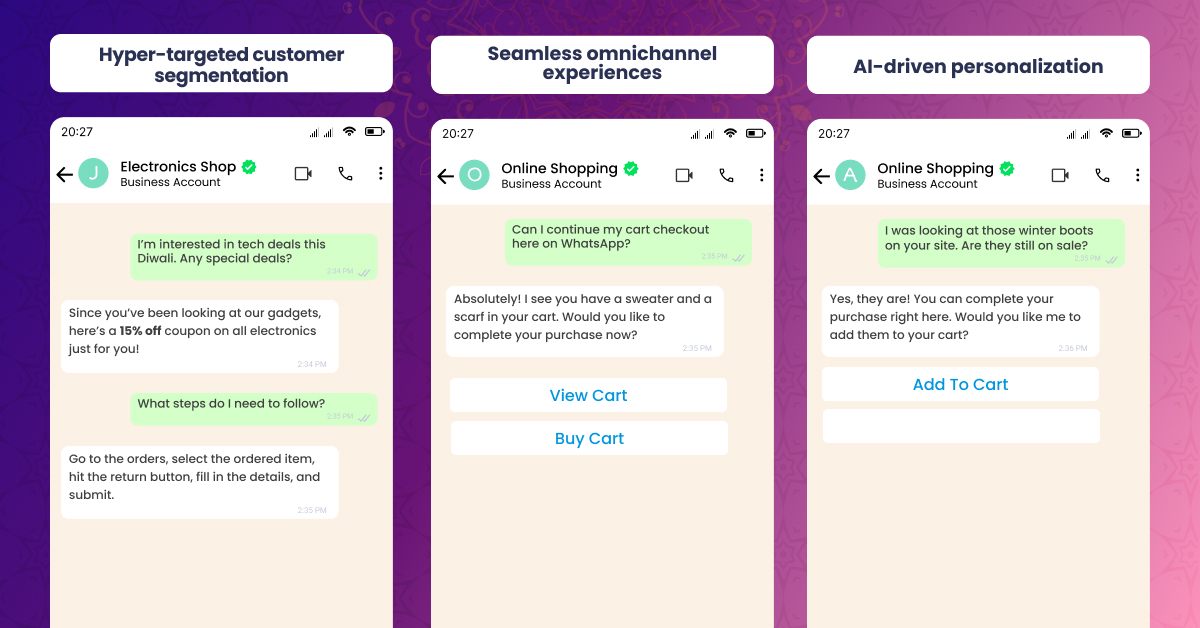
1. Hyper-Targeted Customer Segmentation
First, conversational AI helps you sharpen your customer segments. AI agents analyze purchase history, browsing behavior, and chat interactions to build detailed customer profiles. Then, they use these profiles to send festive campaigns to the right people at the right time.
For example, if a customer often browses electronics, the AI agent can automatically send an offer on the latest gadgets, which increases the chance of a sale.
2. Consistent Omnichannel Experiences
Next, connect your conversational AI across all sales and marketing channels. This gives customers a consistent experience throughout their purchase journey. In addition, AI syncs customer data in real time, so conversations continue smoothly wherever the customer picks up.
3. AI-Driven Personalization
Along with an omnichannel strategy, personalization is key. Conversational AI understands what a shopper wants in the moment and guides them through a personal shopping journey. As a result, you can share product recommendations, special offers, and content that match each customer’s interests.
From Click to Cart: How Conversational AI Keeps Up With Shoppers
To see how conversational AI for e-commerce works in practice, let’s look at an example.
Emily wants to redecorate her living room. Instead of visiting a furniture store, she starts online, scrolling social media for ideas. Here’s how your business can help her at every step.
1. Helping Her Explore
First, the AI agent studies Emily’s browsing behavior and preferences, and then suggests products that match her taste. So, instead of feeling overwhelmed by options, she quickly finds pieces she likes.
2. Keeping the Experience Consistent Across Devices
Emily researches on her phone but prefers to buy on her laptop. Conversational AI keeps the context of her conversation, so the experience stays connected across devices wherever she picks up.
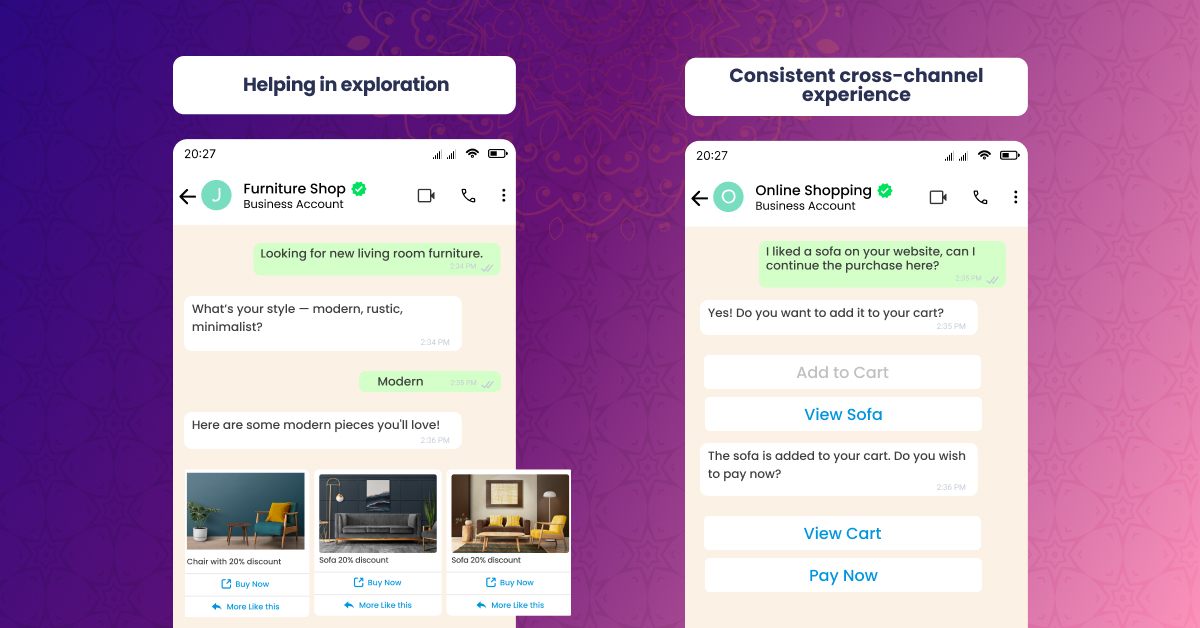
3. Re-Engaging Her Proactively
Later, Emily leaves your site to compare prices. The AI agent then sends a timely WhatsApp reminder about the sofa in her cart, along with a limited-time festive discount. As a result, she comes back to complete her purchase instead of buying elsewhere.
4. Answering Questions in Real Time
During checkout, Emily asks about delivery dates and fabric care. The AI agent answers instantly, which removes doubts and reduces cart abandonment.
5. Staying Engaged After the Purchase
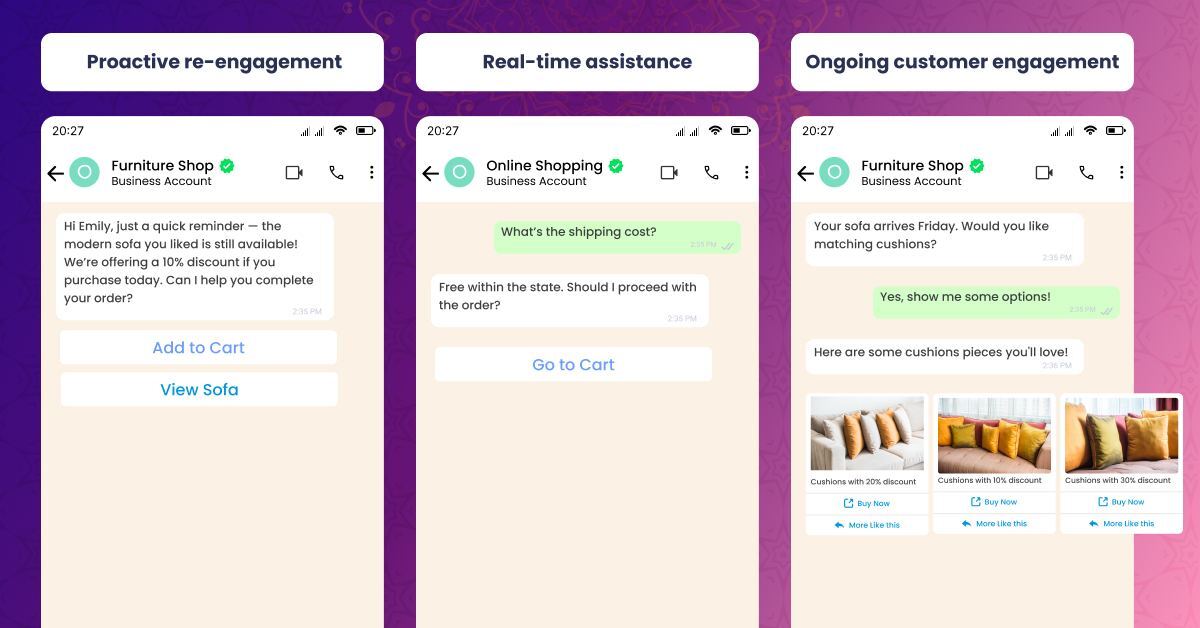
Finally, the AI agent’s job doesn’t end at checkout. It shares order updates, suggests matching cushions, and offers styling tips. Therefore, Emily is more likely to buy again.
How to Prepare for Future Festive Seasons With Conversational AI
Here are five tips to get ready for the next peak season:
- Forecast demand with predictive analytics: use AI to analyze past sales data and predict demand. This way, you avoid stockouts and overstock.
- Run hyper-personalized campaigns: use AI-driven segmentation to tailor promotions to each customer group.
- Offer multilingual support: equip your WhatsApp AI agents to chat in multiple languages, so you can serve diverse customers during festivals worldwide.
- Provide 24/7 real-time support: AI agents answer instantly at any hour. As a result, response times stay low even during peak demand.
- Build continuous feedback loops: collect customer feedback through chat, and then use it to improve your AI agent’s answers over time.
Conclusion
Conversational AI for e-commerce changes how you connect with shoppers. It gives them the instant, personal help they want, while you capture more sales during the busiest time of the year.
More importantly, the benefits last beyond the festive season. With better data, stronger relationships, and always-on support, your store is ready for long-term growth.
Gupshup’s AI agents for retail and e-commerce help you deliver personalized shopping experiences, recover carts, and grow sales on WhatsApp and other channels. Ready to make this your best festive season yet? Book a demo today.
FAQs
What is conversational AI for e-commerce?
Conversational AI for e-commerce uses AI agents and chatbots that understand natural language to chat with shoppers on WhatsApp, websites, and apps. They recommend products, answer questions, process orders, recover abandoned carts, and send order updates 24/7.
How can conversational AI be used in e-commerce?
Online stores use conversational AI for product discovery, personalized recommendations, cart recovery, order tracking, returns, payment collection, and customer support. It also helps run targeted festive campaigns and collect feedback.
How does conversational AI increase e-commerce sales?
It answers questions instantly, removes doubts at checkout, recommends relevant products, and re-engages shoppers who abandon their carts. As a result, more visitors complete purchases and come back to buy again.
What is the difference between a chatbot and conversational AI?
A basic chatbot follows fixed rules and scripted replies. Conversational AI, on the other hand, uses natural language understanding and context to hold human-like conversations, personalize answers, and complete multi-step tasks.
Can conversational AI work on WhatsApp for e-commerce?
Yes. With the WhatsApp Business API, AI agents can share product catalogs, take orders, accept payments, send order updates, and recover abandoned carts, all inside WhatsApp.
How do I prepare my e-commerce store for festive season traffic?
Forecast demand with past data, set up AI agents for 24/7 support, plan personalized campaigns, automate cart recovery and order updates, and make sure your product information is consistent across all channels

Manna, an IT graduate with 8 years of content writing experience, is passionate about words and their power to convey ideas. When she's not crafting content, she is immersed in books, enjoys cricket matches and the rhythm of music, relishes beach strolls, and cherishes quality time with her furry friend. Her love for languages extends beyond writing, as she is a knower of Hindi, English, Urdu, and Spanish.