When was the last time you walked into a bank to resolve a simple query? With busy lives and packed schedules, people rarely have time for routine tasks like this anymore, and that gap is exactly where AI in finance starts to make a real difference.
As financial services move further into 2026, Generative AI (Gen AI) and artificial intelligence are taking center stage. McKinsey estimates AI could add between $200 billion and $340 billion annually to the banking sector alone.
For banks, integrating Gen AI isn’t just about adopting new technology. It takes a mix of traditional and novel approaches.
How Banks Can Successfully Scale Gen AI
- Leadership alignment: Senior executives must lead the charge, setting clear goals and giving AI initiatives real sponsorship
- Value-centered use cases: Identifying AI applications that directly improve customer satisfaction or operational efficiency is key
- Strategic adaptation: Leaders need to translate complex concepts like reinforcement learning and neural networks into actionable business strategy
What sets scaling Gen AI apart is its scope. Just as the smartphone sparked entirely new industries, Gen AI opens pathways for a wide range of advanced analytics and operational improvements. Management teams now have to do more than adopt these tools; they have to build ecosystems that make them sustainable and adaptable.
As financial institutions embrace these technologies, platforms like Gupshup’s Conversational Cloud offer practical ways to put AI to work at scale, whether that’s real-time customer interactions or stronger fraud detection.
In this article, we’ll look at how financial leaders can make the most of AI in finance, the key benefits it delivers, and what to watch for as the technology keeps evolving.
What Is AI in Finance?
AI in finance refers to the use of technologies like machine learning (ML) and data-driven algorithms to analyze information, automate processes, and improve decision-making across the financial sector. These tools deliver smarter, faster, and more precise outcomes than manual processes ever could.
AI helps organizations make sense of complex datasets, whether that’s analyzing market trends, evaluating customer behavior, or spotting anomalies. This means less manual effort, better accuracy, and decisions that actually match both operational goals and customer expectations.
One standout feature of AI is that it evolves. Unlike traditional systems that need constant manual updates, AI learns from new data and adjusts on its own, which matters in an industry where conditions shift quickly, from volatile markets to new regulatory demands.
AI in finance isn’t reserved for big banks and hedge funds, either. It’s just as useful for smaller financial service providers, fintech startups, and individual advisors.
One fast-growing branch of this space is conversational AI. It strengthens customer relationships, opens new communication channels, and improves accessibility and responsiveness, helping financial organizations keep up with what customers actually expect.
Where AI in Finance Delivers the Most Value
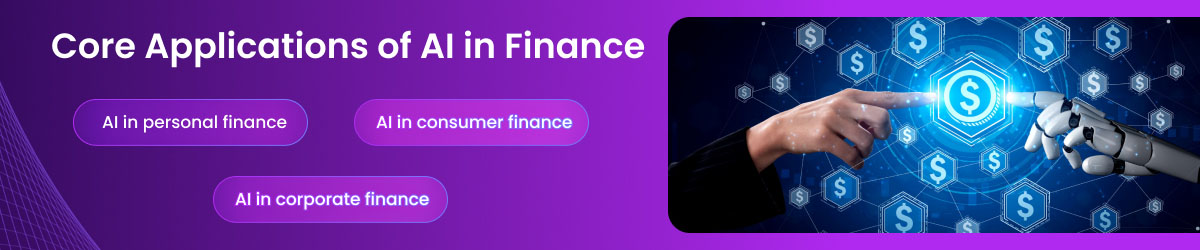
AI in finance is now built into nearly every corner of the industry. Here’s where it shows up most.
AI in Personal Finance
Managing personal finances is no longer a chore, thanks to AI. Tools for budgeting, financial guidance, and wealth management put more control directly in people’s hands.
From chatbots offering 24/7 assistance to personalized insights based on spending habits, AI puts financial independence within reach. Advanced natural language processing lets users get tailored advice, like a reminder about an upcoming bill or a heads-up on potential overspending, without needing a human to step in.
AI in Consumer Finance
With online payment fraud projected to cost billions annually, security has become non-negotiable. AI’s ability to catch irregular patterns and flag suspicious activity has changed consumer finance.
AI algorithms can analyze every transaction, online or in-store, in real time to catch signs of fraud. That protects individual accounts and builds trust in the institutions behind them. Banks that adopt AI-driven fraud detection systems often see a direct lift in customer satisfaction and loyalty.
AI in Corporate Finance
For companies, financial health comes down to managing risk and making informed decisions. AI streamlines corporate finance work, especially loan underwriting and risk assessment.
AI can predict loan default risk more accurately than traditional methods by analyzing far larger volumes of data. It also strengthens anti-money laundering efforts by catching unusual transaction patterns that a human analyst might miss, both critical as organizations try to balance growth with security and compliance.
Key Use Cases of AI in Finance
AI in finance has made a real impact on the sector. Here are some of the use cases already delivering results for both consumers and professionals.
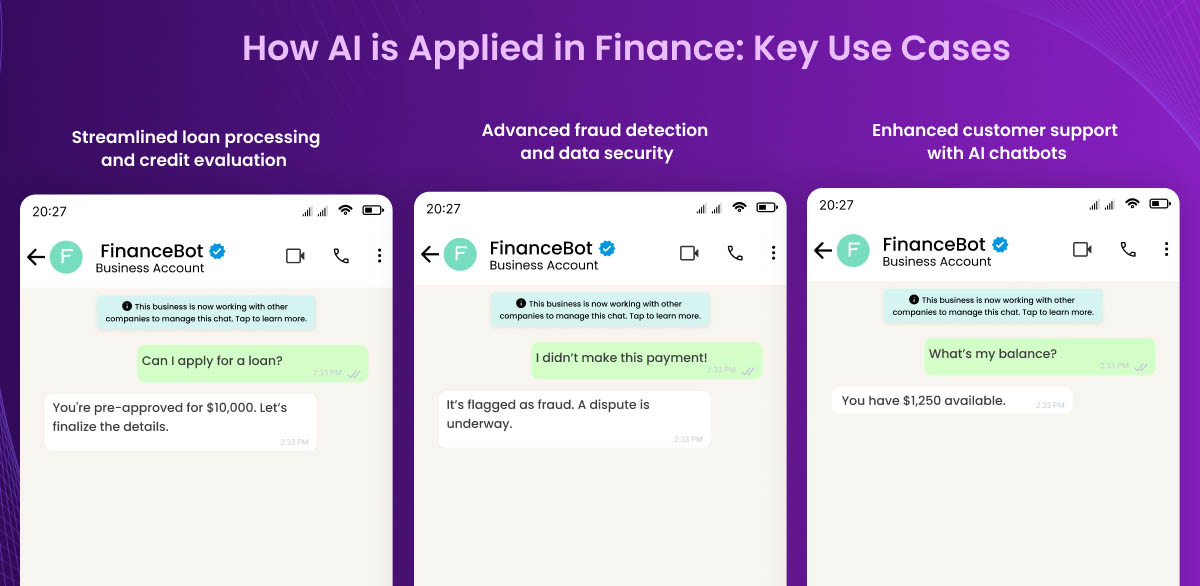
Streamlined Loan Processing and Credit Evaluation
AI agents simplify loan processing by evaluating credit data, income, and spending habits within seconds. Advanced models help ensure bias-free assessments, making loans more accessible and inclusive.
Enhanced Customer Engagement With AI Agents
AI agents handle customer queries and guide users through microjourneys like product discovery or service exploration. A prospect looking for the right insurance product, for example, can navigate their options with AI assistance instead of a long form.
Employee Support for Real-Time Solutions
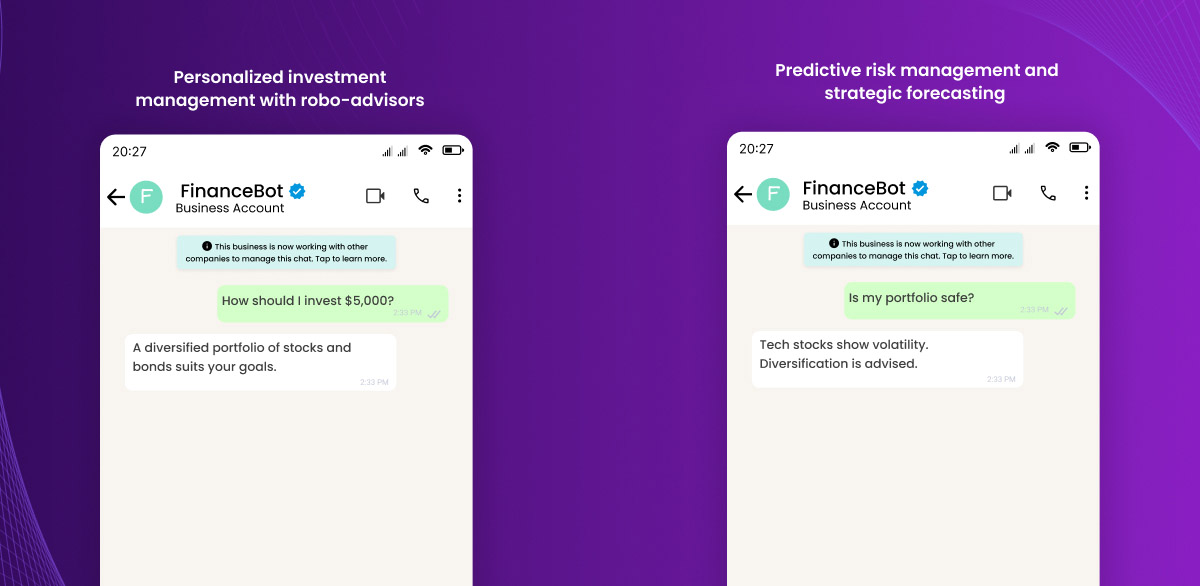
In fintech and insurance, AI agents support employees in the field with instant product information and customer-specific insights, so they can give tailored recommendations on the spot.
Voice AI for Intuitive Q&A Support
Voice-enabled AI agents make services more accessible, letting users ask questions or resolve issues hands-free. Tata AIG, for example, uses Voice AI for quick claim queries and policy status updates.
Service Automation for Core Financial Tasks

AI agents now handle essential tasks like account checks, transaction status updates, reminders, and even card cancellations, cutting down on manual work and increasing efficiency.
Product and Service Discovery
AI helps customers find the right service or product for their needs, whether that’s the best savings plan or a relevant investment opportunity, acting as a personal guide rather than a static menu.
Query Management
AI agents guide customers through marketing microjourneys, whether that’s product discovery or navigating a promotion, making sure customers get relevant information at each step of the funnel.
How Gupshup's Conversational Cloud Supports the Financial Sector
Platforms like Gupshup’s Conversational Cloud have been instrumental in helping the financial sector put AI in finance to work at scale. By enabling secure, real-time customer interactions, it helps banks and financial institutions send instant responses, streamline processes like loan applications, and send proactive fraud alerts, all through intuitive, AI-powered chat interfaces.
Take Tonik Bank as an example. Tonik Bank used Gupshup’s AI chatbot to transform customer service, with results that speak for themselves:
- 75% of queries resolved autonomously, cutting dependency on human agents
- Faster query resolution, which improved customer satisfaction
- Real cost savings, freeing up resources for more complex work
These numbers show what’s possible when banks scale AI the right way, without compromising on service standards.
The Benefits of AI in Finance for Financial Institutions
From loan approvals to fraud alerts, AI in finance is already changing how institutions operate day to day. Here’s a closer look at the benefits showing up across efficiency, customer experience, accuracy, security, and decision-making.
Operational Efficiency and Cost Reduction
One of the clearest benefits of AI in finance is automating routine work. By using AI models and machine learning, financial institutions cut down on repetitive tasks and reduce operational costs:
- Process automation: AI simplifies transaction reconciliation, document verification, and compliance monitoring
- Cost savings: Automating manual work reduces staffing needs and frees up resources for more strategic priorities
- Faster workflows: Tasks that used to take days, like loan approvals, now take minutes
Enhanced Customer Experiences
AI is reshaping customer interactions in finance by personalizing service and making engagement effortless.
- Personalized financial solutions: Predictive analytics lets AI recommend tailored products, like investment options or savings plans, based on customer behavior
- 24/7 assistance: Machine-learning-powered chatbots deliver round-the-clock support
- Seamless onboarding: AI automates KYC steps like facial recognition and document verification, keeping onboarding compliant and frictionless
- Data-driven insights: AI models build a deeper understanding of what customers actually need, which builds loyalty and trust
Improved Accuracy and Reduced Errors
AI in finance also minimizes human error and sharpens the precision of everyday operations:
- Error-free analytics: AI processes huge volumes of financial data accurately, improving forecasts, reporting, and strategic decisions
- Stronger risk management: Predictive analytics helps AI models sharpen risk assessments for lending and investment decisions
- Regulatory compliance: AI automates compliance checks, reducing both the risk of penalties and the manual burden of staying compliant
Stronger Security and Fraud Detection
Fraud detection is one of the standout benefits of AI in finance, protecting both customer trust and institutional assets.
- Real-time anomaly detection: Machine learning catches irregular transaction patterns, like unusual spending or unauthorized access, and flags them instantly
- Proactive security: AI models keep learning from new fraud tactics instead of relying on static rules
- Stronger cybersecurity: AI spots vulnerabilities in digital transactions and surfaces alerts before they become bigger problems
Data-Driven Decision-Making
AI gives institutions insights drawn from real-time data analysis, leading to sharper decisions:
- Predictive strategy: AI surfaces emerging trends, helping institutions refine products and services around real demand
- Smarter resource allocation: Data insights support better budgeting, staffing, and risk management
- Market analysis: AI tracks market trends and customer preferences more effectively than traditional research methods
The Future of AI in Finance: Emerging Trends and Technologies
The next phase of AI in finance goes beyond automation and into anticipation: tools that predict what a customer needs before they ask. Here’s what’s coming next in personalization, generative AI, and responsible AI practices.
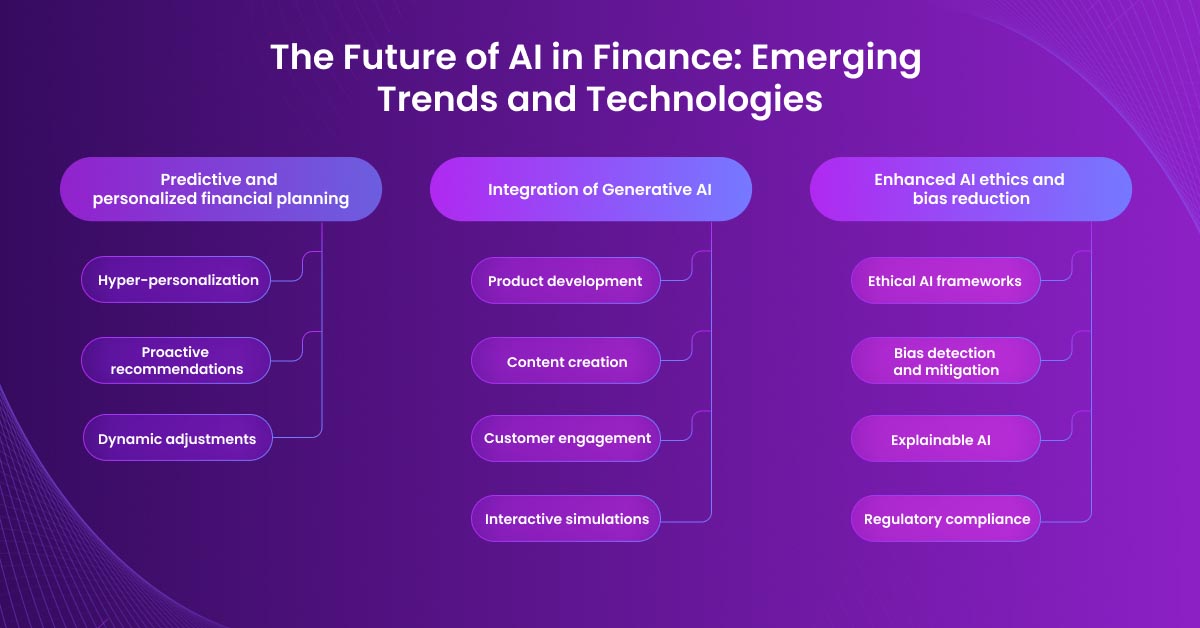
Predictive and Personalized Financial Planning
Personalized financial planning is where AI in finance is headed next. Emerging AI models and predictive analytics will enable far more tailored solutions for individual customers.
- Hyper-personalization: AI will use a customer’s real-time financial history, spending patterns, and life events to build customized savings plans, investment portfolios, and credit options
- Proactive recommendations: As machine learning advances, institutions will be able to proactively suggest early debt repayment, better insurance policies, or alternative investment strategies
- Dynamic adjustments: Personalized plans will shift in response to changing market conditions, so the advice stays relevant
Integration of Generative AI
Generative AI is set to play a bigger role in financial product development, content creation, and customer engagement.
- Product development: Generative AI will help create new financial products, like customizable insurance packages or flexible loan options, for niche market segments
- Content creation: AI can generate personalized financial reports, explain complex investment strategies in plain language, or build educational materials that improve financial literacy
- Customer engagement: AI-powered chatbots and virtual assistants, built on Gupshup’s Conversation Builder, will deliver more natural, human-like conversations, handling complex queries and offering support during financial stress
- Interactive simulations: Customers will be able to use generative AI to visualize outcomes, like retirement savings growth or mortgage payment plans, through scenario modeling
Enhanced AI Ethics and Bias Reduction
As AI in finance grows more central to the industry, ethics and bias reduction matter just as much as performance.
- Ethical AI frameworks: fair, accountable, and transparent standards for every model
- Bias detection: training on diverse datasets and flagging discriminatory outcomes in real time
- Explainable AI: decisions customers and regulators can actually understand
- Regulatory compliance: guidelines that balance innovation with fairness
Conclusion: The Future of AI in Finance
Artificial intelligence in finance has moved from optional to necessary. From better customer experiences to sharper operational efficiency, AI in finance delivers benefits across the entire financial services spectrum. Institutions that adopt AI-driven solutions like Gupshup’s Conversational Cloud gain a real edge: more automation, more personalization, and stronger regulatory compliance.
Ready to put AI in finance to work for your institution? Talk to Gupshup about building AI solutions tailored to your needs.
FAQs
What are the benefits of using AI in finance?
AI improves efficiency, cuts operational costs, prevents fraud, and sharpens decision-making with data-driven insights. It personalizes customer experiences, streamlines processes like loan approvals and onboarding, and helps institutions stay compliant.
What is the role of artificial intelligence in financial technology?
AI in fintech automates processes, analyzes large datasets for better decisions, and strengthens security. It powers personalized services like robo-advisors, streamlines KYC, and improves fraud detection, all of which drive innovation and competitiveness.
What is the main benefit of artificial intelligence?
The main benefit of AI is its ability to analyze complex data quickly and accurately, enabling automation, personalization, and innovation. That translates into smarter decisions, cost savings, and better user experiences across industries.
Jaitashri is a content and social media marketer. Through insightful and data-driven content, she enables her audiences to leverage the potential of B2B SaaS products. Beyond writing, she's a culinary explorer, avid reader, and passionate painter, infusing creativity into every endeavor.
 +91-9355000192
 Login
Login