+91-9355000192
 Login
Login
Transforming Public Service: The Role of AI Virtual Assistants in Modern Governance
- What Are AI Virtual Assistants?
- How AI Virtual Assistants Are Changing Citizen Engagement
- Use Cases for Government Agencies
- Gupshup and Ministry of Consumer Affairs Collaboration
- The Future of Gen AI Virtual Assistants in Governance
- AI Virtual Assistants Are Redefining Citizen Engagement
- FAQs
See the power of intelligent conversations for your brand.

Government agencies are adopting new technology to improve public services and connect better with citizens, but educating the public about a new policy is often harder than launching it.
Traditional channels like newspapers and TV ads spread information, but they can’t answer a citizen’s follow-up question. Over 53% of survey respondents say they struggle to navigate government portals or understand what a policy means for them, according to Liferay’s research on public-sector citizen experience.
This is the gap AI virtual assistants are built to close. India’s Ministry of Consumer Affairs and Gupshup, reported by the Economic Times, show what this looks like in practice: their web-based assistant, Jagriti, gives citizens a direct, responsive way to resolve consumer complaints instead of navigating a portal alone.
What Are AI Virtual Assistants?
An AI virtual assistant is a software application that helps users complete tasks or find information through natural conversation. In government services, these tools use conversational AI to answer questions, offer guidance, and simplify interactions that would otherwise mean long hold times or confusing portals.
Because they process natural language, AI virtual assistants work for a broad range of citizens, not just people comfortable with technical forms and menus. Whether built as chatbots, voice assistants, or web-based assistants, they all do the same core job: making bureaucratic processes easier to navigate.
How AI Virtual Assistants Are Changing Citizen Engagement
The introduction of AI-powered virtual assistants marks a real shift in how government agencies reach citizens. Here’s what changes:
24/7 Availability
AI virtual assistants don’t keep office hours. Citizens can get information or file a request at 11 PM on a Sunday, not just between 9 and 5 on a weekday.
Multilingual Support
India’s linguistic diversity makes a single-language help desk impractical. Virtual assistants can respond in a citizen’s own language, closing a gap that a service built around one or two languages simply can’t.
Quick Resolution of Queries
From filing a grievance to checking an application status, a virtual assistant answers instantly instead of putting citizens in a queue.
Improved Accessibility
A web-based AI virtual assistant works from any device with an internet connection. That means citizens in remote areas no longer need to travel to a government office just to ask a question.
Data-Driven Decision Making
Every interaction with an AI virtual assistant generates data on what citizens actually ask about. That’s a direct feedback loop agencies can use to fix confusing policies before they turn into widespread complaints.
Use Cases for Government Agencies
The collaboration between the Ministry of Consumer Affairs and Gupshup shows a few of the ways government agencies are already putting AI virtual assistants to work. Here’s where AI voice assistants and other virtual tools fit in:
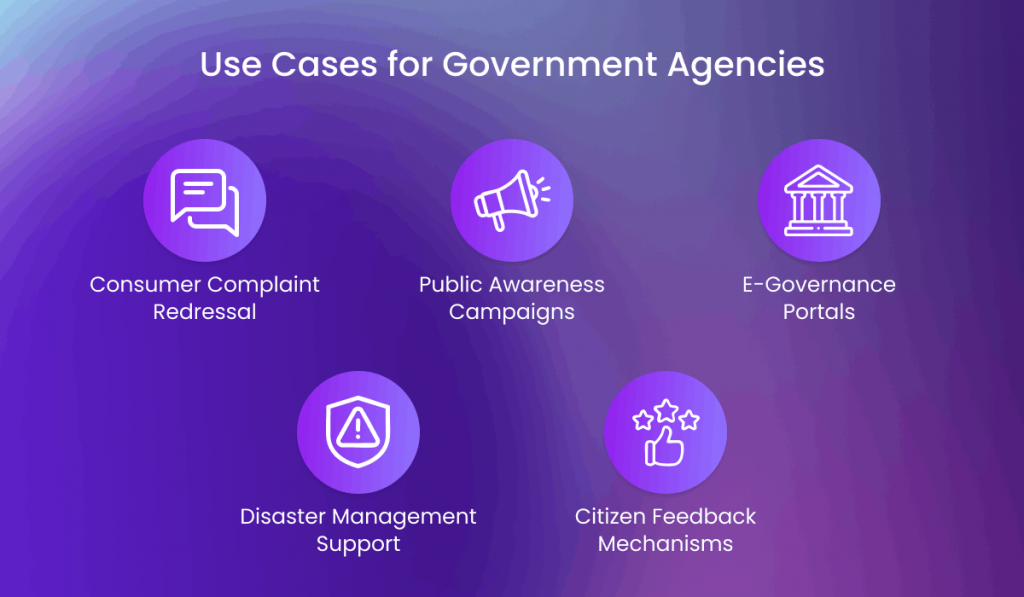
Consumer Complaint Redressal
An AI virtual assistant simplifies filing and tracking complaints. Citizens can log a grievance, check its status, and get guidance on their consumer rights in one conversation.
Public Awareness Campaigns
Governments can use AI virtual assistants to spread information on public health, safety rules, or new policies. During COVID-19, several countries used AI assistants this way to answer questions and share real-time updates.
E-Governance Portals
A web-based AI virtual assistant built into an e-governance platform helps citizens navigate tasks like filing taxes, renewing licenses, or applying for welfare benefits, without getting lost in menus.
Disaster Management Support
During emergencies, virtual assistants can share real-time information on evacuation routes, relief centers, and safety measures, exactly when citizens need answers most.
Citizen Feedback Mechanisms
AI-powered assistants collect citizen feedback directly, giving agencies a real-time line to the public instead of relying on surveys alone.
Gupshup and Ministry of Consumer Affairs Collaboration
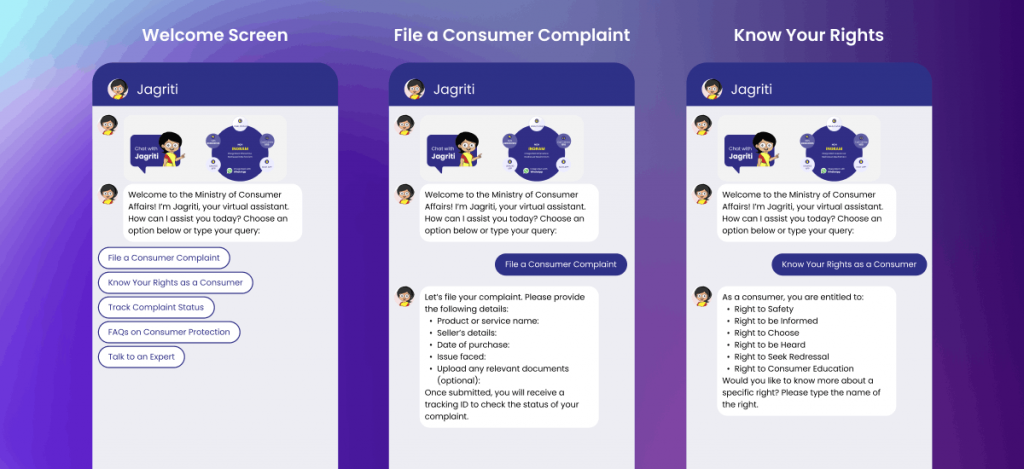
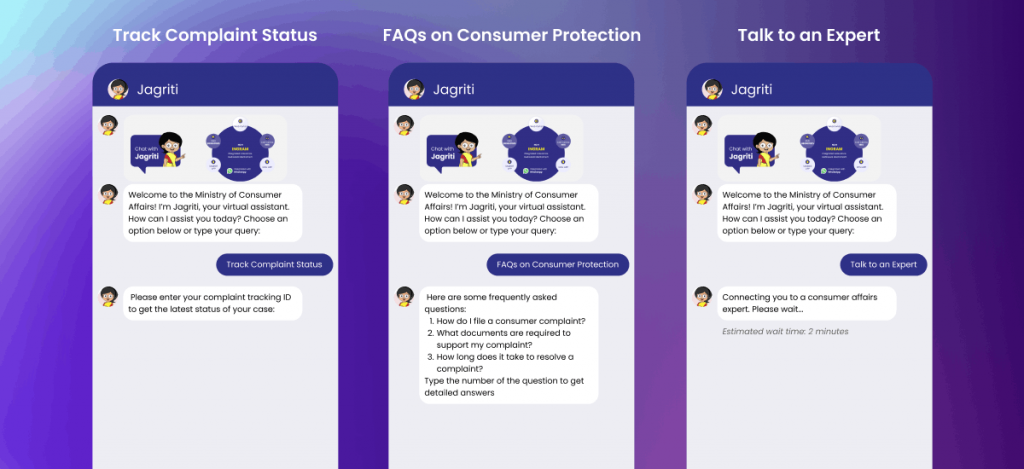
The Ministry of Consumer Affairs’ partnership with Gupshup shows how far this technology has come in public service. Their AI agent, named Jagriti, is built to simplify how consumers resolve grievances.
This AI-powered assistant helps consumers understand their rights, file complaints, and get answers without navigating a call center or a confusing portal. It handles a wide range of queries: clarifying product warranties, flagging fraudulent practices, and guiding people through legal recourse. Multilingual support means the service works across India’s diverse population, not just for English speakers.
Here is a mockup illustration for the Jagriti virtual assistant:
The Future of Gen AI Virtual Assistants in Governance
AI virtual assistants in governance are only going to get more capable. As natural language processing and machine learning improve, expect government deployments to include:
- More natural voice interactions: assistants that sound and respond like a real conversation, not a script
- Personalized guidance based on a citizen’s past interactions and preferences
- Integration with technologies like blockchain, adding another layer of data security and transparency
- Proactive engagement, where AI agents flag an upcoming deadline or policy change before a citizen has to ask
AI Virtual Assistants Are Redefining Citizen Engagement
AI virtual assistants are changing what citizen engagement looks like: accessible, fast, and transparent, instead of a queue or a confusing form. The Ministry of Consumer Affairs and Gupshup partnership is one clear example of what that shift can achieve for a government agency willing to try it.
As more agencies adopt AI virtual assistants, citizens get faster answers and governments get a direct line to the people they serve.
👉 Ready to bring an AI virtual assistant to your agency? Request a demo with Gupshup and see how a solution like Jagriti could work for your citizens.
FAQs
What is an AI virtual assistant?
An AI virtual assistant is a software application that uses AI to help users complete tasks, find information, or interact with a service through conversation. In governance, it uses conversational AI to help citizens navigate government services without needing to understand the system behind them.
How do AI virtual assistants work in governance?
AI virtual assistants use natural language processing to understand and respond to citizen queries. They help with filing complaints, tracking applications, and finding policy information, which improves both transparency and service delivery.
What are the benefits of using AI virtual assistants in public services?
- 24/7 availability: citizens can get help anytime, not just during office hours
- Multilingual support: closes the language gap for a diverse population
- Quick query resolution: instant answers instead of a queue
- Better accessibility: reachable from any device with an internet connection
- Data insights: agencies learn what citizens actually need from real interaction data
What is a web-based AI virtual assistant?
A web-based AI virtual assistant runs in a browser, so citizens can use it from a desktop, tablet, or phone without installing any software.
What is the role of AI voice assistants in public governance?
AI voice agents let citizens complete tasks or get information using voice commands instead of typing. That’s especially useful for people with limited digital literacy or a physical disability that makes typing difficult.

Divya is a multifaceted writer and a journalism graduate. A wordsmith by profession and passion, she crafts compelling narratives as a seasoned content writer while also weaving poetic tapestries in her leisure moments. Whether delving into informational prose or evocative verse, her love for the written word brings finesse to every piece she pens down.