+91-9355000192
 Login
Login
Why the Future of Marketing Is Conversational: Takeaways From Beerud Sheth on Dil Se Omni Talks
- Broadcast Marketing Is Over
- The Real Meaning of Omnichannel Customer Engagement
- Why Context Matters More Than AI Intelligence
- Conversational AI Strategy: What to Build, Buy, or Rent
- What This Means for Brands
See the power of intelligent conversations for your brand.

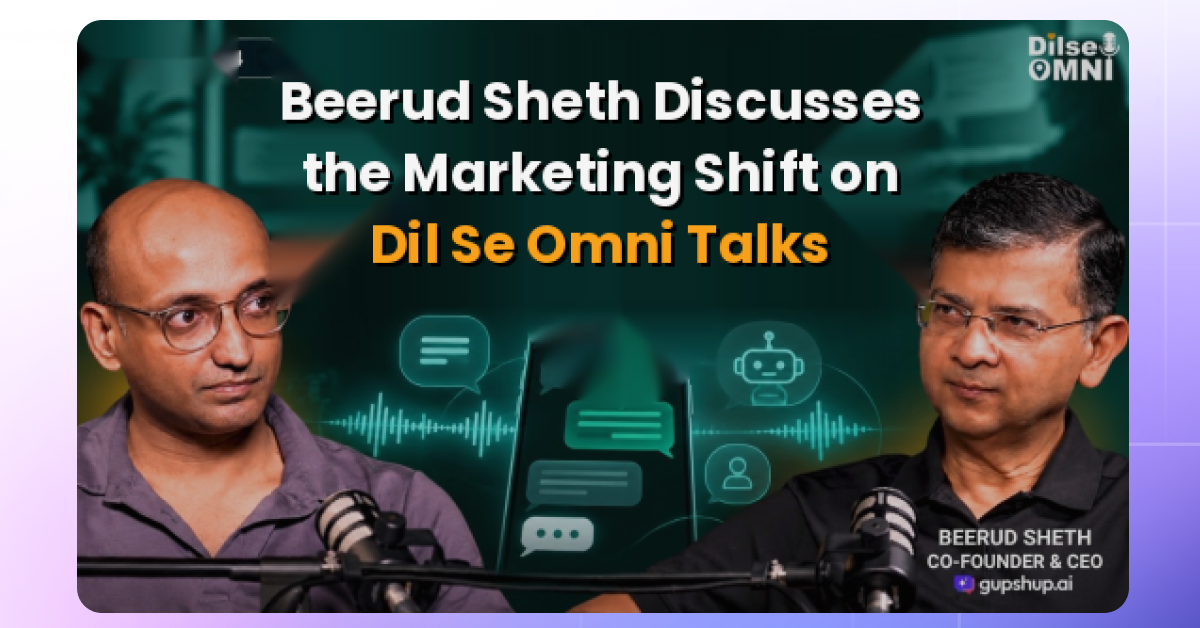
Gupshup CEO Beerud Sheth recently joined Saurabh Agrawal on the Dil Se Omni Talks podcast for a wide-ranging conversation on where customer engagement is headed. Here are the ideas worth carrying forward, especially for anyone thinking about Gupshup, omnichannel messaging, and where AI actually fits into customer conversations.
Broadcast Marketing Is Over
For decades, brands have largely talked at customers: send a message, hope for a click, move on. That model is breaking down. Every message now costs more to send, as WhatsApp and RCS pricing continues to rise, and consumers are pushing back on high-volume messaging by blocking brands and opting out. Messages now have to earn a response, not just an impression.
That has consequences for how marketers measure success. Open rates and click rates still get most of the attention, but reply rates matter just as much, arguably more, because a customer replying signals real intent. Real sales conversations start with questions: Do you have more colors? What’s the quality like? Campaigns built only to generate interest and then hand off to sales are missing something. The distance between marketing and sales is shrinking, and treating every touchpoint as one continuous conversation, rather than separate stages, is where this is heading.
The Real Meaning of Omnichannel Customer Engagement
Ask ten marketers what “omnichannel” means, and you’ll get ten different answers. The useful version isn’t about being present on every channel. It’s about being conversational on every channel.
WhatsApp, RCS, SMS, voice, video, and eventually newer surfaces like smart glasses aren’t separate channels to manage independently. They’re surfaces. The real work is building a single AI Agent, one consistent brain, that shows up reliably across all of them. A customer should get the same experience whether they’re messaging on WhatsApp, receiving a rich RCS message, or speaking with a AI voice agent– the same way you’re still you whether someone calls you, texts you, or meets you in person.
WhatsApp stays central to two-way conversational engagement, letting brands move past one-off notifications into ongoing dialogue. RCS brings richer, verified messaging directly into the native inbox, combining branding and interactivity in a way SMS never could. Voice extends this further, especially where typing is a barrier. Voice notes are especially common in markets like the Middle East, and hybrid experiences, like a call handing off to a text message for something like a document upload, are becoming more common too.
Treating these as separate, disconnected channels isn’t omnichannel. It’s fragmentation. The businesses getting this right invest in one conversational AI experience and let the surface, not the substance, change depending on where the customer shows up.
Why Context Matters More Than AI Intelligence
As AI models keep improving, the question becomes: if a model can eventually do everything, what will it still fail at? The answer is context.
An AI model, however advanced, can’t act on what it can’t see. It doesn’t know your pricing, your policies, your catalog, or your history with a specific customer unless that information is made available to it. Intelligence without context is like hiring a brilliant new employee and sending them straight into a sales call without training them on the product or the pricing. No business would do that with a person, yet plenty do it with AI.
A lot of this context lives in undocumented places: support conversations, the history of past campaigns, institutional knowledge nobody’s ever written down. The brands that differentiate themselves won’t be the ones with access to the smartest model. They’ll be the ones that did the work of organizing their own proprietary context.
The Importance of Human Handoff in AI
Not every AI interaction goes smoothly, and that’s fine, as long as there’s a clear way out. A poorly designed AI experience can trap a customer in an endless loop, offering more automated steps instead of a path to a real person when the system genuinely can’t help. Overengineering an AI Agent to handle everything, instead of knowing when to step back, is a common mistake.
The best conversational AI experiences have clear guardrails: a defined scope for what the AI Agent handles, and a smooth handoff to a Human Assistant when a query falls outside that scope. Context makes the agent useful. A clear exit makes it trustworthy.
AI-Powered Campaigns at a New Scale
A human marketer running a campaign works within real limits: maybe a dozen segments, two or three journeys, occasional manual optimization based on results reviewed after the fact. Those aren’t limits of imagination. They’re limits of time and manual effort.
AI removes that ceiling. Instead of a dozen segments, a campaign can run with a million, each with its own customized copy. Instead of two or three journeys, there can be thousands, continuously tested and optimized in real time instead of reviewed weekly. This isn’t the old way of working, just faster. It’s a different kind of campaign: individualized and constantly adjusting in ways manual execution never allowed.
That shifts where marketers actually spend their time. Execution, once most of the job, is getting simpler and more automated. Which means the thinking behind a campaign- who to target, what to say, why it matters- becomes the part that separates one brand from another. As execution gets commoditized, the gap between good marketers and great ones is only going to widen, because strategic thinking is exactly what AI can’t substitute for.
Conversational AI Strategy: What to Build, Buy, or Rent
For a CMO figuring out a conversational AI strategy, the pace of change can be disorienting. New models and tools show up constantly, and it’s tempting to try to keep up with all of it directly. A more grounded starting point: nobody builds everything.
No business is going to build its own frontier AI models, and few should try building their own orchestration layer from scratch either. That work is genuinely hard and better left to platforms built for it. What brands should focus their own effort on is the customer experience itself: the campaigns, the segments, the journeys, the objectives that reflect what the business actually needs. Everything underneath- channel connections, campaign management, human handoff, analytics- is better handled by a platform built for the whole lifecycle of customer engagement rather than assembled piece by piece.
One mistake worth avoiding here: building a separate AI Agent for every channel. A business shouldn’t have one agent for WhatsApp, a different one for RCS, and another for voice. That fragments the brand experience and creates a maintenance burden that compounds, since any policy or tone change then has to be replicated across disconnected systems. Better to have one consistent AI Agent deployed across every conversational surface.
And brands shouldn’t let fear of getting it wrong stall progress. Test with employees first, roll out to a small percentage of customers before scaling, and build guardrails from the start so the brand voice stays protected while the team learns what works. Treating this as a learning curve, rather than something that has to be perfect on day one, is what actually builds an advantage over time.
What This Means for Brands
The thread running through all of this: the basic unit of customer interaction is shifting from a click to a message. A click requires guessing what a customer wants from indirect signals. A message carries that intent directly, along with sentiment and context no click-path analysis could capture.
This is the shift Gupshup Conversation Cloud is built to help businesses navigate, orchestrating AI Agents and Human Assistants across WhatsApp, RCS, SMS, and Voice, so every customer conversation is grounded in the right context, backed by campaigns built to scale, and has a clear path to a human when needed.
Watch the full podcast episode

A marketer who loves turning complex tech into simple stories that customers connect with. He enjoy building go-to-market strategies, scale customer acquisition, and explore how AI can reshape marketing and customer engagement.