+91-9355000192
 Login
Login
What Are AI Agents? Exploring Their Role in Marketing, Commerce, and Support
- What Are AI Agents?
- How Do AI Agents Work?
- How AI Agents Have Evolved
- AI Agents vs. Conversational AI vs. Chatbots
- What Makes AI Agents Different and Powerful?
- AI Agents in Marketing
- AI Agents in Commerce
- AI Agents in Customer Support
- The Future of AI Agents
- Conclusion
- FAQs
See the power of intelligent conversations for your brand.

Businesses today are constantly looking for better ways to engage customers, streamline operations, and scale support without scaling headcount. At the center of that shift are AI Agent, often powered by conversational AI, which are changing how marketing, commerce, and customer support actually work.
What Are AI Agents?
AI Agents are software programs built with artificial intelligence that can understand human language and act on it autonomously. They can hold a conversation, answer questions, and handle customer interactions much like a human agent would.
Powered by large language models, AI Agents analyze data, learn from every interaction, and get better at responding over time.
How Do AI Agents Work?
AI Agents work with a level of autonomy that mimics human decision-making. At their core, they perceive their environment, reason about the current situation, and take action toward a specific goal.
That autonomy comes from a mix of algorithms, machine learning, and often reinforcement learning, which lets the agent improve based on feedback over time. The functioning of AI Agents typically relies on a few connected pieces working together:
- Perception: collecting and interpreting input, whether that’s text in a chat conversation or sensor data in robotics.
- Knowledge representation: storing and retrieving information the agent needs to reason about the world.
- Decision-making: evaluating possible actions using techniques like neural networks and decision trees, then choosing the one that best fits the goal.
- Adaptability: continuously learning from new input, so a chatbot built this way can handle a question it’s never seen before instead of stalling on a script.
In a customer service setting, this is what lets an agent personalize a response based on a customer’s past behavior instead of running through the same fixed flow for everyone. Getting this right responsibly, including keeping the agent aligned with human values, remains one of the central challenges in building these systems.
How AI Agents Have Evolved
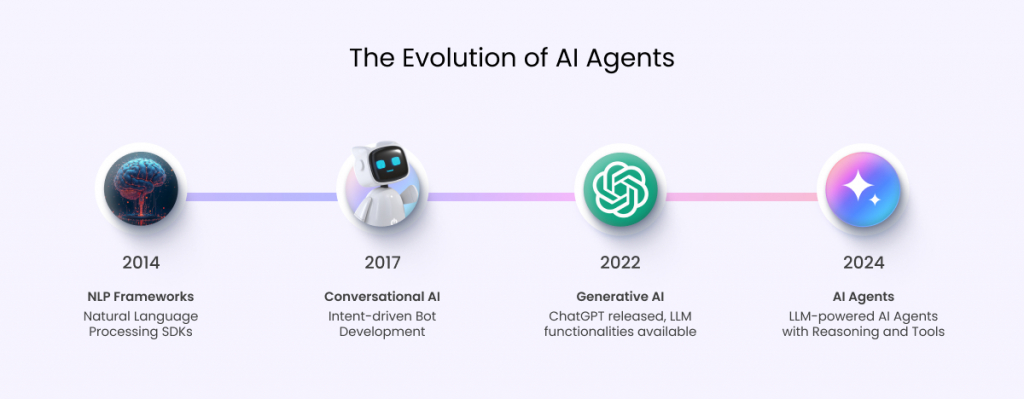
AI Agents are a recent innovation, but they’ve built on nearly a decade of AI progress:
- 2014: NLP frameworks and SDKs first gave machines a working ability to interpret human language.
- 2017: Conversational AI took over, with intent-driven bots that could hold more interactive, meaningful dialogue.
- 2022: Generative AI went mainstream, largely on the back of ChatGPT’s introduction, bringing large language models into everyday use.
- 2024 onward: Agents began combining that LLM capability with real reasoning and tool use, operating with more autonomy.
- Today: The frontier has moved to multi-agent systems, where several AI Agents coordinate on a single task instead of working alone.
Each stage builds directly on the one before it, which is why AI Agents today can do far more than the scripted bots of a decade ago.
AI Agents vs. Conversational AI vs. Chatbots
These three terms are used interchangeably, but they aren’t the same thing.
Conversational AI covers the technology that lets a system understand and generate natural language, using NLP, speech recognition, and dialogue management to build chatbots or virtual assistants. It’s the communication layer.
Non-agentic chatbots: Use that layer inside fixed, rule-based flows. They respond to specific commands, don’t adapt between interactions, and work best for simple, predictable use cases like FAQs or order-status lookups.
AI Agents: Use conversational AI as their interface, but add autonomy on top of it. They can reason about a situation, take independent action, and learn from past interactions instead of waiting for a scripted trigger. That’s what lets an agent handle a layered question like “can I return this if I used a coupon, and can I pick up a replacement in-store today?” in one pass, instead of deflecting to a policy page.
The right choice depends on what you actually need. A non-agentic chatbot is cheaper to deploy and predictable by design, which works fine for narrow, high-volume queries. An AI Agent is worth the extra complexity when the interaction needs flexibility, memory, or real-time decisions.
What Makes AI Agents Different and Powerful?
Reasoning
AI Agents can process large amounts of data and make dynamic decisions instead of following fixed rules. That lets them read context, gauge intent, and adjust their response in a way that feels closer to a human conversation than a scripted one.
Memory
AI Agent carry both short-term and long-term memory, so they can recall a customer’s preferences and past interactions instead of starting cold every time. That’s also what lets an agent find the shortest path to resolution instead of re-asking questions the customer already answered.
Action
Reasoning and memory only matter if the agent can act on them. AI Agent can pull the right tool for the job, whether that’s looking up an order, running a diagnostic, or completing a transaction, which is what lets it handle tasks end to end instead of just answering a question and stopping there.
AI Agents in Marketing
In marketing, AI Agents are transforming how brands connect with their audiences, offering personalized, real-time engagement that resonates with individual customers.
Personalized Customer Journeys
AI Agents analyze customer behavior, preferences, and purchase history to build personalized customer journeys instead of one-size-fits-all messaging, whether that’s a product recommendation or content matched to what someone’s actually interested in.
Enhancing the Customer Experience
By engaging customers directly through chat on websites, apps, and social channels, AI Agents answer questions and guide purchase decisions in real time, which drives the customer service satisfaction a slower, ticket-based process can’t match.
Automating Campaign Management
AI Agent can also run campaign management themselves: targeting the right segment, optimizing ad spend against real-time performance, and reporting results, which frees marketing teams to focus on strategy instead of execution.
AI Agents in Commerce
In commerce, AI Agents streamline operations and enhance customer interactions, driving efficiency and sales growth.
Interactive Shopping Assistants
As interactive shopping assistants, AI Agents guide shoppers through products, answer detailed questions, and suggest complementary items, simplifying the shopping experience enough to measurably lift conversions.
Inventory and Order Management
AI Agents can predict demand from historical data to keep stock levels where they need to be, and automate order processing to cut errors and speed up fulfillment.
Customer Feedback and Insights
By collecting and analyzing feedback at scale, AI Agent surface patterns in customer sentiment that help teams refine products, service, and marketing based on what customers are actually saying, not just what they bought.
AI Agents in Customer Support
AI Agents revolutionize customer support by providing scalable, 24/7 assistance and significantly improving response times.
Automated Help Desks
AI Agents handle first-line support, resolving common questions and routing complex cases to a human agent, so service stays consistent even during a volume spike.
Multilingual Support
Because AI Agents can understand and respond in multiple languages, they remove the language barrier that limits WhatsApp-based support for global brands.
Predictive Service
By analyzing interaction patterns, AI Agent can flag a likely issue before a customer even reaches out, which turns support from reactive to proactive.
The Future of AI Agents
As AI Agents get more autonomous, the guardrails around them matter just as much as their capability. Three things matter most: filtering out harmful or offensive content before it reaches a user, keeping responses grounded in verified information rather than plausible-sounding guesses, and respecting copyright and intellectual property in anything the agent generates or reproduces.
Security matters too. As agents get more sophisticated, so does the incentive to manipulate them, which is why many deployments still pair AI Agents with structured, NLP-based bots as a stable bridge between fully scripted systems and fully autonomous ones.
The next stage is multi-agent collaboration: multiple AI Agent working together on a single task, each handling the part it’s best suited for. That’s a more resilient design than asking one agent to do everything, and it’s where the field is heading next.
Conclusion
AI Agents, powered by agentic AI, aren’t just another technology trend. They’re already reshaping how marketing, commerce, and support work, and the brands adopting them now are the ones building a real advantage before it becomes table stakes.
The gap between a brand using scripted bots and one using AI Agents is only going to widen. Starting now, even with one use case, is what puts you ahead of it.
FAQs
What are AI Agent?
AI Agent are software programs that can understand language, make decisions, and act on them autonomously, without needing a human to guide every step.
How do AI Agents work?
They process an input, reason about it using techniques like NLP and machine learning, and either respond or take an action, learning from the outcome to improve the next interaction.
What are the types of AI Agents?
- Reactive agents: respond to input without memory.
- Goal-based agents: act based on a desired outcome.
- Utility-based agents: weigh actions by probability and reward.
- Learning agents: improve over time through experience.
How are AI Agent different from chatbots?
A chatbot handles conversation. An AI Agent goes further, executing tasks and integrating with business systems for real end-to-end automation, not just a reply.
Which industries benefit most from AI Agent?
- Customer support (faster resolution, lower cost per contact)
- E-commerce (personalized recommendations, order tracking)
- Healthcare (virtual assistants, patient monitoring)
- Finance (fraud detection, automated trading)
- HR (resume screening, interview scheduling)
Can AI Agent integrate with existing business systems?
Yes. AI Agents connect to CRM, ERP, HRMS, and other enterprise tools through APIs, so they fit into a stack you already run instead of replacing it.
How do AI Agents improve customer experience?
They cut wait times, personalize every interaction, and handle repetitive queries around the clock, freeing human agents for the harder problems.

Vartika leads marketing at Gupshup and has ~16 years of experience in marketing across early-stage startups and large enterprises. A Marketing specialist by profession, a wanderer at heart, an enthusiastic cook, and a painter for the soul.