+91-9355000192
 Login
Login
Building a Conversational-First Brand: The 2026 Strategic Blueprint
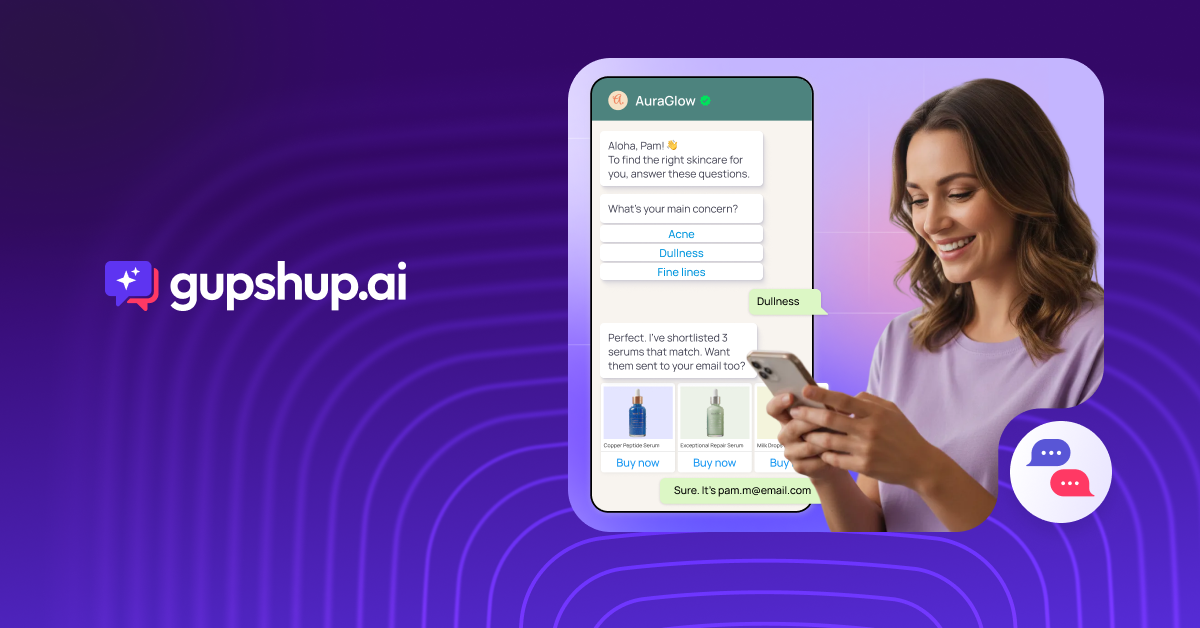
See the power of intelligent conversations for your brand.

While you were finalizing 2026 budgets, the conversational AI market quietly crossed a tipping point. What was a $12.67 billion experiment in 2024 is projected to become a $206.6 billion standard by 2034—a 32.2% annual surge driven by one simple truth: customers increasingly prefer messaging apps over traditional channels for brand interactions.
This isn’t about jumping on a trend. It’s about meeting customers where they already spend hours of their day. Leading brands like Dot & Key, 6thStreet, Sharaf DG, and Axis Bank have integrated conversations across their customer journeys, and while results vary by implementation, the strategic direction is clear.
As you define your 2026 growth strategy, here’s how to build a conversational-first approach that actually delivers results.
The Strategic Conversational Blueprint for 2026
1. Identify Your Core Messaging Channels
Start by mapping where your customers actually are—not where you wish they were.
WhatsApp is the obvious starting point for most markets. With 2.75 billion+ users globally, it’s become the default communication channel in markets across Asia, Latin America, Europe, and the Middle East. Unless you serve markets where WhatsApp is still catching up, this should be your first conversational channel.
RCS (Rich Communication Services), often called “SMS 2.0,” deserves serious consideration. It delivers rich, interactive experiences within the native messaging app on Android and iOS devices—no app download required. The advantage? You can engage your existing SMS database with conversational experiences without requiring opt-ins to a new channel.
Instagram Direct Message, Facebook Messenger, and TikTok may also be relevant depending on your audience demographics and product category. Fashion and beauty brands, for instance, often see strong engagement on Instagram DM.
The key is prioritization. Don’t try to launch on five channels simultaneously. Choose 1-2 channels where your customers are most active, execute well, then expand.
2. Design Experiences, Not Just Messages
Customer patience is thin—people decide within seconds whether to engage with a message or dismiss it. Simply broadcasting promotions on WhatsApp or RCS won’t cut through the noise. Your competition isn’t just your direct competitors; it’s the Netflix show your recipients are watching, the work email notifications they keep receiving and the endless social media scroll they indulge in.
The solution? Turn every message into an invitation to converse. Here are a few examples of the shift from broadcast to conversation:

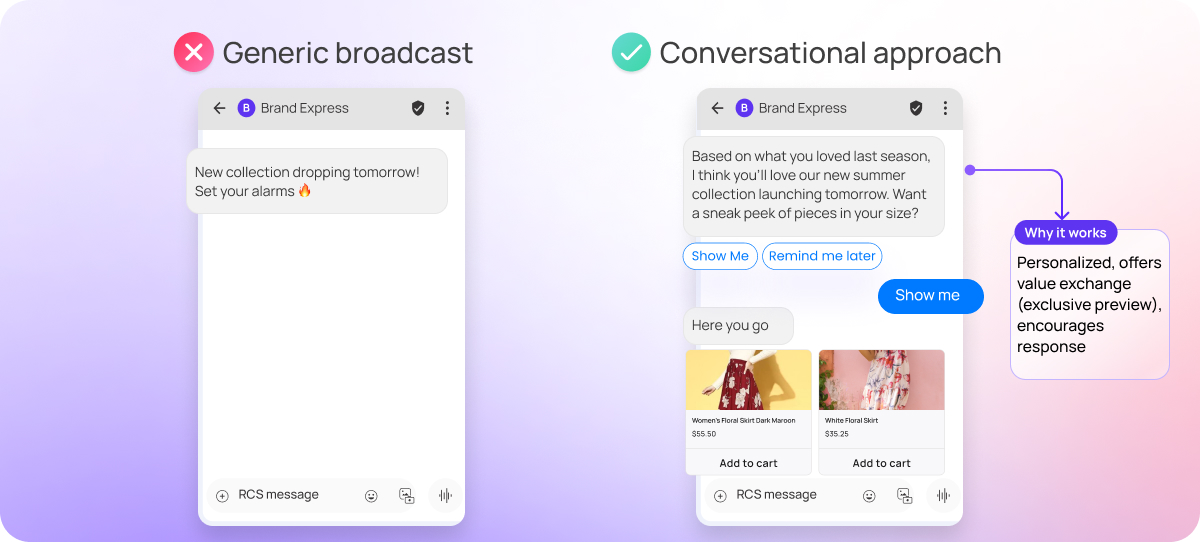
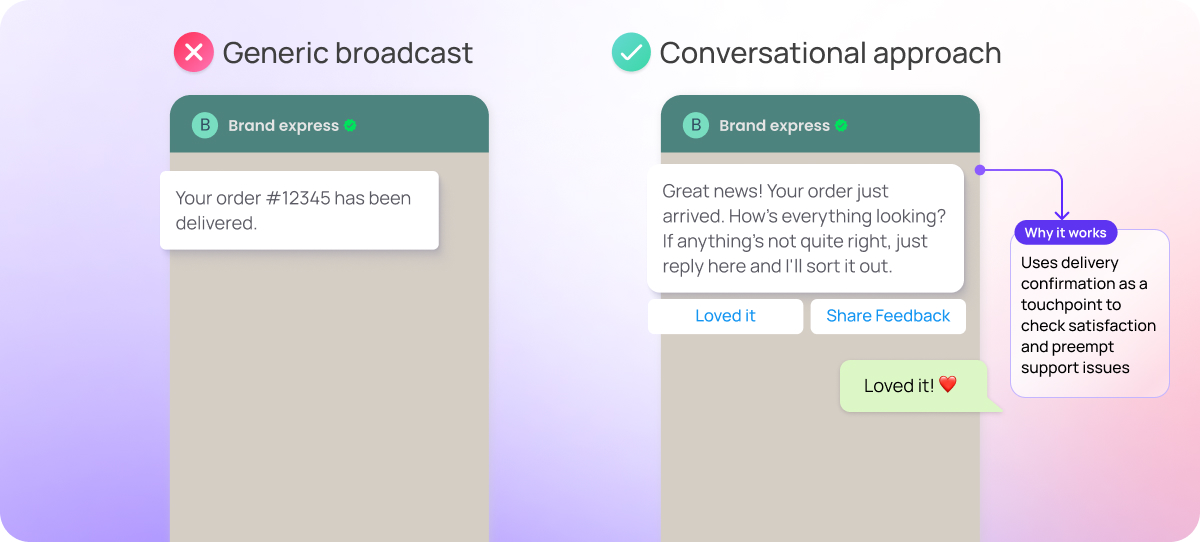
Pro tip: Designing for conversation isn’t just better for engagement—it’s more cost-effective. Most messaging platforms offer free chat session windows after a customer responds. By encouraging replies, you can continue the conversation and achieve your business objectives without incurring additional message charges.
3. Build a Presence That Generates Brand Affinity
Let’s be honest: reaching out only to sell feels transactional. Customers don’t want a parade of promotional messages. They tolerate brands that do this, but they don’t develop loyalty to them.
The opportunity is to create a conversational presence that makes your brand useful across the entire customer journey—not just during sale announcements.
This means enabling customers to:
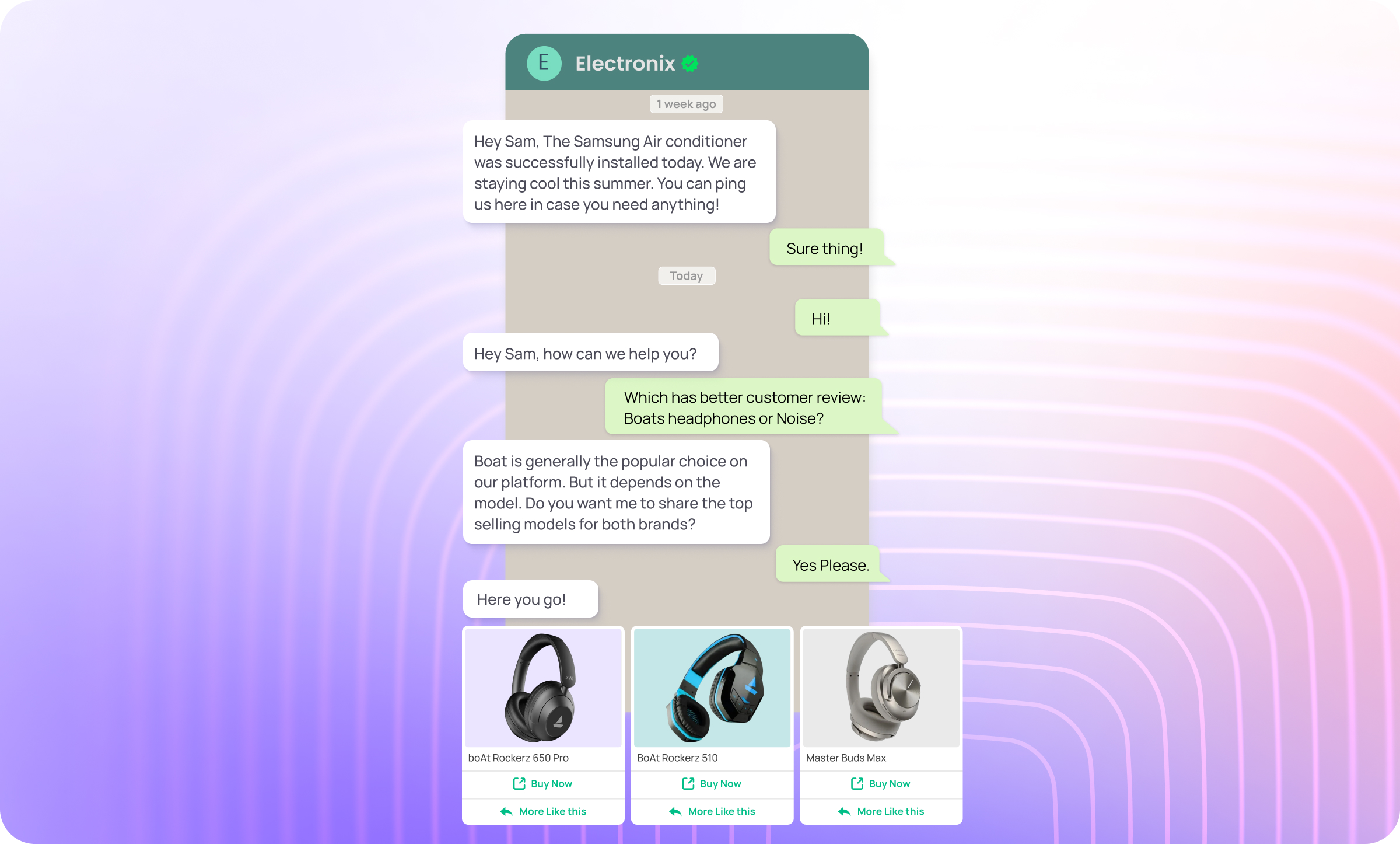
- Get product recommendations based on their preferences and past behavior
- Complete purchases directly in the conversation (conversational commerce)
- Resolve support issues without leaving the messaging app
- Access account information and track orders
- Discover content and inspiration relevant to their interests
Modern AI agents can handle these interactions with remarkable sophistication—often indistinguishable from human conversations for straightforward queries. The technology allows you to be “always available” without the cost of staffing 24/7 support teams.
The strategic payoff? When you become genuinely useful, customers initiate conversations with you rather than waiting for your next broadcast. And here’s the kicker: user-initiated conversations are significantly cheaper than brand-initiated messages on most platforms. You can even maximize returns by intelligently surfacing relevant offers or products when a customer reaches out.
4. Create a Multi-Channel, Multi-Modal Strategy
Putting all your eggs in one basket is risky in conversational engagement. Channels may experience outages. Policies change. Customer preferences evolve.
A multi-channel approach protects your conversational strategy by:
- Creating flexibility: Customers can reach you from wherever they are most comfortable
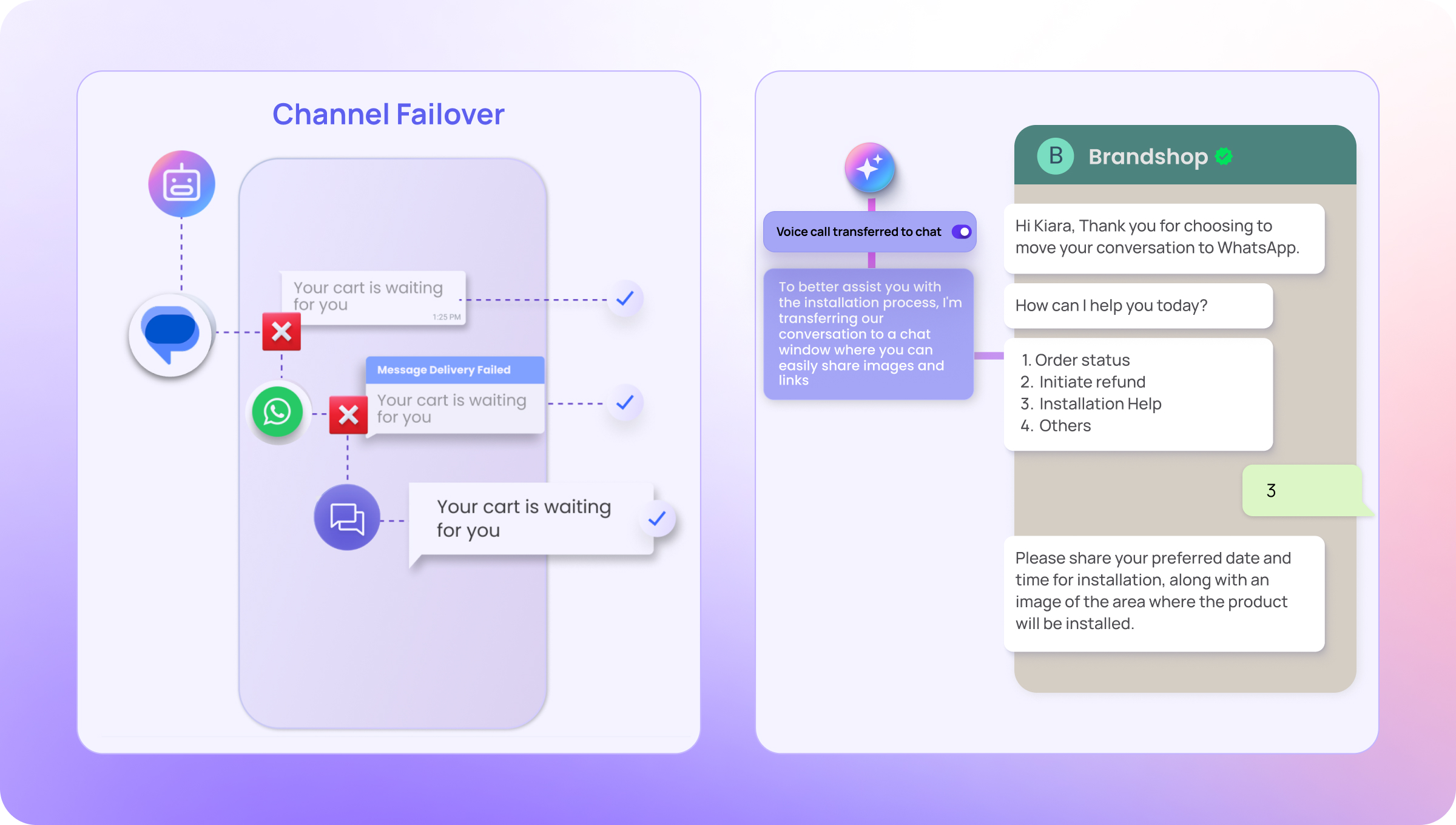
- Ensuring continuity: If WhatsApp is down, critical messages can still reach customers via RCS or SMS
- Optimizing costs: You can route conversations to the most cost-effective channel for different use cases
Consider building presence across:
- WhatsApp for rich, interactive conversations
- RCS for engaging customers who don’t use WhatsApp
- SMS as a reliable fallback for critical transactional messages
- Voice for complex support issues or high-value customer segments
Smart automation strategies that will help you optimize costs and experience:
- Failovers: If a WhatsApp message isn’t delivered, automatically send via RCS, then SMS as backup
- Deflection: Route incoming voice calls to chat when possible (chat is typically 70-80% cheaper than voice support)
Channel preference: Learn which channel each customer prefers and prioritize accordingly
5. Capture Conversational Intelligence
Every conversation with a customer reveals preferences, pain points, and behavior patterns. Not capturing this data is leaving money on the table.
Think beyond just storing chat logs. Capture:
- Every click within conversational experiences (which products they viewed, which offers they engaged with)
- Response patterns (how quickly they reply, what questions they ask, when they drop off)
- Behavioral signals (abandoned conversations, repeat topics, product preferences)
- Customer profile and preferences (particularly valuable when acquiring new leads form Click-to-WhatsApp ads — allowing you to build first-party data from the first interaction)
This conversational intelligence becomes your competitive advantage. It feeds your personalization engine, informs product development, optimizes marketing spend, and helps predict customer needs before they articulate them.
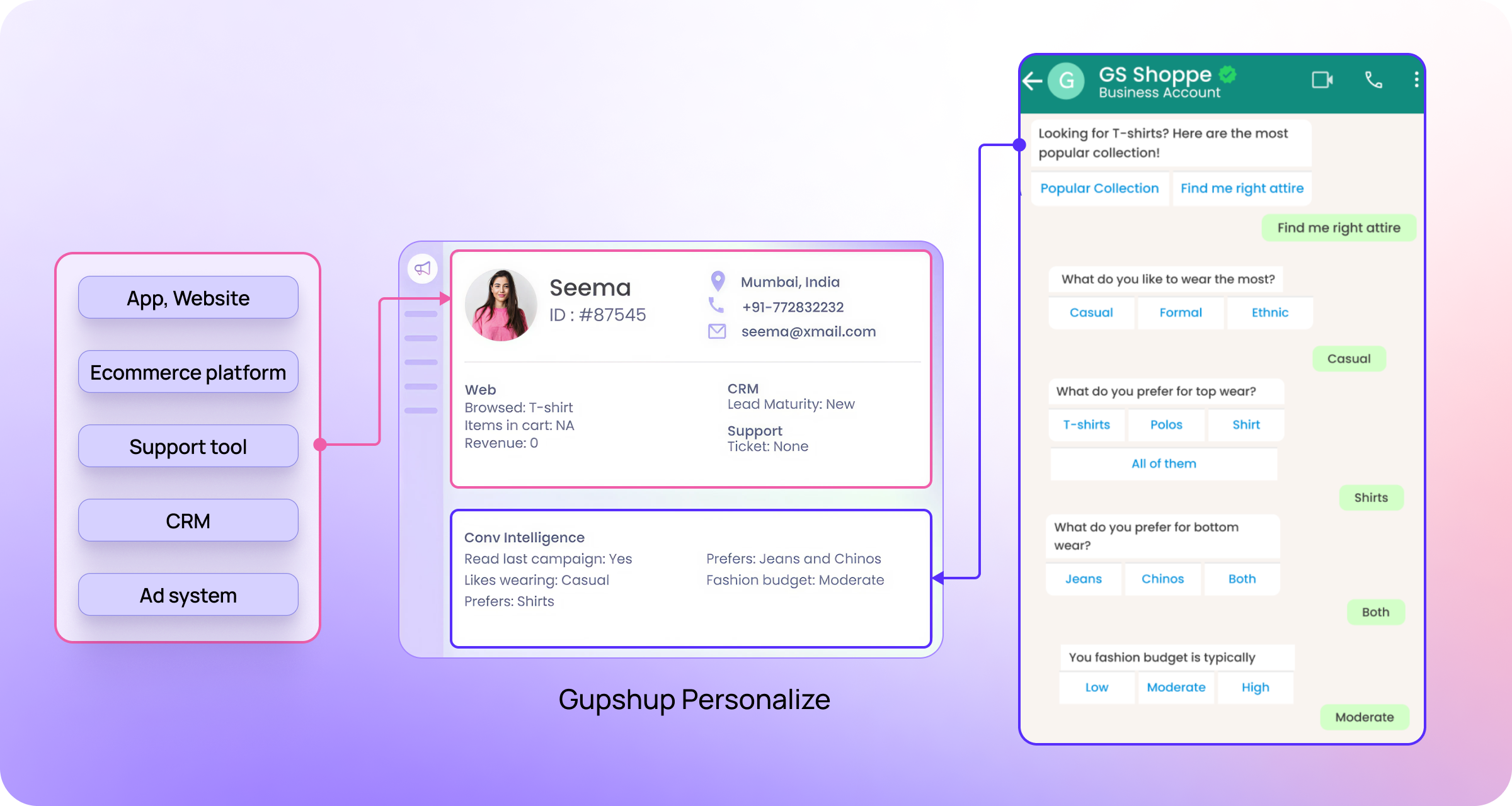
The technical requirement: choose a platform that captures this data in a structured, usable format—not just chat transcripts—and integrates with your CRM and analytics tools.
Before You Dive In: Three Critical Realities
Reality #1: Initial Investment is Substantial
Quality conversational AI and chatbots requires upfront investment in platform infrastructure, system integration, content design, and agent training. This isn’t “spin up a bot in an afternoon” territory. Budget 3-6 months for proper implementation of your first conversational journey.
Reality #2: Bad Bots Damage Brands
A poorly designed conversational experience frustrates customers more than having no bot at all. The “I don’t understand, please rephrase” loop makes people actively avoid your brand. Start with one well-executed journey (e.g., order tracking or product discovery) before expanding. Test thoroughly with real customers.
Reality #3: Privacy and Compliance Matter
Capturing conversational data means handling sensitive customer information. Ensure your approach complies with GDPR, CCPA, and regional data protection regulations. Be transparent about data usage. Build trust by giving customers control over their data.
Choosing Your Technology Stack
Your conversational strategy is only as capable as the infrastructure supporting it. When evaluating platforms, these capabilities are non-negotiable:
- Unified Interface: Can you manage WhatsApp, RCS, SMS, Instagram DM, and voice from a single platform? Or will your team juggle multiple dashboards and fragmented customer views?
- Intelligent Data Capture: Does the platform track conversational behavior across channels in a structured format? Can you see a customer’s full conversation history regardless of which channel they used?
- Journey Builder Flexibility: Can your marketing team create and modify conversational flows without requiring developers for every change? Look for visual journey builders with conditional logic.
- AI Agent Capabilities: How sophisticated is natural language understanding? Can the AI handle context across multiple messages? Does it gracefully hand off to humans when needed? Does it come with guardrails?
- Failover and Routing Logic: Does it automatically switch channels if delivery fails? Can you set business rules for when to escalate to human agents?
- Integration Ecosystem: How easily does it connect to your CRM, e-commerce platform, support desk, and analytics tools?
Full disclosure: We built Gupshup Conversation Cloud to address these requirements. Our platform enables end-to-end multi-channel conversational engagement—from Click-to-WhatsApp ads through AI-powered conversations to live agent handoffs—all from a unified interface. But whether you choose Gupshup or another platform, don’t compromise on these core capabilities. Your conversational strategy depends on them.
Your 2026 Action Plan – Conversation Strategy
- January: Audit your current messaging touchpoints. Where are customers already trying to message you? What manual processes could be automated? Which customer journeys are most frustrating?
- February: Map one high-impact customer journey to conversational design. Choose something with clear ROI—abandoned cart recovery, order tracking, or basic product recommendations.
- March: Launch pilot on your primary channel (likely WhatsApp or RCS). Test with a segment of your customer base. Measure engagement, conversion, and customer satisfaction.
- Q2: Analyze results, iterate based on learnings, expand to additional journeys or channels.
- Q3-Q4: Scale what works, optimize continuously, build towards comprehensive conversational presence.
The brands that win in 2026 won’t be the ones with the most channels or the fanciest AI. They’ll be the ones that make customers feel genuinely understood and served—one conversation at a time.
Ready to map your conversational strategy? Let’s explore how Gupshup Conversation Cloud can bring your vision to life. Book a consultation Today.

Product marketer who is helping brands not just connect with their customers but converse with them - to build a long, meaningful relationship that converts into lasting business impact.